Oxnard committee recommends introduction of clarified cross-connection, backflow ordinance; staff will review notice timing
January 28, 2026 | Oxnard City, Ventura County, California
This article was created by AI summarizing key points discussed. AI makes mistakes, so for full details and context, please refer to the video of the full meeting. Please report any errors so we can fix them. Report an error »
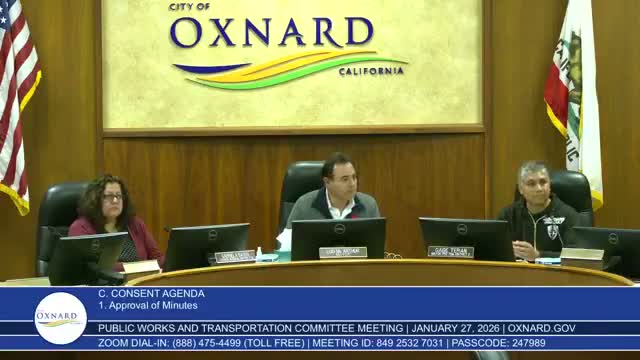
The Oxnard City Public Works and Transportation Committee voted unanimously Jan. 27 to recommend that the City Council introduce and waive first reading of an ordinance that updates the city’s cross-connection control and backflow prevention standards.
The ordinance, described by staff as clarifying edits to Article 4 of Chapter 22, standardizes terminology and code references across the code but does not change implementation procedures or customer responsibilities, staff said. "The version that was attached to the agenda has been updated a little bit with no substantive changes," a staff member told the committee.
Why it matters: cross-connection and backflow controls protect the municipal water supply from contamination if private devices fail. Staff told the committee the city monitors roughly "over 6,000 devices in the city," and emphasized that timely testing and certification are a public-health priority.
Public comment and scheduling concerns
Ronald Arguello, speaking as an Oxnard municipal utilities ratepayer, asked the city to either send inspection notices earlier ("at least 2 weeks and ideally 1 month before the start of the 30 day inspection period") or extend the initial compliance deadline from 30 to 45 days to allow for mail delays and limited tester availability. "Either sending notices earlier or extending the initial deadline would give rate payers a reasonable opportunity to complete testing and submit required forms without unnecessary stress," he said.
Staff response and limits
Chris Peyton, Water Division Manager, said the division currently sends notices near the start of the month and that the timetable can be adjusted in coordination with implementation of the new ordinance and policy handbook. He also noted state rules require a 30-day turnaround on failed devices, which constrains flexibility when a device fails but does not prevent staff from working with customers on scheduling issues.
What changed in the ordinance
Staff explained the redline edits standardize defined terms (for example, clarifying the use of "user," "account holder," "premise," and "property"), correct internal code references, capitalize defined terms consistently and add article numbers for appeal provisions so customers understand how to seek relief or abatement. Staff said those edits are intended to make the ordinance easier to apply and to preserve necessary timelines tied to state-mandated actions.
Committee action and next steps
Mayor Pro Tem moved to take the recommended action to introduce the ordinance "as corrected"; the motion was seconded and the committee recorded a 3-0 vote in favor. The committee's recommendation goes to the full City Council for consideration of introduction and the waiver of first reading.
The committee and staff agreed to review the caller’s suggested changes to notice timing; staff committed to look at the timetable and consider whether notices can be sent earlier or whether administrative flexibility (for example, accepting scheduling explanations) can be formalized in the handbook. The committee did not change the ordinance’s compliance requirements or timelines at this meeting.
The ordinance, described by staff as clarifying edits to Article 4 of Chapter 22, standardizes terminology and code references across the code but does not change implementation procedures or customer responsibilities, staff said. "The version that was attached to the agenda has been updated a little bit with no substantive changes," a staff member told the committee.
Why it matters: cross-connection and backflow controls protect the municipal water supply from contamination if private devices fail. Staff told the committee the city monitors roughly "over 6,000 devices in the city," and emphasized that timely testing and certification are a public-health priority.
Public comment and scheduling concerns
Ronald Arguello, speaking as an Oxnard municipal utilities ratepayer, asked the city to either send inspection notices earlier ("at least 2 weeks and ideally 1 month before the start of the 30 day inspection period") or extend the initial compliance deadline from 30 to 45 days to allow for mail delays and limited tester availability. "Either sending notices earlier or extending the initial deadline would give rate payers a reasonable opportunity to complete testing and submit required forms without unnecessary stress," he said.
Staff response and limits
Chris Peyton, Water Division Manager, said the division currently sends notices near the start of the month and that the timetable can be adjusted in coordination with implementation of the new ordinance and policy handbook. He also noted state rules require a 30-day turnaround on failed devices, which constrains flexibility when a device fails but does not prevent staff from working with customers on scheduling issues.
What changed in the ordinance
Staff explained the redline edits standardize defined terms (for example, clarifying the use of "user," "account holder," "premise," and "property"), correct internal code references, capitalize defined terms consistently and add article numbers for appeal provisions so customers understand how to seek relief or abatement. Staff said those edits are intended to make the ordinance easier to apply and to preserve necessary timelines tied to state-mandated actions.
Committee action and next steps
Mayor Pro Tem moved to take the recommended action to introduce the ordinance "as corrected"; the motion was seconded and the committee recorded a 3-0 vote in favor. The committee's recommendation goes to the full City Council for consideration of introduction and the waiver of first reading.
The committee and staff agreed to review the caller’s suggested changes to notice timing; staff committed to look at the timetable and consider whether notices can be sent earlier or whether administrative flexibility (for example, accepting scheduling explanations) can be formalized in the handbook. The committee did not change the ordinance’s compliance requirements or timelines at this meeting.
View the Full Meeting & All Its Details
This article offers just a summary. Unlock complete video, transcripts, and insights as a Founder Member.
✓
Watch full, unedited meeting videos
✓
Search every word spoken in unlimited transcripts
✓
AI summaries & real-time alerts (all government levels)
✓
Permanent access to expanding government content
30-day money-back guarantee
