Ellington board approves ~2.91% budget after debate over administrator pay and superintendent savings
January 29, 2026 | Ellington School District, School Districts, Connecticut
This article was created by AI summarizing key points discussed. AI makes mistakes, so for full details and context, please refer to the video of the full meeting. Please report any errors so we can fix them. Report an error »
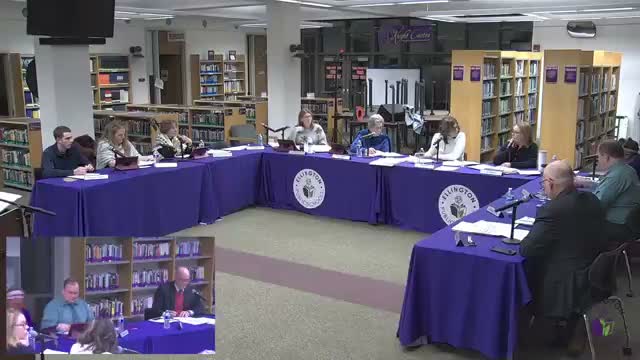
The Ellington Board of Education voted to approve the district budget, setting the proposed increase at approximately 2.91 after a motion and a friendly amendment during Monday’s meeting.
Board member Harris moved 'that we pass the budget at 2.93 percent' and accepted a friendly amendment to 2.91 during discussion, then called the question. The motion passed by voice vote; no roll-call tally appears in the transcript.
The vote followed extended discussion about personnel moves and contract terms. One board member asked the group to note that 'in the contract when if an administrator's salary or administrator is switched to a position of a lower salary the contract requires that they receive their higher salary' and recounted that the provision was applied when an administrator moved roles this past year. Another board member summarized the contractual effect as a two-year freeze on salary changes for a reassigned administrator: 'they're frozen' for two years and 'by year 3 ... they would revert to the contract price.'
Board members debated whether reassigning principals or creating a new assistant-principal position (a 10-month post) would produce the savings the administration estimated. One member said, 'every penny counts,' while others cautioned about 'collateral damage' from moving people into roles that may not match their skills.
The budget motion and passage were made with the understanding that staff and board members can present further reductions to the Board of Finance before the district’s formal presentation. A board member (Unidentified Speaker 5) noted the procedural step: presenting the budget to the town of Ellington per 'town charter 1 1 0 2.' Several members asked for a special meeting so absent members could participate and so the board could examine models A, B and C and the superintendent-contract savings line, which was discussed as roughly $18,000.
Next steps: the approved budget will be presented to the town Board of Finance; board members indicated they may hold a single-item special meeting to revisit the superintendent savings and other model-driven reductions prior to that submission.
Board member Harris moved 'that we pass the budget at 2.93 percent' and accepted a friendly amendment to 2.91 during discussion, then called the question. The motion passed by voice vote; no roll-call tally appears in the transcript.
The vote followed extended discussion about personnel moves and contract terms. One board member asked the group to note that 'in the contract when if an administrator's salary or administrator is switched to a position of a lower salary the contract requires that they receive their higher salary' and recounted that the provision was applied when an administrator moved roles this past year. Another board member summarized the contractual effect as a two-year freeze on salary changes for a reassigned administrator: 'they're frozen' for two years and 'by year 3 ... they would revert to the contract price.'
Board members debated whether reassigning principals or creating a new assistant-principal position (a 10-month post) would produce the savings the administration estimated. One member said, 'every penny counts,' while others cautioned about 'collateral damage' from moving people into roles that may not match their skills.
The budget motion and passage were made with the understanding that staff and board members can present further reductions to the Board of Finance before the district’s formal presentation. A board member (Unidentified Speaker 5) noted the procedural step: presenting the budget to the town of Ellington per 'town charter 1 1 0 2.' Several members asked for a special meeting so absent members could participate and so the board could examine models A, B and C and the superintendent-contract savings line, which was discussed as roughly $18,000.
Next steps: the approved budget will be presented to the town Board of Finance; board members indicated they may hold a single-item special meeting to revisit the superintendent savings and other model-driven reductions prior to that submission.
View the Full Meeting & All Its Details
This article offers just a summary. Unlock complete video, transcripts, and insights as a Founder Member.
✓
Watch full, unedited meeting videos
✓
Search every word spoken in unlimited transcripts
✓
AI summaries & real-time alerts (all government levels)
✓
Permanent access to expanding government content
30-day money-back guarantee
