Georgia agriculture commissioner details HPAI response, hemp enforcement and funding needs; requests construction cash for new lab
January 29, 2026 | Agriculture & Consumer Affairs, HOUSE OF REPRESENTATIVES, Committees, Legislative, Georgia
This article was created by AI summarizing key points discussed. AI makes mistakes, so for full details and context, please refer to the video of the full meeting. Please report any errors so we can fix them. Report an error »
Commissioner Tyler Harper of the Georgia Department of Agriculture briefed the House Agriculture & Consumer Affairs committee on the agency’s recent emergency responses, enforcement activity and budget requests, saying the department needs additional resources to sustain licensing, inspections and laboratory capacity.
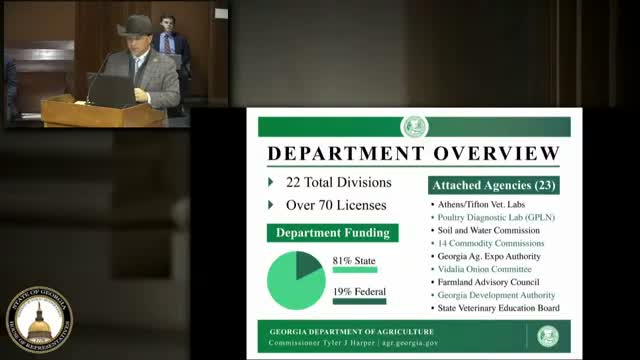
Harper opened with an agency overview, noting the department employs about 570 people across more than 22 divisions, issues roughly 70 license types and operates on an approximate 80/20 split of state and federal funding. He said attached entities — including veterinary and poultry labs, commodity commissions and the state fair authority — rely on the department as a pass‑through funding mechanism.
Harper said the department recently confirmed two cases of high‑path avian influenza (HPAI) on broiler breeder farms in Walker County and immediately activated its agricultural emergency operations center to mount a response. ‘‘We hit the ground running,’’ Harper said, describing site operations that at times included ‘‘upwards of 70 people’’ from the department, integrators and contractors. He described biosecurity protocols, the use of Tyvek suits and foaming rigs (‘‘basically a firefighter foam’’) and said containment is critical to preventing spread.
Harper said the department typically achieves containment in most cases within 12–24 hours and that last year HPAI response costs for two main commercial events were ‘‘a little over $300,000,’’ with federal reimbursements falling short of full costs. To maintain field communications at sites without cell service, Harper said the department deployed Starlink units.
On disaster recovery, Harper said the department’s FarmRecovery block grant application and online portal (Farmrecovery.com) are ready but currently under legal review at USDA. He said two scheduled follow‑up meetings with USDA had been canceled and the agency is waiting for sign‑off from USDA’s Office of General Counsel before opening applications.
Harper also reviewed the hemp program, which he said was moved under the department’s law enforcement unit. He reported about 7,900 licensed hemp entities in the state, described an inspection dashboard that updates inspection reports in near real time, and said 81 inspection cases had been referred to law enforcement, including 27 related to sales to people under age 21.
On infrastructure and trust funds, Harper described the Georgia Agricultural Trust Fund — funded by gate‑card sales tied to the Georgia Agricultural Tax Exemption (GATE) program — and said the fund’s annual report is required by law. He noted state fees and market activity revenue, but said those funds are insufficient for large infrastructure needs. He cited ongoing investments at the Atlanta State Farmers Market, including a west‑side retention pond and increased security staff, and said the trust fund is primarily used for maintenance and life‑safety projects.
Harper outlined budget requests for the department’s operational needs and equipment: an operational ask of roughly $3.8 million (the governor included about $2.5 million across FY‑26 amended and FY‑27), a request for an annual appropriation for 48 vehicles to address a prior multi‑million‑dollar backlog, and laptop refreshes for staff retention. He also said the department temporarily relocated its food safety and dairy lab to Georgia Tech while the old agricultural building is renovated and is seeking construction funding for a new consolidated lab at the Forest Park/Farmers Market site. ‘‘The governor included $25,000,000 of our $34,000,000 construction ask,’’ Harper said, and the department is requesting the remaining amount to complete the project.
Harper closed by noting rapid growth in regulated entities — a 33% rise to just over 88,000 licensees in three years — while employment rose only about 12%, creating sizable workload pressure on staff.
Committee members asked questions about FarmRecovery outreach (Harper said the department will use Farmrecovery.com, social media, partner organizations and its licensed‑entity email list), trust fund revenue sources (Harper cited gate‑card sales tied to the GATE tax‑exemption program), and broader economic stresses facing growers.
Harper framed agriculture as a sector under strain from consolidation, rising input costs and labor issues and said addressing those problems will require coordinated federal and state work. He said the department is ready to administer recovery funds and execute projects once USDA approval and legislative appropriations are in place.
The committee adjourned after a Georgia Tech presentation and brief additional discussion about upcoming bills and committee business.
Harper opened with an agency overview, noting the department employs about 570 people across more than 22 divisions, issues roughly 70 license types and operates on an approximate 80/20 split of state and federal funding. He said attached entities — including veterinary and poultry labs, commodity commissions and the state fair authority — rely on the department as a pass‑through funding mechanism.
Harper said the department recently confirmed two cases of high‑path avian influenza (HPAI) on broiler breeder farms in Walker County and immediately activated its agricultural emergency operations center to mount a response. ‘‘We hit the ground running,’’ Harper said, describing site operations that at times included ‘‘upwards of 70 people’’ from the department, integrators and contractors. He described biosecurity protocols, the use of Tyvek suits and foaming rigs (‘‘basically a firefighter foam’’) and said containment is critical to preventing spread.
Harper said the department typically achieves containment in most cases within 12–24 hours and that last year HPAI response costs for two main commercial events were ‘‘a little over $300,000,’’ with federal reimbursements falling short of full costs. To maintain field communications at sites without cell service, Harper said the department deployed Starlink units.
On disaster recovery, Harper said the department’s FarmRecovery block grant application and online portal (Farmrecovery.com) are ready but currently under legal review at USDA. He said two scheduled follow‑up meetings with USDA had been canceled and the agency is waiting for sign‑off from USDA’s Office of General Counsel before opening applications.
Harper also reviewed the hemp program, which he said was moved under the department’s law enforcement unit. He reported about 7,900 licensed hemp entities in the state, described an inspection dashboard that updates inspection reports in near real time, and said 81 inspection cases had been referred to law enforcement, including 27 related to sales to people under age 21.
On infrastructure and trust funds, Harper described the Georgia Agricultural Trust Fund — funded by gate‑card sales tied to the Georgia Agricultural Tax Exemption (GATE) program — and said the fund’s annual report is required by law. He noted state fees and market activity revenue, but said those funds are insufficient for large infrastructure needs. He cited ongoing investments at the Atlanta State Farmers Market, including a west‑side retention pond and increased security staff, and said the trust fund is primarily used for maintenance and life‑safety projects.
Harper outlined budget requests for the department’s operational needs and equipment: an operational ask of roughly $3.8 million (the governor included about $2.5 million across FY‑26 amended and FY‑27), a request for an annual appropriation for 48 vehicles to address a prior multi‑million‑dollar backlog, and laptop refreshes for staff retention. He also said the department temporarily relocated its food safety and dairy lab to Georgia Tech while the old agricultural building is renovated and is seeking construction funding for a new consolidated lab at the Forest Park/Farmers Market site. ‘‘The governor included $25,000,000 of our $34,000,000 construction ask,’’ Harper said, and the department is requesting the remaining amount to complete the project.
Harper closed by noting rapid growth in regulated entities — a 33% rise to just over 88,000 licensees in three years — while employment rose only about 12%, creating sizable workload pressure on staff.
Committee members asked questions about FarmRecovery outreach (Harper said the department will use Farmrecovery.com, social media, partner organizations and its licensed‑entity email list), trust fund revenue sources (Harper cited gate‑card sales tied to the GATE tax‑exemption program), and broader economic stresses facing growers.
Harper framed agriculture as a sector under strain from consolidation, rising input costs and labor issues and said addressing those problems will require coordinated federal and state work. He said the department is ready to administer recovery funds and execute projects once USDA approval and legislative appropriations are in place.
The committee adjourned after a Georgia Tech presentation and brief additional discussion about upcoming bills and committee business.
View the Full Meeting & All Its Details
This article offers just a summary. Unlock complete video, transcripts, and insights as a Founder Member.
✓
Watch full, unedited meeting videos
✓
Search every word spoken in unlimited transcripts
✓
AI summaries & real-time alerts (all government levels)
✓
Permanent access to expanding government content
30-day money-back guarantee
