Georgia Tech showcases AgTech projects: poultry robotics, printed electronics from wood and a peanut inspection prototype
January 29, 2026 | Agriculture & Consumer Affairs, HOUSE OF REPRESENTATIVES, Committees, Legislative, Georgia
This article was created by AI summarizing key points discussed. AI makes mistakes, so for full details and context, please refer to the video of the full meeting. Please report any errors so we can fix them. Report an error »
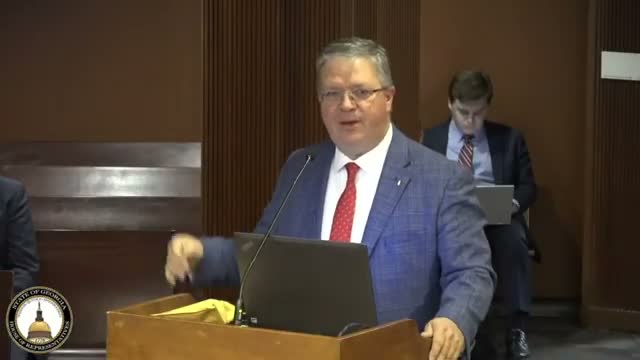
Doug Britton of Georgia Tech described research and pilot projects that aim to add value to timber and agricultural residues and to bring advanced technologies into the state’s poultry and row‑crop sectors.
Britton outlined four product tracks from Georgia Tech’s Renewable Bioproducts Institute and the REWOOD initiative: transistor paper for printed electronics; lignin‑based and cellulosic materials for battery separators; Xylosolv, a wood‑derived solvent used in pharmaceutical processing; and a sustainable nylon (Zylon). He said the university received seed funding from the state and has produced prototypes, but cautioned that scaling from lab to pilot production and convincing industry customers are substantial challenges.
On AgTech, Britton described work to automate poultry processing using 3‑D imaging to map external carcass shape to internal bone structure and generate individualized cut trajectories. He said that early lab robots are being evolved into high‑speed, washdown‑capable machines and that a recent December test moved the technology closer to commercial proof of concept. He also described autonomous poultry‑house robots for continuous monitoring (health, egg collection) that could aid early detection of disease such as avian influenza.
Britton described a handheld interferometric biosensor developed from Georgia Tech work that can detect pathogens (Salmonella, Campylobacter, E. coli) and certain chemicals (PAA, 2,4‑D, PFAS). He said a Valdosta company, Salvis (a subsidiary of CJB Technologies), has commercialized a handheld unit based on the platform.
On crop sensing, Britton summarized studies of volatile organic compounds emitted by plants as early indicators of water stress in peanut crops, and said the team has used decision‑tree analysis to differentiate stressed and non‑stressed plants. He also summarized early tests to modernize peanut inspection and buying‑point processes using state seed funding and said handouts were provided to the committee.
Britton described outreach and workforce efforts, including a rural computer‑science program that deployed about 19 FarmBot gantry robots in classrooms, reaching thousands of students, and emphasized cross‑institutional partnerships to scale research and transfer technologies to industry.
In Q&A, Representative Ford (a cotton and peanut producer) asked whether Georgia Tech had examined alternative cotton harvesters; Britton said the institute has limited work in the cotton space so far, but is willing to support investigations and collaborate with industry stakeholders.
The presentation illustrated applied research the state supported with seed funding; Georgia Tech emphasized the remaining scale‑up and market‑proofing challenges that will require industry engagement and additional investment.
Britton outlined four product tracks from Georgia Tech’s Renewable Bioproducts Institute and the REWOOD initiative: transistor paper for printed electronics; lignin‑based and cellulosic materials for battery separators; Xylosolv, a wood‑derived solvent used in pharmaceutical processing; and a sustainable nylon (Zylon). He said the university received seed funding from the state and has produced prototypes, but cautioned that scaling from lab to pilot production and convincing industry customers are substantial challenges.
On AgTech, Britton described work to automate poultry processing using 3‑D imaging to map external carcass shape to internal bone structure and generate individualized cut trajectories. He said that early lab robots are being evolved into high‑speed, washdown‑capable machines and that a recent December test moved the technology closer to commercial proof of concept. He also described autonomous poultry‑house robots for continuous monitoring (health, egg collection) that could aid early detection of disease such as avian influenza.
Britton described a handheld interferometric biosensor developed from Georgia Tech work that can detect pathogens (Salmonella, Campylobacter, E. coli) and certain chemicals (PAA, 2,4‑D, PFAS). He said a Valdosta company, Salvis (a subsidiary of CJB Technologies), has commercialized a handheld unit based on the platform.
On crop sensing, Britton summarized studies of volatile organic compounds emitted by plants as early indicators of water stress in peanut crops, and said the team has used decision‑tree analysis to differentiate stressed and non‑stressed plants. He also summarized early tests to modernize peanut inspection and buying‑point processes using state seed funding and said handouts were provided to the committee.
Britton described outreach and workforce efforts, including a rural computer‑science program that deployed about 19 FarmBot gantry robots in classrooms, reaching thousands of students, and emphasized cross‑institutional partnerships to scale research and transfer technologies to industry.
In Q&A, Representative Ford (a cotton and peanut producer) asked whether Georgia Tech had examined alternative cotton harvesters; Britton said the institute has limited work in the cotton space so far, but is willing to support investigations and collaborate with industry stakeholders.
The presentation illustrated applied research the state supported with seed funding; Georgia Tech emphasized the remaining scale‑up and market‑proofing challenges that will require industry engagement and additional investment.
Don't Miss a Word: See the Full Meeting!
Go beyond summaries. Unlock every video, transcript, and key insight with a Founder Membership.
✓
Get instant access to full meeting videos
✓
Search and clip any phrase from complete transcripts
✓
Receive AI-powered summaries & custom alerts
✓
Enjoy lifetime, unrestricted access to government data
30-day money-back guarantee
