Mount Clemens weighs roughly $1.4 million downtown sidewalk overhaul, debates trees, pavers and planters
January 23, 2026 | Mount Clemens, Macomb County, Michigan
This article was created by AI summarizing key points discussed. AI makes mistakes, so for full details and context, please refer to the video of the full meeting. Please report any errors so we can fix them. Report an error »
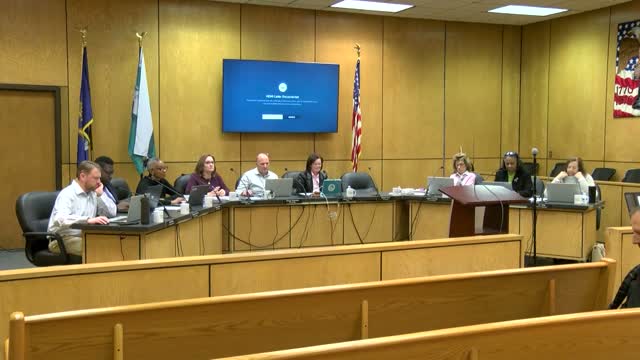
At a Mount Clemens work session, staff presented the results of a SEMCOG-funded downtown sidewalk evaluation and a preliminary construction estimate for replacing defective sidewalks, removing brick strips and addressing failing trees.
Ashley, the city staff presenter, said the team inspected downtown parcels with a GIS app and attached video/photo documentation to parcels. "So overall, to do the downtown district, it's about $1,400,000 is what we're estimating," Ashley said, describing a base estimate that assumes concrete replacement, removal of brick strips in the public right-of-way and removal of existing trees.
The nut graf: the project team presented three main trade-offs commissioners must weigh: (1) full removal of trees and replacement with plain poured concrete (the base estimate), (2) replanting with structural soil and tree grates (an added option staff estimated at roughly $620,000), and (3) selective use of decorative pavers or saw-cut decorative concrete for focal areas such as the Clock Tower.
Staff broke out responsibility and funding: roughly $870,000 of the construction cost would be city-allocated items (slabs impacted by trees, slabs affected by utilities, brick removal in city right-of-way), and roughly $550,000 would be the aggregate construction cost attributable to property owners. Ashley cautioned those figures do not yet reflect any prepayment discounts property owners may receive or higher prices if the project is rebid.
On tree strategy, staff said the base number assumed tree removals; replanting one-for-one with tree grates and structural soil raised the additional cost estimate to about $620,000 because grates and installation drive the expense. As a lower-cost aesthetic alternative, staff proposed using planters similar to those on Macomb Place and the Cherry Street Mall, estimating that choice could reduce the additional cost to roughly $124,000 compared with full tree-and-grate restoration.
Design options also included replacing large decorative red-brick areas one-for-one with matching pavers (estimated at about $780,000 for those specific zones) or using saw-cut patterns in poured concrete as a less expensive decorative treatment. Commissioners asked staff to provide photographic examples of saw-cut decorative concrete and requested a focused cost estimate for replacing bricks around the Clock Tower so the commission can compare options.
Staff recommended moving to square-foot pricing downtown instead of a per-flag (5x5 slab) model because irregular slab sizes in the downtown area make per-flag accounting confusing; staff said square-foot pricing was modeled to yield similar charges to property owners as the residential program but warned unit prices may need reassessment at bid time.
On funding, staff reported a sidewalk fund balance of about $858,000 and said the city has previously supplemented the fund and could transfer additional general-fund dollars to complete District 12 work as needed. Staff noted phasing was a likely approach: bid the overall project but construct in phases (two to four phases were discussed), with major downtown construction targeted around 2027 and some non-downtown district work possible earlier.
Commissioners signaled broad support for prioritizing plain concrete replacement for most of downtown for cost reasons while reserving pavers or planters for focal features such as the Clock Tower. One commissioner summarized a common view: keep pavers only at the Clock Tower and use saw-cut concrete and selective plantings elsewhere to control costs while preserving a focal area.
Next steps: commissioners asked staff to return with a refined estimate that includes a dedicated cost for Clock Tower brick replacement, example photos of saw-cut concrete treatments, and an explicit phasing and bid approach. The work session adjourned by motion at the end of the meeting.
Quotes used in this article came directly from the meeting transcript and are attributed to speakers as recorded.
Ashley, the city staff presenter, said the team inspected downtown parcels with a GIS app and attached video/photo documentation to parcels. "So overall, to do the downtown district, it's about $1,400,000 is what we're estimating," Ashley said, describing a base estimate that assumes concrete replacement, removal of brick strips in the public right-of-way and removal of existing trees.
The nut graf: the project team presented three main trade-offs commissioners must weigh: (1) full removal of trees and replacement with plain poured concrete (the base estimate), (2) replanting with structural soil and tree grates (an added option staff estimated at roughly $620,000), and (3) selective use of decorative pavers or saw-cut decorative concrete for focal areas such as the Clock Tower.
Staff broke out responsibility and funding: roughly $870,000 of the construction cost would be city-allocated items (slabs impacted by trees, slabs affected by utilities, brick removal in city right-of-way), and roughly $550,000 would be the aggregate construction cost attributable to property owners. Ashley cautioned those figures do not yet reflect any prepayment discounts property owners may receive or higher prices if the project is rebid.
On tree strategy, staff said the base number assumed tree removals; replanting one-for-one with tree grates and structural soil raised the additional cost estimate to about $620,000 because grates and installation drive the expense. As a lower-cost aesthetic alternative, staff proposed using planters similar to those on Macomb Place and the Cherry Street Mall, estimating that choice could reduce the additional cost to roughly $124,000 compared with full tree-and-grate restoration.
Design options also included replacing large decorative red-brick areas one-for-one with matching pavers (estimated at about $780,000 for those specific zones) or using saw-cut patterns in poured concrete as a less expensive decorative treatment. Commissioners asked staff to provide photographic examples of saw-cut decorative concrete and requested a focused cost estimate for replacing bricks around the Clock Tower so the commission can compare options.
Staff recommended moving to square-foot pricing downtown instead of a per-flag (5x5 slab) model because irregular slab sizes in the downtown area make per-flag accounting confusing; staff said square-foot pricing was modeled to yield similar charges to property owners as the residential program but warned unit prices may need reassessment at bid time.
On funding, staff reported a sidewalk fund balance of about $858,000 and said the city has previously supplemented the fund and could transfer additional general-fund dollars to complete District 12 work as needed. Staff noted phasing was a likely approach: bid the overall project but construct in phases (two to four phases were discussed), with major downtown construction targeted around 2027 and some non-downtown district work possible earlier.
Commissioners signaled broad support for prioritizing plain concrete replacement for most of downtown for cost reasons while reserving pavers or planters for focal features such as the Clock Tower. One commissioner summarized a common view: keep pavers only at the Clock Tower and use saw-cut concrete and selective plantings elsewhere to control costs while preserving a focal area.
Next steps: commissioners asked staff to return with a refined estimate that includes a dedicated cost for Clock Tower brick replacement, example photos of saw-cut concrete treatments, and an explicit phasing and bid approach. The work session adjourned by motion at the end of the meeting.
Quotes used in this article came directly from the meeting transcript and are attributed to speakers as recorded.
Don't Miss a Word: See the Full Meeting!
Go beyond summaries. Unlock every video, transcript, and key insight with a Founder Membership.
✓
Get instant access to full meeting videos
✓
Search and clip any phrase from complete transcripts
✓
Receive AI-powered summaries & custom alerts
✓
Enjoy lifetime, unrestricted access to government data
30-day money-back guarantee
