OCA: MEPS estimates unreliable for tracking California behavioral-health out-of-plan spending; HPD administrative data conflicts
January 27, 2026 | Department of Health Care Access and Information, Agencies under Office of the Governor, Executive, California
This article was created by AI summarizing key points discussed. AI makes mistakes, so for full details and context, please refer to the video of the full meeting. Please report any errors so we can fix them. Report an error »
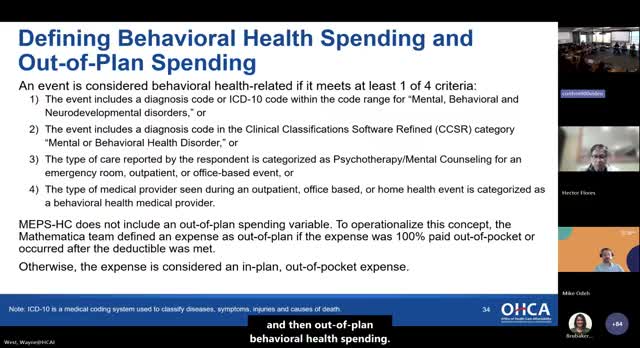
OCA staff and their contractor Mathematica presented analysis intended to estimate Californians' behavioral-health spending that occurs outside health plans (out-of-plan or fully out-of-pocket). Mathematica used four years of the Medical Expenditure Panel Survey (MEPS-HC) but staff told the advisory committee that state-level sample sizes are small and the number of respondents reporting out-of-plan behavioral health spending ranged only from about 41 to 45 over the four-year window, producing wide confidence intervals.
Andrew Fair (Mathematica) said the MEPS-based point estimates suggest out-of-plan behavioral health spending increased from roughly $918 million in 2019 to about $1.4 billion in 2022 (rising from an estimated 6% to 14% of behavioral health spending), but cautioned AHRQ guidance recommends at least 60 unweighted observations for reliable published estimates and that the MEPS results should be treated cautiously.
OCA compared MEPS results to administrative data from HCAI's Health Care Payments Database (HPD), where in‑plan behavioral spending appears to have increased from roughly $9.1 billion in 2019 to $11.6 billion in 2022. Staff concluded that MEPS produced in‑plan estimates at odds with administrative claims and therefore cannot be relied on alone to estimate out-of-plan trends for California. OCA said it will seek collaborations (California Health Care Foundation, CPEN) and consider other data sources and analyses to improve estimates.
Committee discussion noted many behavioral health encounters are self-referred or delivered by national online vendors, that pediatric and youth services need better capture, and that state licensing and workforce datasets or targeted surveys might improve measurement. OCA emphasized ongoing HPD analyses and the need to combine administrative and survey methods.
Next steps: OCA will pursue additional partnerships and HPD analyses, continue stakeholder outreach, and report refreshed behavioral health spending data in 2027 public reporting.
Andrew Fair (Mathematica) said the MEPS-based point estimates suggest out-of-plan behavioral health spending increased from roughly $918 million in 2019 to about $1.4 billion in 2022 (rising from an estimated 6% to 14% of behavioral health spending), but cautioned AHRQ guidance recommends at least 60 unweighted observations for reliable published estimates and that the MEPS results should be treated cautiously.
OCA compared MEPS results to administrative data from HCAI's Health Care Payments Database (HPD), where in‑plan behavioral spending appears to have increased from roughly $9.1 billion in 2019 to $11.6 billion in 2022. Staff concluded that MEPS produced in‑plan estimates at odds with administrative claims and therefore cannot be relied on alone to estimate out-of-plan trends for California. OCA said it will seek collaborations (California Health Care Foundation, CPEN) and consider other data sources and analyses to improve estimates.
Committee discussion noted many behavioral health encounters are self-referred or delivered by national online vendors, that pediatric and youth services need better capture, and that state licensing and workforce datasets or targeted surveys might improve measurement. OCA emphasized ongoing HPD analyses and the need to combine administrative and survey methods.
Next steps: OCA will pursue additional partnerships and HPD analyses, continue stakeholder outreach, and report refreshed behavioral health spending data in 2027 public reporting.
Don't Miss a Word: See the Full Meeting!
Go beyond summaries. Unlock every video, transcript, and key insight with a Founder Membership.
✓
Get instant access to full meeting videos
✓
Search and clip any phrase from complete transcripts
✓
Receive AI-powered summaries & custom alerts
✓
Enjoy lifetime, unrestricted access to government data
30-day money-back guarantee
