OCA outlines spending-target enforcement path: technical assistance, optional public testimony and PIPs; waivers deferred
January 27, 2026 | Department of Health Care Access and Information, Agencies under Office of the Governor, Executive, California
This article was created by AI summarizing key points discussed. AI makes mistakes, so for full details and context, please refer to the video of the full meeting. Please report any errors so we can fix them. Report an error »
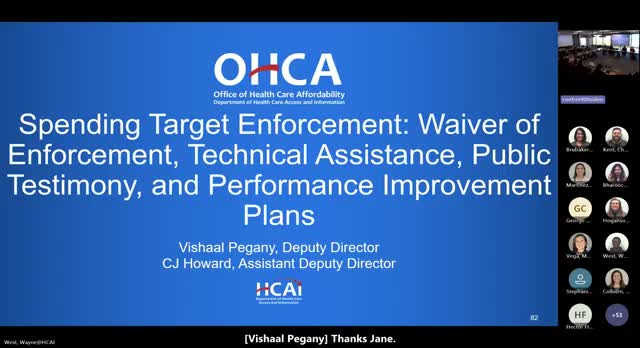
OCA staff presented a step-by-step enforcement framework for the state's health care cost-growth targets. The process begins with data submission and OCA analysis; if an entity exceeds its applicable target, the office notifies the entity and provides 45 days to submit additional information. OCA will then assess performance and provide mandatory technical assistance letters that outline research, models and tailored descriptive statistics showing drivers of excess spending.
If concerns persist, the director may require optional public testimony from the entity to explain drivers of excess spending; the board and OCA would use that input in deciding whether to require a Performance Improvement Plan (PIP). PIPs would be submitted by entities (45 days to propose, with possible extensions), evaluated by OCA with board input and implemented for up to three years with monitoring and progress reports. OCA compared PIP models in Massachusetts and Oregon (45–90 day proposal windows; 18–24 month implementation in those states) and proposed California's PIP timeframe could extend up to three years with interim reporting.
Staff said OCA would not create a separate statutory waiver process at this time because "reasonable factors" listed in the statute substantially overlap with enforcement considerations OCA will already weigh (anticipated investment costs, extraordinary circumstances, and outside factors). Committee members pressed for transparency, thresholds for selecting entities for PIPs or public testimony, and mechanisms for stakeholder input, including labor representatives, county boards of supervisors and unions when access, workforce and equity concerns are implicated.
OCA said it will consult relevant state regulators before taking enforcement actions that materially affect payers, and will refine regulations this year, with planned board discussion of penalties in April and a regulatory timeline through fall 2026.
If concerns persist, the director may require optional public testimony from the entity to explain drivers of excess spending; the board and OCA would use that input in deciding whether to require a Performance Improvement Plan (PIP). PIPs would be submitted by entities (45 days to propose, with possible extensions), evaluated by OCA with board input and implemented for up to three years with monitoring and progress reports. OCA compared PIP models in Massachusetts and Oregon (45–90 day proposal windows; 18–24 month implementation in those states) and proposed California's PIP timeframe could extend up to three years with interim reporting.
Staff said OCA would not create a separate statutory waiver process at this time because "reasonable factors" listed in the statute substantially overlap with enforcement considerations OCA will already weigh (anticipated investment costs, extraordinary circumstances, and outside factors). Committee members pressed for transparency, thresholds for selecting entities for PIPs or public testimony, and mechanisms for stakeholder input, including labor representatives, county boards of supervisors and unions when access, workforce and equity concerns are implicated.
OCA said it will consult relevant state regulators before taking enforcement actions that materially affect payers, and will refine regulations this year, with planned board discussion of penalties in April and a regulatory timeline through fall 2026.
Don't Miss a Word: See the Full Meeting!
Go beyond summaries. Unlock every video, transcript, and key insight with a Founder Membership.
✓
Get instant access to full meeting videos
✓
Search and clip any phrase from complete transcripts
✓
Receive AI-powered summaries & custom alerts
✓
Enjoy lifetime, unrestricted access to government data
30-day money-back guarantee
