Deschutes County says Healthy Schools program linked to fewer youth behavioral‑health ED visits and major cost savings
January 28, 2026 | Deschutes County, Oregon
This article was created by AI summarizing key points discussed. AI makes mistakes, so for full details and context, please refer to the video of the full meeting. Please report any errors so we can fix them. Report an error »
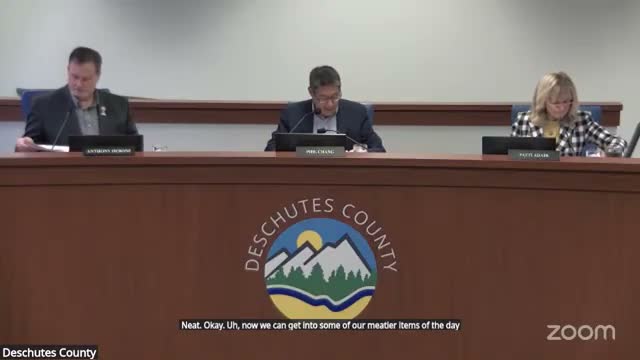
Deschutes County public‑health officials presented a four‑year evaluation Jan. 28 showing that the county’s Healthy Schools partnership with Bend‑La Pine Schools has been widely adopted at middle and high schools and is tied to meaningful reductions in adolescent behavioral‑health emergency visits.
Jessica Jacks, program manager for Deschutes County Health Services, and Amy Snyder, supervisor of adolescent and school health, told the county commissioners that public‑health specialists embedded in school settings helped increase the use of evidence‑based prevention programs and improve links to care.
County staff said the evaluation found that the partnership helped prevent 84 behavioral‑health emergency‑department visits in one year — a 21% reduction among 11‑ to 17‑year‑olds living in ZIP codes with Healthy Schools — and estimated avoided charges of about $812,000 for ED visits alone, rising to roughly $1.5 million when hospitalizations are included. "This evaluation found that it is highly effective to partner local public health with a large school system to improve delivery of prevention and health promotion programs," Snyder said.
Why it matters: the program embeds public‑health specialists in classrooms and school leadership teams, augmenting teachers’ efforts with targeted, evidence‑based interventions the county says are necessary to address complex adolescent issues like suicide and substance use. Presenters said the program reaches about 5,000 students per year in the targeted grades and that, by 2024, 83–100% of teachers in priority topic areas were using evidence‑based practices.
How the study was done: Snyder described a quasi‑experimental cluster design that compared trends in behavioral‑health ED visits across ZIP codes with and without Healthy Schools. County epidemiologists used regression models and external reviewers — including Oregon Health & Science University and Matchstick Consulting (Sources of Strength operator) — to validate the analysis. "We had a number of different practices…to help assure that we were doing the best that we could do not to be biased in our interpretations," Jacks said, referring commissioners to a technical report posted online.
Service delivery and referrals: staff highlighted improvements in school‑based referral systems. County staff said that when the district launched an electronic referral system, only about 52% of referrals resulted in appointments; after targeted outreach and system fixes (including better family notification about the third‑party navigation service Care Solace), that proportion improved by roughly 15 percentage points. "Care Solace is an electronic referral and navigation system…they help them get those appointments set," Snyder said.
Funding and next steps: commissioners asked whether the evaluation could help diversify funding. Staff said they are discussing options with current funders and state programs, including Oregon Health Authority prevention funds, and pointed to one‑time settlement funds and other state initiatives as potential contributors. Commissioners and staff agreed to share the evaluation with potential partners and to pursue opportunities to scale the model if additional funding is secured.
What’s next: the county posted a full technical report online and plans further conversation with the board about sustaining and expanding the work. Commissioners thanked staff for the analysis and for the program’s reported initial impacts.
Sources: Presentation and testimony by Jessica Jacks (Program Manager, Deschutes County Health Services) and Amy Snyder (Supervisor, Adolescent & School Health) at the Deschutes County Board of Commissioners meeting, Jan. 28, 2026.
Jessica Jacks, program manager for Deschutes County Health Services, and Amy Snyder, supervisor of adolescent and school health, told the county commissioners that public‑health specialists embedded in school settings helped increase the use of evidence‑based prevention programs and improve links to care.
County staff said the evaluation found that the partnership helped prevent 84 behavioral‑health emergency‑department visits in one year — a 21% reduction among 11‑ to 17‑year‑olds living in ZIP codes with Healthy Schools — and estimated avoided charges of about $812,000 for ED visits alone, rising to roughly $1.5 million when hospitalizations are included. "This evaluation found that it is highly effective to partner local public health with a large school system to improve delivery of prevention and health promotion programs," Snyder said.
Why it matters: the program embeds public‑health specialists in classrooms and school leadership teams, augmenting teachers’ efforts with targeted, evidence‑based interventions the county says are necessary to address complex adolescent issues like suicide and substance use. Presenters said the program reaches about 5,000 students per year in the targeted grades and that, by 2024, 83–100% of teachers in priority topic areas were using evidence‑based practices.
How the study was done: Snyder described a quasi‑experimental cluster design that compared trends in behavioral‑health ED visits across ZIP codes with and without Healthy Schools. County epidemiologists used regression models and external reviewers — including Oregon Health & Science University and Matchstick Consulting (Sources of Strength operator) — to validate the analysis. "We had a number of different practices…to help assure that we were doing the best that we could do not to be biased in our interpretations," Jacks said, referring commissioners to a technical report posted online.
Service delivery and referrals: staff highlighted improvements in school‑based referral systems. County staff said that when the district launched an electronic referral system, only about 52% of referrals resulted in appointments; after targeted outreach and system fixes (including better family notification about the third‑party navigation service Care Solace), that proportion improved by roughly 15 percentage points. "Care Solace is an electronic referral and navigation system…they help them get those appointments set," Snyder said.
Funding and next steps: commissioners asked whether the evaluation could help diversify funding. Staff said they are discussing options with current funders and state programs, including Oregon Health Authority prevention funds, and pointed to one‑time settlement funds and other state initiatives as potential contributors. Commissioners and staff agreed to share the evaluation with potential partners and to pursue opportunities to scale the model if additional funding is secured.
What’s next: the county posted a full technical report online and plans further conversation with the board about sustaining and expanding the work. Commissioners thanked staff for the analysis and for the program’s reported initial impacts.
Sources: Presentation and testimony by Jessica Jacks (Program Manager, Deschutes County Health Services) and Amy Snyder (Supervisor, Adolescent & School Health) at the Deschutes County Board of Commissioners meeting, Jan. 28, 2026.
View the Full Meeting & All Its Details
This article offers just a summary. Unlock complete video, transcripts, and insights as a Founder Member.
✓
Watch full, unedited meeting videos
✓
Search every word spoken in unlimited transcripts
✓
AI summaries & real-time alerts (all government levels)
✓
Permanent access to expanding government content
30-day money-back guarantee
