District data review: Lodi Unified shows modest gains; leaders push 'visible learning' to improve ELA and math
January 21, 2026 | Lodi Unified, School Districts, California
This article was created by AI summarizing key points discussed. AI makes mistakes, so for full details and context, please refer to the video of the full meeting. Please report any errors so we can fix them. Report an error »
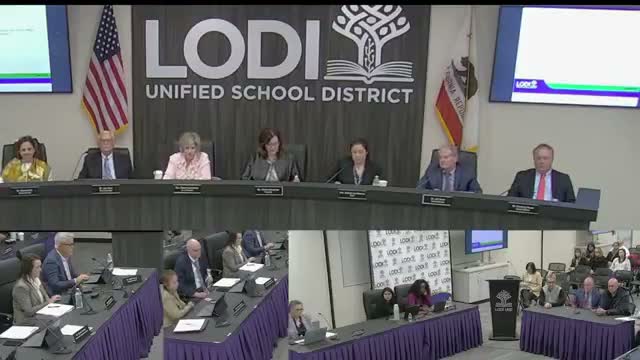
Doctor Horton and assessment coordinator Zubin Dalman presented the district’s 2025 California School Dashboard indicators and local assessment strategy, telling the board that most state indicators show modest year-over-year improvement but that the scale of under-performance remains: just under 40% of students met grade-level readiness in English language arts and under 30% in math over the most recent three-year window.
Dalman outlined correlation analyses comparing I Ready interim assessments and state CAST/CAASPP results, reporting strong Pearson correlations that allow the district to identify likely end-of-year outcomes earlier in the cycle. The presenters argued that using I Ready as an early predictor creates intervention windows (beginning-to-middle and middle-to-end of year) where teachers can deploy tier 1 and tier 1-plus strategies to alter trajectories.
Two classroom teachers — Oakwood third-grade teacher Alyssa Erickson and a sixth-grade teacher from George Washington — described 'visible learning' practices in their classrooms: co-created success criteria, clear models of work, daily formative checks, peer and self-assessment, and structured intervention time. Erickson said the approach gives students "a clear model of what they're expected to do" and lets teachers act on formative data more quickly. The presenters and teachers urged sustained professional learning, principal engagement with teachers, and scaling PLCs (professional learning communities) as the next phase.
Board members pushed on why district scores have been flat for a decade, asked whether changes would show quickly, and sought more data for high-school attendance and dual-enrollment outcomes. Staff said the state data are a "rear view mirror" and emphasized the district's plan to focus on current cohorts with more real-time assessments and accountability metrics.
No policy change was adopted at the meeting; staff said they will return with implementation details, phase-2 acceptance criteria and accountability measures.
Dalman outlined correlation analyses comparing I Ready interim assessments and state CAST/CAASPP results, reporting strong Pearson correlations that allow the district to identify likely end-of-year outcomes earlier in the cycle. The presenters argued that using I Ready as an early predictor creates intervention windows (beginning-to-middle and middle-to-end of year) where teachers can deploy tier 1 and tier 1-plus strategies to alter trajectories.
Two classroom teachers — Oakwood third-grade teacher Alyssa Erickson and a sixth-grade teacher from George Washington — described 'visible learning' practices in their classrooms: co-created success criteria, clear models of work, daily formative checks, peer and self-assessment, and structured intervention time. Erickson said the approach gives students "a clear model of what they're expected to do" and lets teachers act on formative data more quickly. The presenters and teachers urged sustained professional learning, principal engagement with teachers, and scaling PLCs (professional learning communities) as the next phase.
Board members pushed on why district scores have been flat for a decade, asked whether changes would show quickly, and sought more data for high-school attendance and dual-enrollment outcomes. Staff said the state data are a "rear view mirror" and emphasized the district's plan to focus on current cohorts with more real-time assessments and accountability metrics.
No policy change was adopted at the meeting; staff said they will return with implementation details, phase-2 acceptance criteria and accountability measures.
View the Full Meeting & All Its Details
This article offers just a summary. Unlock complete video, transcripts, and insights as a Founder Member.
✓
Watch full, unedited meeting videos
✓
Search every word spoken in unlimited transcripts
✓
AI summaries & real-time alerts (all government levels)
✓
Permanent access to expanding government content
30-day money-back guarantee
