School Committee hears DCAP/MTSS revision and mental‑health screening results
January 28, 2026 | Methuen Public Schools, School Boards, Massachusetts
This article was created by AI summarizing key points discussed. AI makes mistakes, so for full details and context, please refer to the video of the full meeting. Please report any errors so we can fix them. Report an error »
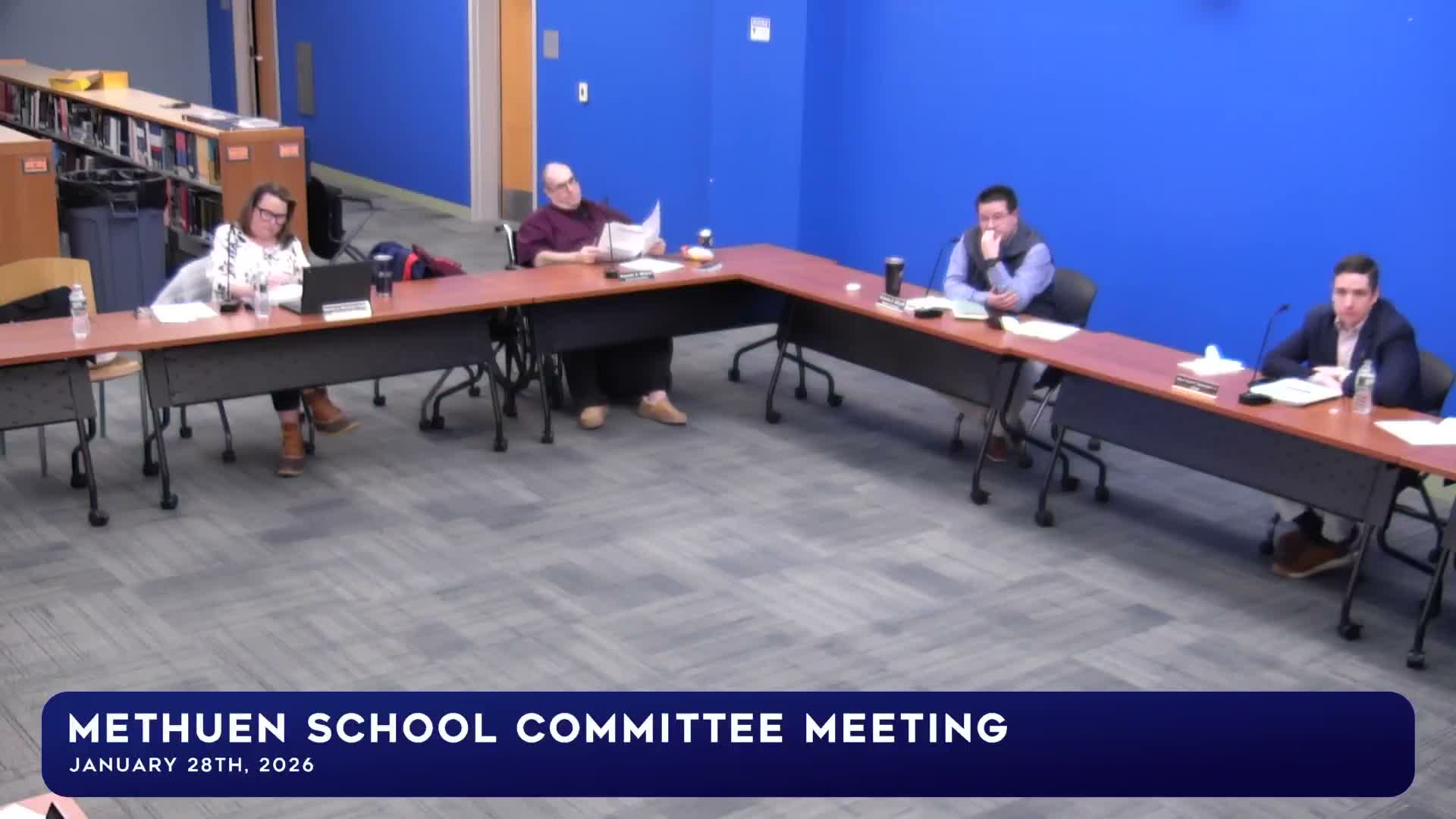
District staff updated the School Committee on multi‑tiered systems of support (MTSS), the District Curriculum Accommodation Plan (DCAP), and mental‑health screening results.
Staff said the DCAP—outdated for more than a decade—is being rewritten as a compact, practical document organized around assessment, attention/regulation, executive functioning, behavior and instruction. The revisioning team is creating concrete examples so teachers can use the DCAP as an on‑the‑job resource rather than a lengthy reference document; staff plan annual revisions to keep it current.
On mental‑health screening, staff reported an 81 percent participation rate in grades 5–12 for fall screening and said there were no significant declines in outcomes despite expected seasonal backslide. Presenters noted declines in some severe anxiety and depression indicators over a multiyear series and said the district is tracking which interventions align with improved outcomes. The district described an opt‑out process in which parents are notified two weeks before administration, may view survey questions in advance, and can opt out; opt‑outs are flagged in the system to persist year to year.
Board members asked how students who struggle to understand written screener questions (for example, students with reading difficulties or certain special‑education needs) are supported. Staff said that counselors follow up and the district will provide additional details on delivery and follow‑up procedures upon request.
Staff also reported caseload monitoring metrics: slightly over 1,000 tier‑2 and tier‑3 services provided by counselors in quarter one, down modestly from last year due to fewer staff, and that 67 percent of those services resulted in improved academic progress. The district said it made 129 referrals to Care Solace and 19 to Cartwheel to augment counseling services.
Next steps described included continued data work by MTSS subgroups (data, tier‑1 practices, engagement/attendance and curriculum mapping) and pilot implementation of bullying‑prevention curricula and parent workshops.
Staff said the DCAP—outdated for more than a decade—is being rewritten as a compact, practical document organized around assessment, attention/regulation, executive functioning, behavior and instruction. The revisioning team is creating concrete examples so teachers can use the DCAP as an on‑the‑job resource rather than a lengthy reference document; staff plan annual revisions to keep it current.
On mental‑health screening, staff reported an 81 percent participation rate in grades 5–12 for fall screening and said there were no significant declines in outcomes despite expected seasonal backslide. Presenters noted declines in some severe anxiety and depression indicators over a multiyear series and said the district is tracking which interventions align with improved outcomes. The district described an opt‑out process in which parents are notified two weeks before administration, may view survey questions in advance, and can opt out; opt‑outs are flagged in the system to persist year to year.
Board members asked how students who struggle to understand written screener questions (for example, students with reading difficulties or certain special‑education needs) are supported. Staff said that counselors follow up and the district will provide additional details on delivery and follow‑up procedures upon request.
Staff also reported caseload monitoring metrics: slightly over 1,000 tier‑2 and tier‑3 services provided by counselors in quarter one, down modestly from last year due to fewer staff, and that 67 percent of those services resulted in improved academic progress. The district said it made 129 referrals to Care Solace and 19 to Cartwheel to augment counseling services.
Next steps described included continued data work by MTSS subgroups (data, tier‑1 practices, engagement/attendance and curriculum mapping) and pilot implementation of bullying‑prevention curricula and parent workshops.
Don't Miss a Word: See the Full Meeting!
Go beyond summaries. Unlock every video, transcript, and key insight with a Founder Membership.
✓
Get instant access to full meeting videos
✓
Search and clip any phrase from complete transcripts
✓
Receive AI-powered summaries & custom alerts
✓
Enjoy lifetime, unrestricted access to government data
30-day money-back guarantee
