WSDOT: Hansen Road I‑90 overcrossing closed for safety after rapid deterioration; replacement favored but funding uncertain
January 28, 2026 | Moses Lake City, Grant County, Washington
This article was created by AI summarizing key points discussed. AI makes mistakes, so for full details and context, please refer to the video of the full meeting. Please report any errors so we can fix them. Report an error »
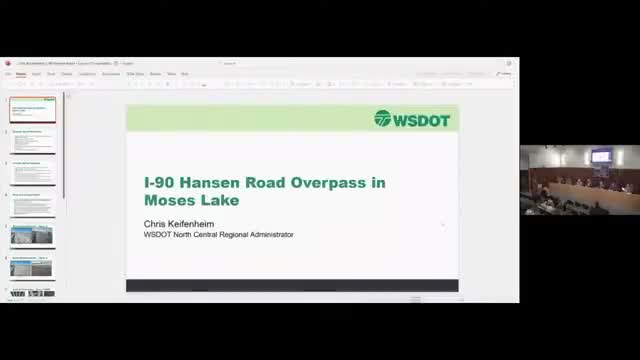
Chris Kiefenheim, regional administrator for the North Central Region of the Washington State Department of Transportation, told the Moses Lake City Council the Hansen Road overcrossing on Interstate 90 was closed on Jan. 17 after a Jan. 14 inspection revealed accelerating chloride-related deterioration.
Kiefenheim said the inspection found cracking that has progressed from the deck into columns and girders, creating a public‑safety concern about concrete dropping onto traffic below. "The deterioration had progressed exponentially, quicker than we were expecting," he said, and WSDOT moved inspections to every six months to monitor the structure.
Kiefenheim outlined two options: a rehabilitation to replace the bridge deck and repair columns and girder ends, which he estimated at $5 million to $10 million and would extend the bridge's life by roughly 10 years with a 9–15 month timeline; or a full replacement, estimated at $12 million to $20 million with a 15–24 month timeline and a design life of about 75 years. He said WSDOT's technical judgment favors replacement on benefit‑cost and lifespan grounds but added that "we don't have the funding readily available within the state" to do that work immediately.
Councilmembers and members of the public pressed WSDOT about local impacts and alternatives. Public commenters raised emergency‑response concerns tied to a roughly 10– to 12‑mile detour and urged review of a nearby five‑road intersection, which one resident called "Malfunction Junction." UPS driver Joshua Cooper urged more public engagement and proposed a future second crossing; Cooper also warned detour traffic could accelerate deterioration on the nearby Hiawatha interchange.
On funding, Kiefenheim said the work is a preservation project and WSDOT is combing through statewide preservation allocations (about $800 million for the current biennium) and other budget lines to find money that is not already under contract. He said projects done in less than 30 working days may be eligible for emergency contracting, but the Hansen work is expected to exceed that threshold and will require typical bidding and contracting if a full replacement is chosen. "We're looking at every rock," Kiefenheim said, while acknowledging legislative action would be required for funding outside existing preservation budgets.
The bridge was originally built in 1958 and widened and raised in 1992; WSDOT provided photos showing substantially worse cracking in January 2026 compared with inspections in June 2025. Traffic counts cited in the presentation showed roughly 5,300 vehicles per day prior to recent development near the interchange.
Mayor and staff noted the timing could help, with the state legislature in session and the city's lobbyist and local representative engaged on the issue. Kiefenheim said WSDOT hoped a funding decision could come within one to two weeks but that timeline was not certain.
Next steps: WSDOT will continue funding searches and design work; the city said it will continue local outreach and legislative advocacy. No formal council action on the bridge was recorded at the meeting.
Kiefenheim said the inspection found cracking that has progressed from the deck into columns and girders, creating a public‑safety concern about concrete dropping onto traffic below. "The deterioration had progressed exponentially, quicker than we were expecting," he said, and WSDOT moved inspections to every six months to monitor the structure.
Kiefenheim outlined two options: a rehabilitation to replace the bridge deck and repair columns and girder ends, which he estimated at $5 million to $10 million and would extend the bridge's life by roughly 10 years with a 9–15 month timeline; or a full replacement, estimated at $12 million to $20 million with a 15–24 month timeline and a design life of about 75 years. He said WSDOT's technical judgment favors replacement on benefit‑cost and lifespan grounds but added that "we don't have the funding readily available within the state" to do that work immediately.
Councilmembers and members of the public pressed WSDOT about local impacts and alternatives. Public commenters raised emergency‑response concerns tied to a roughly 10– to 12‑mile detour and urged review of a nearby five‑road intersection, which one resident called "Malfunction Junction." UPS driver Joshua Cooper urged more public engagement and proposed a future second crossing; Cooper also warned detour traffic could accelerate deterioration on the nearby Hiawatha interchange.
On funding, Kiefenheim said the work is a preservation project and WSDOT is combing through statewide preservation allocations (about $800 million for the current biennium) and other budget lines to find money that is not already under contract. He said projects done in less than 30 working days may be eligible for emergency contracting, but the Hansen work is expected to exceed that threshold and will require typical bidding and contracting if a full replacement is chosen. "We're looking at every rock," Kiefenheim said, while acknowledging legislative action would be required for funding outside existing preservation budgets.
The bridge was originally built in 1958 and widened and raised in 1992; WSDOT provided photos showing substantially worse cracking in January 2026 compared with inspections in June 2025. Traffic counts cited in the presentation showed roughly 5,300 vehicles per day prior to recent development near the interchange.
Mayor and staff noted the timing could help, with the state legislature in session and the city's lobbyist and local representative engaged on the issue. Kiefenheim said WSDOT hoped a funding decision could come within one to two weeks but that timeline was not certain.
Next steps: WSDOT will continue funding searches and design work; the city said it will continue local outreach and legislative advocacy. No formal council action on the bridge was recorded at the meeting.
View the Full Meeting & All Its Details
This article offers just a summary. Unlock complete video, transcripts, and insights as a Founder Member.
✓
Watch full, unedited meeting videos
✓
Search every word spoken in unlimited transcripts
✓
AI summaries & real-time alerts (all government levels)
✓
Permanent access to expanding government content
30-day money-back guarantee
