Committee advances bill to let municipalities serve properties outside city limits amid capacity and cost concerns (HB 1075)
January 28, 2026 | 2026 Legislature FL, Florida
This article was created by AI summarizing key points discussed. AI makes mistakes, so for full details and context, please refer to the video of the full meeting. Please report any errors so we can fix them. Report an error »
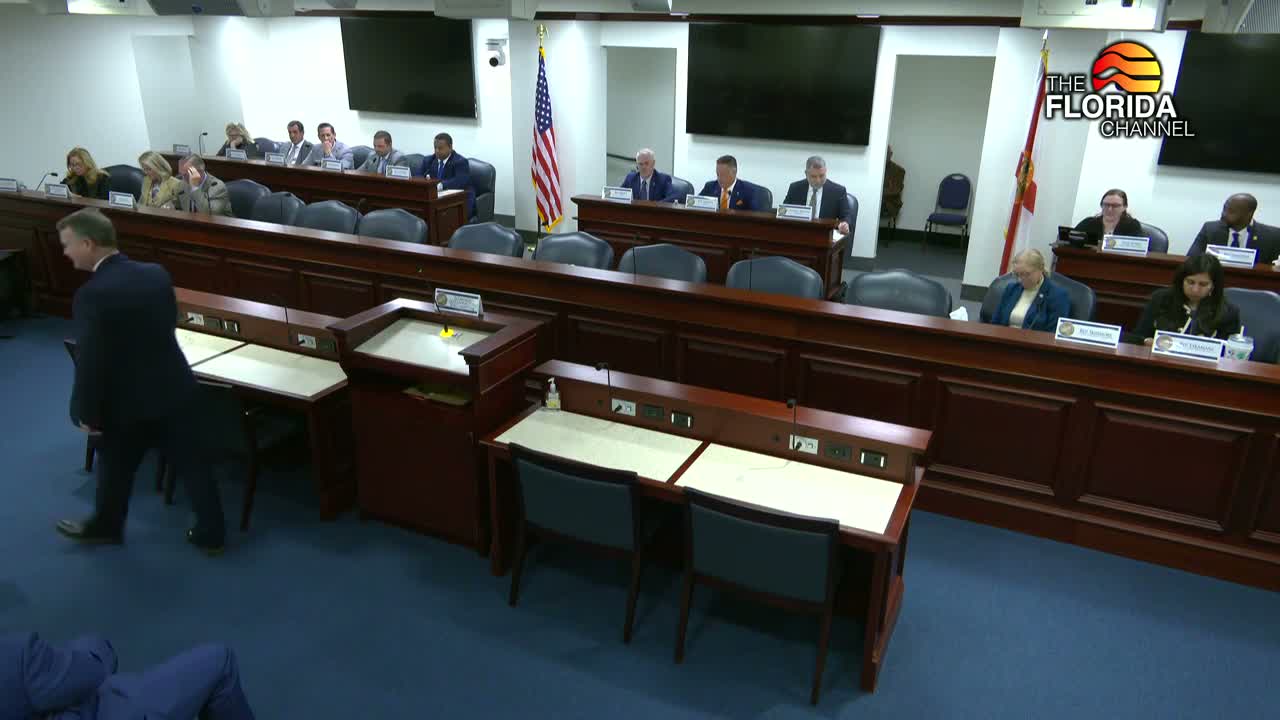
Representative Oliver, sponsor of House Bill 1075, told the committee the bill is intended to protect Florida’s water resources by enabling connections to centralized water and wastewater systems when capacity exists, reducing nutrient leaching from failing septic systems. Under the bill, a municipality that operates utility service must allow an outside property owner to connect if the utility has sufficient capacity and the requester agrees to pay all applicable rates, connection fees and impact fees.
Public witnesses raised practical and fiscal concerns. Lisa Malozi of Cooper City urged protections to ensure development is consistent with surrounding areas and stressed that building new infrastructure can take decades to pay for itself. Rebecca O’Hara of the Florida League of Cities told the committee there is no proximity requirement in the bill’s current language, which could conflict with existing service-territory agreements, interlocal planning, annexation or development agreements; she warned of “dead-end” lines that can produce water-quality issues and taste/odor problems when a long extension serves a single user.
Julian Caraballo, vice mayor of Port St. Lucie, described his city’s planning assumptions: a current population of about 264,000, projected growth of 120,000 over 20 years, and planned bond financings of roughly $224 million for a Range Line Water Treatment Plant and over $500 million for improvements to the Glades Water Treatment Plant. Caraballo asked for an amendment to protect planned capacity and the city’s bonding assumptions.
Members raised the tension between environmental goals and municipal autonomy. Representative Smith said he supported clean water but objected to a “forcing function” that could require cities to serve outside their legal boundaries and asked whether municipalities should have a first right of refusal. Representative Escamani voiced similar concerns about local residents subsidizing service for nonresidents and asked about mitigation measures and cost protections for ratepayers.
Representative Oliver closed by stating this was the bill’s first committee stop and she committed to work with stakeholders on amendments to address those concerns. The committee then voted to report HB 1075 favorably.
Public witnesses raised practical and fiscal concerns. Lisa Malozi of Cooper City urged protections to ensure development is consistent with surrounding areas and stressed that building new infrastructure can take decades to pay for itself. Rebecca O’Hara of the Florida League of Cities told the committee there is no proximity requirement in the bill’s current language, which could conflict with existing service-territory agreements, interlocal planning, annexation or development agreements; she warned of “dead-end” lines that can produce water-quality issues and taste/odor problems when a long extension serves a single user.
Julian Caraballo, vice mayor of Port St. Lucie, described his city’s planning assumptions: a current population of about 264,000, projected growth of 120,000 over 20 years, and planned bond financings of roughly $224 million for a Range Line Water Treatment Plant and over $500 million for improvements to the Glades Water Treatment Plant. Caraballo asked for an amendment to protect planned capacity and the city’s bonding assumptions.
Members raised the tension between environmental goals and municipal autonomy. Representative Smith said he supported clean water but objected to a “forcing function” that could require cities to serve outside their legal boundaries and asked whether municipalities should have a first right of refusal. Representative Escamani voiced similar concerns about local residents subsidizing service for nonresidents and asked about mitigation measures and cost protections for ratepayers.
Representative Oliver closed by stating this was the bill’s first committee stop and she committed to work with stakeholders on amendments to address those concerns. The committee then voted to report HB 1075 favorably.
Don't Miss a Word: See the Full Meeting!
Go beyond summaries. Unlock every video, transcript, and key insight with a Founder Membership.
✓
Get instant access to full meeting videos
✓
Search and clip any phrase from complete transcripts
✓
Receive AI-powered summaries & custom alerts
✓
Enjoy lifetime, unrestricted access to government data
30-day money-back guarantee
