Maine committee hears broad support, amendment requests for ASL-interpreter licensure bill
January 28, 2026 | 2026 Legislature ME, Maine
This article was created by AI summarizing key points discussed. AI makes mistakes, so for full details and context, please refer to the video of the full meeting. Please report any errors so we can fix them. Report an error »
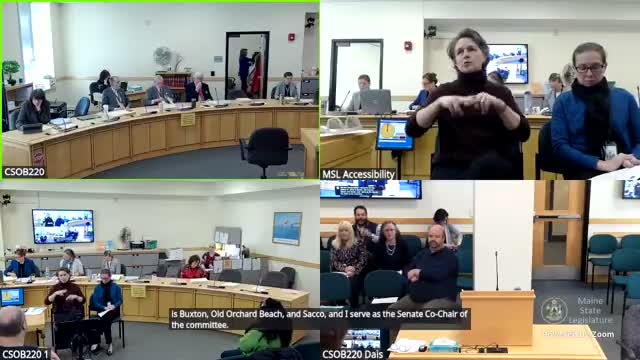
Representative Christy Matheson introduced LD 2087, an Administration bill that seeks to amend Maine’s licensure rules for American Sign Language interpreters to expand the pipeline and clarify emergency response authority.
Penny Valancourt, director of the Office of Professional and Occupational Regulation, told the committee LD 2087 implements recommendations from the Transforming Interpreting Maine needs-assessment. The bill would expand acceptable educational pathways beyond ASL-specific degrees, lengthen conditional licensure from four to five years with an optional sixth year for extreme hardship, and add an emergency exemption allowing non-licensed communication assistance during declared emergencies after consultation between OPOR and the relevant commissioner. Valancourt said applicants would still be required to pass a knowledge exam and an ASL proficiency interview before full licensure.
Betsy Hopkins of the Department of Health and Human Services’ Office of Aging and Disability Services testified in support. Hopkins said extending conditional licensure and broadening degree options would help address workforce shortages, especially in rural areas, and that the emergency exemption would make it easier to mobilize interpreters during time-sensitive events.
Libby Stone Sterling, director of the Bureau of Rehabilitation Services at the Department of Labor, described efforts to explore a registered-apprenticeship pathway modeled on existing programs in other states, including Wisconsin. Sterling said the bureau is reviewing funding options, including grants and reallocated interpreter spending, and plans to pilot an apprenticeship program if feasible.
Matt Webster of the Maine Association of the Deaf expressed conditional support but urged two amendments: a pathway permitting students who have completed at least 60 college credits toward a bachelor’s degree and are in good standing to qualify for conditional licensure; and removing a grandfathering limitation so that the Registry of Interpreters for the Deaf’s alternative pathways would be available to all conditional applicants. Webster said those changes would expand supervised-practice opportunities for interpreters who cannot complete a BA before entering the workforce.
Committee members asked whether stakeholder groups — including the Maine Association of the Deaf — had been part of the work group that drafted recommendations. Valancourt said the time report was community-informed and convened after the October 2023 Lewiston shooting, and she committed to follow up on specific steering-group membership and submitted amendment language. Matheson said the committee will take the testimony into account and has scheduled follow-up work sessions.
Next steps: The public hearing on LD 2087 closed and the committee indicated LD 2087 will come up for work session next Wednesday. Several members asked OPOR and other agencies to engage with stakeholders on potential student and alternative-pathway amendments before that work session.
Penny Valancourt, director of the Office of Professional and Occupational Regulation, told the committee LD 2087 implements recommendations from the Transforming Interpreting Maine needs-assessment. The bill would expand acceptable educational pathways beyond ASL-specific degrees, lengthen conditional licensure from four to five years with an optional sixth year for extreme hardship, and add an emergency exemption allowing non-licensed communication assistance during declared emergencies after consultation between OPOR and the relevant commissioner. Valancourt said applicants would still be required to pass a knowledge exam and an ASL proficiency interview before full licensure.
Betsy Hopkins of the Department of Health and Human Services’ Office of Aging and Disability Services testified in support. Hopkins said extending conditional licensure and broadening degree options would help address workforce shortages, especially in rural areas, and that the emergency exemption would make it easier to mobilize interpreters during time-sensitive events.
Libby Stone Sterling, director of the Bureau of Rehabilitation Services at the Department of Labor, described efforts to explore a registered-apprenticeship pathway modeled on existing programs in other states, including Wisconsin. Sterling said the bureau is reviewing funding options, including grants and reallocated interpreter spending, and plans to pilot an apprenticeship program if feasible.
Matt Webster of the Maine Association of the Deaf expressed conditional support but urged two amendments: a pathway permitting students who have completed at least 60 college credits toward a bachelor’s degree and are in good standing to qualify for conditional licensure; and removing a grandfathering limitation so that the Registry of Interpreters for the Deaf’s alternative pathways would be available to all conditional applicants. Webster said those changes would expand supervised-practice opportunities for interpreters who cannot complete a BA before entering the workforce.
Committee members asked whether stakeholder groups — including the Maine Association of the Deaf — had been part of the work group that drafted recommendations. Valancourt said the time report was community-informed and convened after the October 2023 Lewiston shooting, and she committed to follow up on specific steering-group membership and submitted amendment language. Matheson said the committee will take the testimony into account and has scheduled follow-up work sessions.
Next steps: The public hearing on LD 2087 closed and the committee indicated LD 2087 will come up for work session next Wednesday. Several members asked OPOR and other agencies to engage with stakeholders on potential student and alternative-pathway amendments before that work session.
View the Full Meeting & All Its Details
This article offers just a summary. Unlock complete video, transcripts, and insights as a Founder Member.
✓
Watch full, unedited meeting videos
✓
Search every word spoken in unlimited transcripts
✓
AI summaries & real-time alerts (all government levels)
✓
Permanent access to expanding government content
30-day money-back guarantee
