Committee reviews amended 'Clean Slate' automatic sealing proposal; asks for clarifications
January 28, 2026 | 2026 Legislature ME, Maine
This article was created by AI summarizing key points discussed. AI makes mistakes, so for full details and context, please refer to the video of the full meeting. Please report any errors so we can fix them. Report an error »
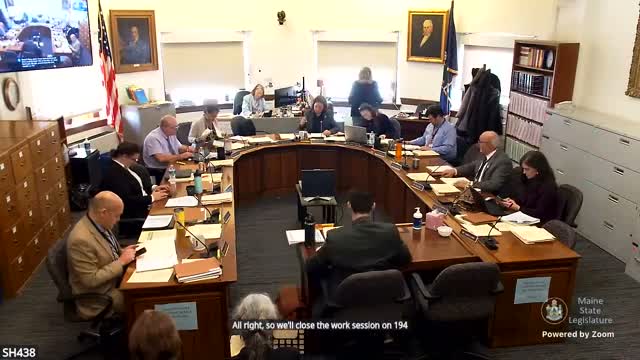
Sen. Rachel Talbot Ross and Ryan Ewing, a strategist for the Clean Slate initiative, presented an amended strike-and-replace version of LD 1911 that would create an automated sealing process for many misdemeanor and some felony convictions.
Ewing said the sponsor's amendment narrows eligible Class C felonies primarily to certain drug offenses, while Class D and E misdemeanors would be eligible except where excluded by the text (for example, crimes involving firearms or other statutory disqualifiers). He noted that red highlighting in spreadsheets provided to the committee identifies offenses that advocates believe should be categorically excluded or that raise interpretation questions.
A principal focus of member questions was operational: how would sealed records interact with licensing agencies, the Maine State Archives, the Bureau of State Police (SBI), and judicial recordkeeping? Ewing and staff said they had inserted clarifying language so licensing agencies that have legal obligations to access records would still receive sealed information where the statute authorizes it, and that court orders generating seals would be copied to the State Archives. Committee staff and the sponsor agreed to follow up with DPFR/SBI to ensure the draft describes the correct receiving offices and processes.
Members also asked whether child-care and certification processes (for example, direct support professionals) would continue to be able to see relevant background information. The sponsor said federal requirements would remain in effect and the amendment attempts to preserve access needed for statutorily mandated checks; staff offered to fetch specific lists of affected licensing agencies and statutory cross-references.
Senator Talbot Ross reiterated that the policy has been vetted for years through the Criminal Records Review Committee (CRRC) with a mix of prosecutors, defense attorneys, judiciary representatives and advocates, and said the committee’s work informed the current amendment. Committee members requested follow-up materials, including precise offense lists with explanatory columns and a fiscal note once the bill text is settled.
No final vote was taken; staff and sponsor will provide corrected materials and answers to technical questions at the next meeting.
Ewing said the sponsor's amendment narrows eligible Class C felonies primarily to certain drug offenses, while Class D and E misdemeanors would be eligible except where excluded by the text (for example, crimes involving firearms or other statutory disqualifiers). He noted that red highlighting in spreadsheets provided to the committee identifies offenses that advocates believe should be categorically excluded or that raise interpretation questions.
A principal focus of member questions was operational: how would sealed records interact with licensing agencies, the Maine State Archives, the Bureau of State Police (SBI), and judicial recordkeeping? Ewing and staff said they had inserted clarifying language so licensing agencies that have legal obligations to access records would still receive sealed information where the statute authorizes it, and that court orders generating seals would be copied to the State Archives. Committee staff and the sponsor agreed to follow up with DPFR/SBI to ensure the draft describes the correct receiving offices and processes.
Members also asked whether child-care and certification processes (for example, direct support professionals) would continue to be able to see relevant background information. The sponsor said federal requirements would remain in effect and the amendment attempts to preserve access needed for statutorily mandated checks; staff offered to fetch specific lists of affected licensing agencies and statutory cross-references.
Senator Talbot Ross reiterated that the policy has been vetted for years through the Criminal Records Review Committee (CRRC) with a mix of prosecutors, defense attorneys, judiciary representatives and advocates, and said the committee’s work informed the current amendment. Committee members requested follow-up materials, including precise offense lists with explanatory columns and a fiscal note once the bill text is settled.
No final vote was taken; staff and sponsor will provide corrected materials and answers to technical questions at the next meeting.
View the Full Meeting & All Its Details
This article offers just a summary. Unlock complete video, transcripts, and insights as a Founder Member.
✓
Watch full, unedited meeting videos
✓
Search every word spoken in unlimited transcripts
✓
AI summaries & real-time alerts (all government levels)
✓
Permanent access to expanding government content
30-day money-back guarantee
