Department warns against raising CON threshold above $5M; committee agrees to incremental change
January 28, 2026 | 2026 Legislature ME, Maine
This article was created by AI summarizing key points discussed. AI makes mistakes, so for full details and context, please refer to the video of the full meeting. Please report any errors so we can fix them. Report an error »
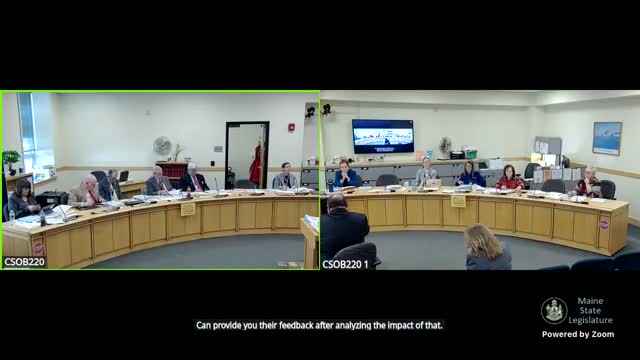
Committee staff and the Department of Health and Human Services reviewed a five-year lookback on ambulatory surgical centers and other outpatient projects and cautioned that raising the certificate-of-need (CON) threshold above $5 million might let large projects evade review through lease or renovation arrangements. The department said lease arrangements can separate a provider's capital outlay from a project’s total cost and reduce the need-analysis component of CON review, which in turn limits agency ability to consider payer mix and community impact.
Department witnesses recounted examples in which existing providers renovated leased space or moved facilities in ways that lowered CON-eligible capital costs while materially changing service capacity. Staff also listed recent projects that did not trigger CON review because of the financing or structure — including urgent care, outpatient radiology and hemodialysis facilities located in more populated corridors rather than rural Maine.
Some members argued for higher thresholds to encourage investment and lower regulatory friction; others said CON is an important tool to protect fragile provider payer mixes in rural areas. After debate the committee considered an amendment to raise the ambulatory-surgical threshold to $7.5 million with CPI indexing and later recorded a committee roll call that showed 6 members in the affirmative and 4 in the negative. Committee staff concluded that the initial bill change raising thresholds to $5 million (with CPI indexing) was the more conservative option favored by department staff, but a majority supported the incremental $7.5M amendment.
Next steps: Committee will adopt language consistent with the chosen threshold amendment for the work session and continue collection of CON data requested by members.
Department witnesses recounted examples in which existing providers renovated leased space or moved facilities in ways that lowered CON-eligible capital costs while materially changing service capacity. Staff also listed recent projects that did not trigger CON review because of the financing or structure — including urgent care, outpatient radiology and hemodialysis facilities located in more populated corridors rather than rural Maine.
Some members argued for higher thresholds to encourage investment and lower regulatory friction; others said CON is an important tool to protect fragile provider payer mixes in rural areas. After debate the committee considered an amendment to raise the ambulatory-surgical threshold to $7.5 million with CPI indexing and later recorded a committee roll call that showed 6 members in the affirmative and 4 in the negative. Committee staff concluded that the initial bill change raising thresholds to $5 million (with CPI indexing) was the more conservative option favored by department staff, but a majority supported the incremental $7.5M amendment.
Next steps: Committee will adopt language consistent with the chosen threshold amendment for the work session and continue collection of CON data requested by members.
Don't Miss a Word: See the Full Meeting!
Go beyond summaries. Unlock every video, transcript, and key insight with a Founder Membership.
✓
Get instant access to full meeting videos
✓
Search and clip any phrase from complete transcripts
✓
Receive AI-powered summaries & custom alerts
✓
Enjoy lifetime, unrestricted access to government data
30-day money-back guarantee
