Committee approves narrow disclosure requirement for AI‑altered campaign media, votes to report majority report
January 28, 2026 | 2026 Legislature ME, Maine
This article was created by AI summarizing key points discussed. AI makes mistakes, so for full details and context, please refer to the video of the full meeting. Please report any errors so we can fix them. Report an error »
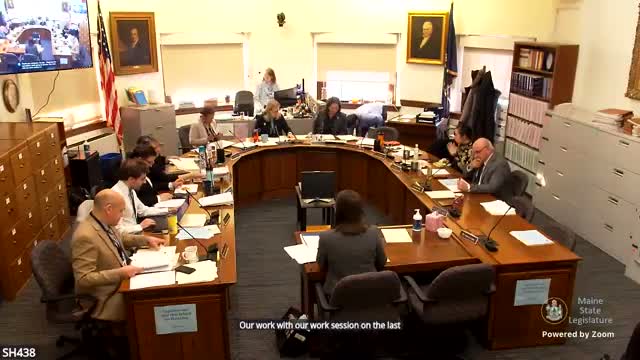
The committee considered LD 517, a sponsor amendment to a concept draft that would require specific disclosures where an election-related public communication contains manipulated or synthetic media that is likely to deceive a reasonable person or change a reasonable person's material understanding of a candidate’s appearance, speech or conduct.
Representative Cook (sponsor) explained the revised, narrowed proposal: the disclosure requirement applies only to "public communications" as defined in Maine’s campaign finance law and only when the communication (a) contains synthetic media as defined in the amendment and (b) either expressly advocates for or against a candidate or names/depicts a clearly identified candidate within statutory pre-election windows. The draft exempts communications that are minor edits (clarifying captions or brightness adjustments) and materials that are clearly satire or parody. The amendment also provides an exception for publishers/broadcasters who were paid to publish a communication but lacked actual knowledge that the content contained synthetic media; it requires that paid copies sent to the Maine State Archives and that licensing interactions be preserved under existing law.
Janet Stocco walked members through enforcement mechanics: the Maine Commission on Governmental Ethics and Election Practices may investigate and, if a violation is found, impose civil penalties tied to the expenditure on the communication (with statutory doubling or tripling in the 28- or 14-day windows before an election). If the commission cannot locate a responsible person or collection of funds, the Attorney General may pursue injunctive relief and collection of unpaid civil penalties. Members pressed staff on whether the bill would be preempted by federal law governing interactive computer services; OPLA said the bill's definition of public communication (which limits internet-triggered coverage to paid promotions on others' platforms) aimed to avoid creating liability for platforms under Section 230, but staff offered to confirm with legal counsel.
Members also discussed First Amendment scrutiny. OPLA summarized a recent federal district court decision striking down a California prohibition on materially deceptive campaign deepfakes; that decision distinguished outright bans from narrowly tailored disclosure regimes under campaign finance rules. Several members asked for further legal analysis from legislative attorneys and civil liberties counsel before the bill is finalized. After caucus and discussion the committee voted to report LD 517 (sponsor's revised amendment) as ought-to-pass as amended on a roll-call vote (8 yes, 2 no, 4 absent).
Representative Cook (sponsor) explained the revised, narrowed proposal: the disclosure requirement applies only to "public communications" as defined in Maine’s campaign finance law and only when the communication (a) contains synthetic media as defined in the amendment and (b) either expressly advocates for or against a candidate or names/depicts a clearly identified candidate within statutory pre-election windows. The draft exempts communications that are minor edits (clarifying captions or brightness adjustments) and materials that are clearly satire or parody. The amendment also provides an exception for publishers/broadcasters who were paid to publish a communication but lacked actual knowledge that the content contained synthetic media; it requires that paid copies sent to the Maine State Archives and that licensing interactions be preserved under existing law.
Janet Stocco walked members through enforcement mechanics: the Maine Commission on Governmental Ethics and Election Practices may investigate and, if a violation is found, impose civil penalties tied to the expenditure on the communication (with statutory doubling or tripling in the 28- or 14-day windows before an election). If the commission cannot locate a responsible person or collection of funds, the Attorney General may pursue injunctive relief and collection of unpaid civil penalties. Members pressed staff on whether the bill would be preempted by federal law governing interactive computer services; OPLA said the bill's definition of public communication (which limits internet-triggered coverage to paid promotions on others' platforms) aimed to avoid creating liability for platforms under Section 230, but staff offered to confirm with legal counsel.
Members also discussed First Amendment scrutiny. OPLA summarized a recent federal district court decision striking down a California prohibition on materially deceptive campaign deepfakes; that decision distinguished outright bans from narrowly tailored disclosure regimes under campaign finance rules. Several members asked for further legal analysis from legislative attorneys and civil liberties counsel before the bill is finalized. After caucus and discussion the committee voted to report LD 517 (sponsor's revised amendment) as ought-to-pass as amended on a roll-call vote (8 yes, 2 no, 4 absent).
Don't Miss a Word: See the Full Meeting!
Go beyond summaries. Unlock every video, transcript, and key insight with a Founder Membership.
✓
Get instant access to full meeting videos
✓
Search and clip any phrase from complete transcripts
✓
Receive AI-powered summaries & custom alerts
✓
Enjoy lifetime, unrestricted access to government data
30-day money-back guarantee
