Commission warns enforcement transfer of IFTA/IRP would not be revenue neutral and could raise costs
January 28, 2026 | 2026 Legislature OK, Oklahoma
This article was created by AI summarizing key points discussed. AI makes mistakes, so for full details and context, please refer to the video of the full meeting. Please report any errors so we can fix them. Report an error »
Commission leaders warned lawmakers that legislation to move IFTA/IRP enforcement away from the Oklahoma Corporation Commission would have fiscal and operational consequences.
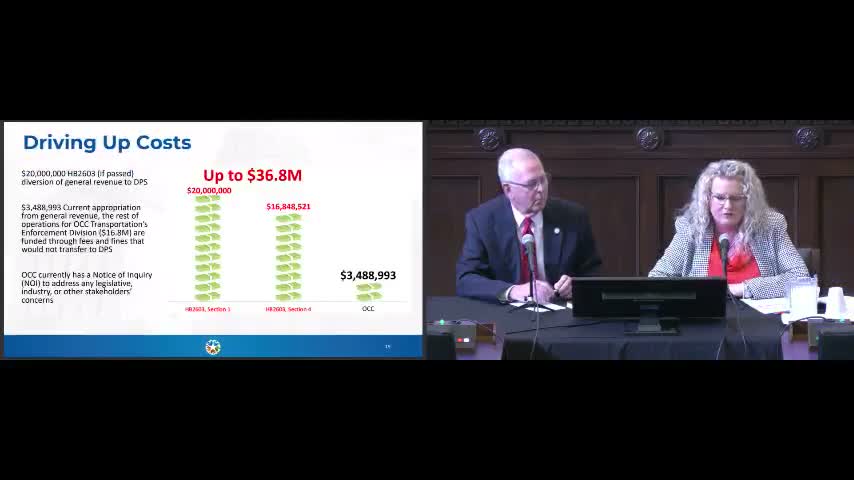
Chief Financial Officer Holly George said a transfer bill currently in the Senate would remove $20 million from general-revenue appropriations and noted that Section 4 of the bill contemplates FY27 funding to cover the transferred responsibilities but does not specify an amount. "Something that's been misunderstood as revenue neutral definitely is not revenue neutral," she said, presenting a visualization that showed an enforcement transfer could cost an additional $16,800,000.
Mark Willingham, an attorney with the commission's Office of General Counsel, explained that OCC officers have limited arrest authority under Title 21 §99a for immediate risks to life or property or under memoranda of understanding with other agencies, but practical constraints (for example, the lack of holding cells in OCC vehicles) mean officers typically detain a suspect and call local law enforcement for transport.
Willingham and staff said citation revenue constitutes about one-third of the Transportation Division program funding and estimated that if officer citation-writing moved to another agency the commission could lose roughly $9.8 million in the program's citation revenue. Staff also said moving enforcement could convert administrative citations against companies into criminal fines against drivers, which could increase burdens on district courts and affect driver outcomes.
Committee members pressed for details about staffing and jurisdictional handoffs. The commission suggested that moving enforcement would require additional appropriations to maintain timely hearings and to cover costs that the commission currently absorbs through service fees and assessments.
No bill vote or committee action occurred during the hearing; legislators requested further information as the transfer bill proceeds through the legislative process.
Chief Financial Officer Holly George said a transfer bill currently in the Senate would remove $20 million from general-revenue appropriations and noted that Section 4 of the bill contemplates FY27 funding to cover the transferred responsibilities but does not specify an amount. "Something that's been misunderstood as revenue neutral definitely is not revenue neutral," she said, presenting a visualization that showed an enforcement transfer could cost an additional $16,800,000.
Mark Willingham, an attorney with the commission's Office of General Counsel, explained that OCC officers have limited arrest authority under Title 21 §99a for immediate risks to life or property or under memoranda of understanding with other agencies, but practical constraints (for example, the lack of holding cells in OCC vehicles) mean officers typically detain a suspect and call local law enforcement for transport.
Willingham and staff said citation revenue constitutes about one-third of the Transportation Division program funding and estimated that if officer citation-writing moved to another agency the commission could lose roughly $9.8 million in the program's citation revenue. Staff also said moving enforcement could convert administrative citations against companies into criminal fines against drivers, which could increase burdens on district courts and affect driver outcomes.
Committee members pressed for details about staffing and jurisdictional handoffs. The commission suggested that moving enforcement would require additional appropriations to maintain timely hearings and to cover costs that the commission currently absorbs through service fees and assessments.
No bill vote or committee action occurred during the hearing; legislators requested further information as the transfer bill proceeds through the legislative process.
View the Full Meeting & All Its Details
This article offers just a summary. Unlock complete video, transcripts, and insights as a Founder Member.
✓
Watch full, unedited meeting videos
✓
Search every word spoken in unlimited transcripts
✓
AI summaries & real-time alerts (all government levels)
✓
Permanent access to expanding government content
30-day money-back guarantee
