House Judiciary advances package of licensure compacts after brief debate over reproductive and gender-affirming care protections
January 26, 2026 | Judiciary, House of Representatives, Committees, Legislative, New Mexico
This article was created by AI summarizing key points discussed. AI makes mistakes, so for full details and context, please refer to the video of the full meeting. Please report any errors so we can fix them. Report an error »
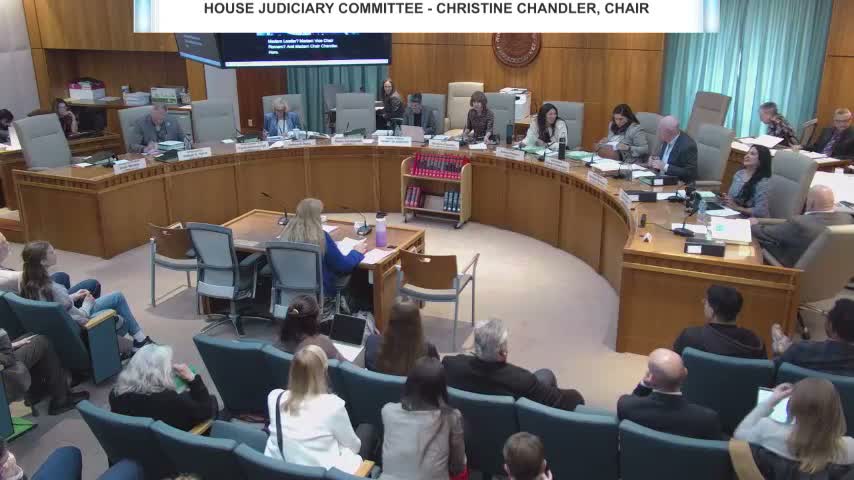
Chairwoman Thompson presided over a House Judiciary Committee hearing focused on a suite of interstate licensure compacts intended to streamline licensing for health and allied professionals and expand access to care in New Mexico.
Supporters from business groups, health-care trade associations and state agencies argued the compacts would help fill provider shortages. Allison Riley, vice president of government affairs at the New Mexico Chamber of Commerce, said the package is “essential to attracting medical professionals,” and Christina Fisher of Think New Mexico told the committee passing the bills would be “the quickest way” to open access to more providers; Fisher noted the state needs “327 more physician assistants” to meet benchmarks.
Analysts and staff said most committee substitutes are small, New Mexico-specific edits negotiated with a bipartisan working group and compact managers to address state concerns while preserving the compacts’ national framework. Bob Horowitz, an analyst for the House majority office, summarized key additions: prohibiting employers from making compact participation a condition of employment; requiring boards to post compact rules and actions on their websites; adding confidentiality and state-law protections; and including federal and state criminal background checks. Horowitz also said the substitute includes language to reinstate a license if revocation was based solely on the fact the licensee provided reproductive or gender-affirming care in New Mexico.
That provision prompted questions. Representative Martinez asked whether a New Mexico-licensed provider who traveled to Texas and performed an abortion could be criminally liable there, and staff answered that providers must follow the law of the state where they practice and could face liability under that state’s criminal laws. Horowitz reiterated, “the compact requires that anybody who is licensed in any of the states participating in the compact has to abide by that state’s laws.”
Compact counsel and representatives of several licensing organizations signaled broad support but warned that some late changes remain under discussion with compact administrators. Counsel for multiple compacts cautioned that a few proposed edits — especially wording affecting how New Mexico could respond to out-of-state disciplinary actions related to reproductive or gender-affirming care — may be unacceptable to some compact commissions and would require further negotiation.
Committee members and leadership emphasized speed and coordination with compact boards. Several members said they prefer prioritizing compacts that are already operational and can immediately translate into more licensed providers. Leadership said the executive branch has supplied implementation funding and staff at Regulation and Licensing have been consulted about capacity.
Votes at a glance (committee recommendations):
- House Bill 10 (Physician Assistant Licensure Compact, committee substitute): do pass (committee tally reported as 10 yes, 1 excused). Representative Romero moved; Leader Sapanski seconded.
- House Bill 11 (Audiology & Speech–Language Pathology Compact, committee substitute): do pass on substitute (roll-call reported; committee clerk tallies noted).
- House Bill 12 (Physical Therapy Licensure Compact, committee substitute): do pass (committee substitute adds Federal Court of New Mexico as an appeal venue).
- House Bill 13 (Occupational Therapy Licensure Compact, committee substitute): do pass.
- House Bill 14 (Dentistry licensure compact, committee substitute): do pass.
- House Bill 31 (EMS Personnel Compact, committee substitute): do pass (the EMS compact uses a ‘privilege to practice’ model that allows out-of-state EMS personnel to work under defined scope limitations).
- House Bill 50 (Social Work Licensure Compact): do pass recommendation (committee reflected telehealth and CYFD workforce needs).
Several other compacts heard in the meeting either had committee substitutes or were rolled to a future hearing because the formal substitute had not yet been provided (for example, the counseling compact, HB32, was rolled due to a missing substitute). Where compacts require compact-board acceptance of New Mexico changes, staff said the bills may return to the House for concurrence if the compact commission requests different language.
What’s next: the committee advanced multiple compacts to the House floor with committee substitutes where available. Staff said they are pursuing ongoing conversations with compact administrators and the Senate side to finalize language acceptable to both New Mexico and the interstate compact commissions. Chairwoman Thompson closed the hearing after housekeeping items and adjourned the committee.
Ending: committee leadership said implementation planning is underway and urged prompt follow-up with compact boards; no floor action date was announced at the hearing.
Supporters from business groups, health-care trade associations and state agencies argued the compacts would help fill provider shortages. Allison Riley, vice president of government affairs at the New Mexico Chamber of Commerce, said the package is “essential to attracting medical professionals,” and Christina Fisher of Think New Mexico told the committee passing the bills would be “the quickest way” to open access to more providers; Fisher noted the state needs “327 more physician assistants” to meet benchmarks.
Analysts and staff said most committee substitutes are small, New Mexico-specific edits negotiated with a bipartisan working group and compact managers to address state concerns while preserving the compacts’ national framework. Bob Horowitz, an analyst for the House majority office, summarized key additions: prohibiting employers from making compact participation a condition of employment; requiring boards to post compact rules and actions on their websites; adding confidentiality and state-law protections; and including federal and state criminal background checks. Horowitz also said the substitute includes language to reinstate a license if revocation was based solely on the fact the licensee provided reproductive or gender-affirming care in New Mexico.
That provision prompted questions. Representative Martinez asked whether a New Mexico-licensed provider who traveled to Texas and performed an abortion could be criminally liable there, and staff answered that providers must follow the law of the state where they practice and could face liability under that state’s criminal laws. Horowitz reiterated, “the compact requires that anybody who is licensed in any of the states participating in the compact has to abide by that state’s laws.”
Compact counsel and representatives of several licensing organizations signaled broad support but warned that some late changes remain under discussion with compact administrators. Counsel for multiple compacts cautioned that a few proposed edits — especially wording affecting how New Mexico could respond to out-of-state disciplinary actions related to reproductive or gender-affirming care — may be unacceptable to some compact commissions and would require further negotiation.
Committee members and leadership emphasized speed and coordination with compact boards. Several members said they prefer prioritizing compacts that are already operational and can immediately translate into more licensed providers. Leadership said the executive branch has supplied implementation funding and staff at Regulation and Licensing have been consulted about capacity.
Votes at a glance (committee recommendations):
- House Bill 10 (Physician Assistant Licensure Compact, committee substitute): do pass (committee tally reported as 10 yes, 1 excused). Representative Romero moved; Leader Sapanski seconded.
- House Bill 11 (Audiology & Speech–Language Pathology Compact, committee substitute): do pass on substitute (roll-call reported; committee clerk tallies noted).
- House Bill 12 (Physical Therapy Licensure Compact, committee substitute): do pass (committee substitute adds Federal Court of New Mexico as an appeal venue).
- House Bill 13 (Occupational Therapy Licensure Compact, committee substitute): do pass.
- House Bill 14 (Dentistry licensure compact, committee substitute): do pass.
- House Bill 31 (EMS Personnel Compact, committee substitute): do pass (the EMS compact uses a ‘privilege to practice’ model that allows out-of-state EMS personnel to work under defined scope limitations).
- House Bill 50 (Social Work Licensure Compact): do pass recommendation (committee reflected telehealth and CYFD workforce needs).
Several other compacts heard in the meeting either had committee substitutes or were rolled to a future hearing because the formal substitute had not yet been provided (for example, the counseling compact, HB32, was rolled due to a missing substitute). Where compacts require compact-board acceptance of New Mexico changes, staff said the bills may return to the House for concurrence if the compact commission requests different language.
What’s next: the committee advanced multiple compacts to the House floor with committee substitutes where available. Staff said they are pursuing ongoing conversations with compact administrators and the Senate side to finalize language acceptable to both New Mexico and the interstate compact commissions. Chairwoman Thompson closed the hearing after housekeeping items and adjourned the committee.
Ending: committee leadership said implementation planning is underway and urged prompt follow-up with compact boards; no floor action date was announced at the hearing.
Don't Miss a Word: See the Full Meeting!
Go beyond summaries. Unlock every video, transcript, and key insight with a Founder Membership.
✓
Get instant access to full meeting videos
✓
Search and clip any phrase from complete transcripts
✓
Receive AI-powered summaries & custom alerts
✓
Enjoy lifetime, unrestricted access to government data
30-day money-back guarantee
