Senate Education Committee advances SB29 to tighten math teacher preparation, adds phased-in amendments
January 26, 2026 | Education, Senate, Committees, Legislative, New Mexico
This article was created by AI summarizing key points discussed. AI makes mistakes, so for full details and context, please refer to the video of the full meeting. Please report any errors so we can fix them. Report an error »
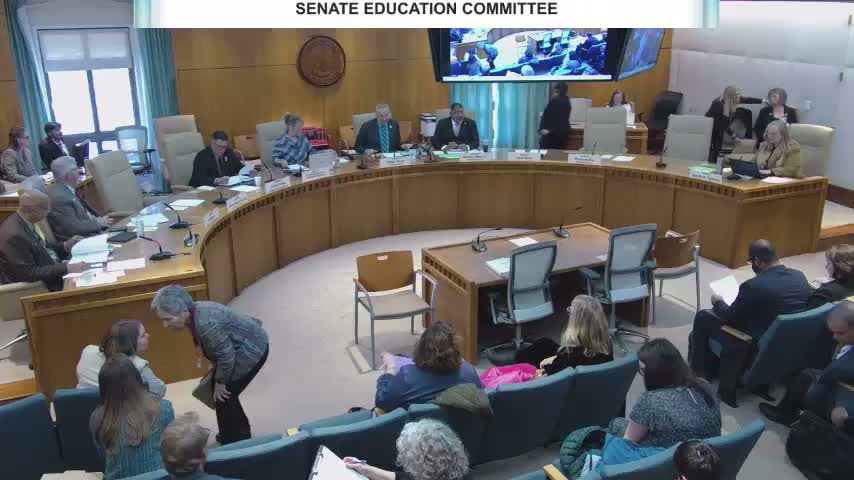
At a Monday meeting of the Senate Education Committee, legislators advanced Senate Bill 29, a framework to strengthen K–12 mathematics instruction by tightening teacher-preparation requirements, establishing early screening and intervention, and creating a system of instructional leadership and monitoring.
The bill’s sponsor told the committee SB29 is intended to address persistently low math outcomes across New Mexico and to build on recent literacy efforts. "It's time we start working on math and how we instruct math, how we train teachers in math," the sponsor said, outlining provisions that increase required math-methods coursework for teacher candidates, set up department guidance for implementation and require early assessment and family engagement.
Advocates and education leaders who testified described widespread support for the bill’s goals. Dominika Chavez of New Mexico Kids Can summarized recent National Assessment of Educational Progress results, saying only one in four New Mexico students is performing at grade level in math and noting that 38% of fourth graders, 58% of eighth graders and 45% of twelfth graders scored below basic on the 2024 NAEP. Higher-education and practitioner witnesses — including Rick Marlette, dean at New Mexico State University, and classroom teachers — urged coordination so the new licensure expectations can be implemented without increasing total degree credit requirements for teacher candidates.
Several witnesses urged caution about added testing and unfunded mandates. Ellen Bernstein, president of the Albuquerque Teachers Federation, supported the preparation standards but warned teachers are already concerned about mandated assessments and asked the committee to "implement SB29 in stages so that we can audit elementary testing requirements before we mandate more tests." Public Charter Schools of New Mexico signaled neutrality and requested flexibility in how schools communicate mathematics support plans and an option for performance-based compliance relief for high-performing schools.
Senator Figueroa offered a multi-part, sponsor-agreed amendment that (1) phases in the new licensure requirement by changing the effective licensing date to apply to licenses issued on or after 07/01/2028 (giving current candidates time to complete their programs); (2) requires grade-specific mathematics screeners that minimize instructional time impact and timely reporting of results so schools can integrate them into instruction; and (3) aligns monthly parent reporting and progress timelines with the state’s literacy reporting cadence so families receive consistent updates. The sponsor accepted these as friendly amendments.
The committee held a roll-call on the amendment; the motion was moved and seconded and the amendment was adopted unanimously. Later the committee voted to advance SB29 as twice-amended out of the Senate Education Committee; the transcript records affirmative roll-call responses and the sponsor thanked members for improving the bill.
Committee members repeatedly raised questions about implementation logistics: how additional coursework will be accommodated without expanding the typical 120-credit bachelor’s degree, who will teach elementary math content courses (math departments vs. education departments), and how PED will support districts, especially small or rural schools, to meet new expectations. PED witnesses said the department has been ramping up supports, is coordinating with regional STEM hubs and deans of educator-preparation programs, and has offered a math specialist position.
The sponsor and witnesses emphasized that the bill is designed as a framework rather than a prescriptive, one-size-fits-all mandate. As the sponsor put it, the law sets expectations and a structure; local districts and institutions will continue to have flexibility on implementation details and the bill can be adjusted by rule or further legislation as needed.
The sponsor also asked the committee to move the separate special-education measure, SB64, to Wednesday’s agenda; the chair agreed and the committee adjourned until 9:00 a.m. Wednesday. SB29 will proceed to the next steps in the legislative process as the committee’s amended recommendation.
The bill’s sponsor told the committee SB29 is intended to address persistently low math outcomes across New Mexico and to build on recent literacy efforts. "It's time we start working on math and how we instruct math, how we train teachers in math," the sponsor said, outlining provisions that increase required math-methods coursework for teacher candidates, set up department guidance for implementation and require early assessment and family engagement.
Advocates and education leaders who testified described widespread support for the bill’s goals. Dominika Chavez of New Mexico Kids Can summarized recent National Assessment of Educational Progress results, saying only one in four New Mexico students is performing at grade level in math and noting that 38% of fourth graders, 58% of eighth graders and 45% of twelfth graders scored below basic on the 2024 NAEP. Higher-education and practitioner witnesses — including Rick Marlette, dean at New Mexico State University, and classroom teachers — urged coordination so the new licensure expectations can be implemented without increasing total degree credit requirements for teacher candidates.
Several witnesses urged caution about added testing and unfunded mandates. Ellen Bernstein, president of the Albuquerque Teachers Federation, supported the preparation standards but warned teachers are already concerned about mandated assessments and asked the committee to "implement SB29 in stages so that we can audit elementary testing requirements before we mandate more tests." Public Charter Schools of New Mexico signaled neutrality and requested flexibility in how schools communicate mathematics support plans and an option for performance-based compliance relief for high-performing schools.
Senator Figueroa offered a multi-part, sponsor-agreed amendment that (1) phases in the new licensure requirement by changing the effective licensing date to apply to licenses issued on or after 07/01/2028 (giving current candidates time to complete their programs); (2) requires grade-specific mathematics screeners that minimize instructional time impact and timely reporting of results so schools can integrate them into instruction; and (3) aligns monthly parent reporting and progress timelines with the state’s literacy reporting cadence so families receive consistent updates. The sponsor accepted these as friendly amendments.
The committee held a roll-call on the amendment; the motion was moved and seconded and the amendment was adopted unanimously. Later the committee voted to advance SB29 as twice-amended out of the Senate Education Committee; the transcript records affirmative roll-call responses and the sponsor thanked members for improving the bill.
Committee members repeatedly raised questions about implementation logistics: how additional coursework will be accommodated without expanding the typical 120-credit bachelor’s degree, who will teach elementary math content courses (math departments vs. education departments), and how PED will support districts, especially small or rural schools, to meet new expectations. PED witnesses said the department has been ramping up supports, is coordinating with regional STEM hubs and deans of educator-preparation programs, and has offered a math specialist position.
The sponsor and witnesses emphasized that the bill is designed as a framework rather than a prescriptive, one-size-fits-all mandate. As the sponsor put it, the law sets expectations and a structure; local districts and institutions will continue to have flexibility on implementation details and the bill can be adjusted by rule or further legislation as needed.
The sponsor also asked the committee to move the separate special-education measure, SB64, to Wednesday’s agenda; the chair agreed and the committee adjourned until 9:00 a.m. Wednesday. SB29 will proceed to the next steps in the legislative process as the committee’s amended recommendation.
Don't Miss a Word: See the Full Meeting!
Go beyond summaries. Unlock every video, transcript, and key insight with a Founder Membership.
✓
Get instant access to full meeting videos
✓
Search and clip any phrase from complete transcripts
✓
Receive AI-powered summaries & custom alerts
✓
Enjoy lifetime, unrestricted access to government data
30-day money-back guarantee
