Senate Finance hears that $6.7 billion in unspent capital outlay is driving reforms to speed projects
January 22, 2026 | Finance, Senate, Committees, Legislative, New Mexico
This article was created by AI summarizing key points discussed. AI makes mistakes, so for full details and context, please refer to the video of the full meeting. Please report any errors so we can fix them. Report an error »
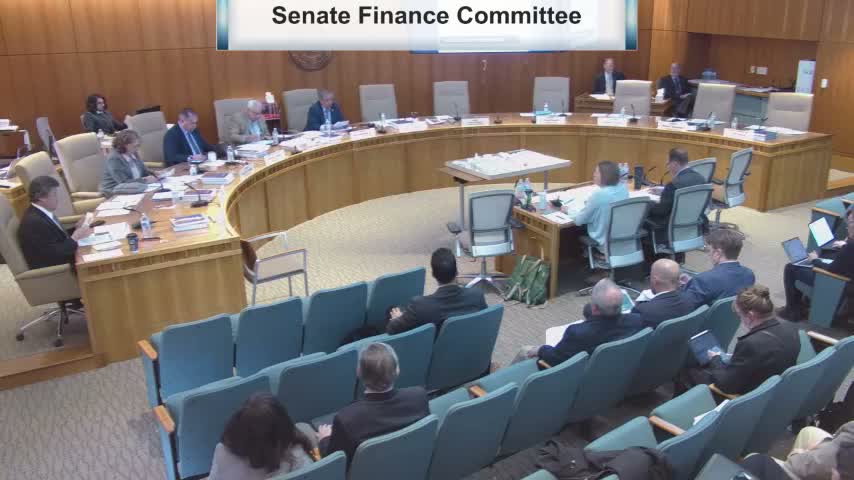
Legislative Finance Committee staff told the Senate Finance Committee on Jan. 27 that roughly $6.7 billion in unspent capital outlay remains tied up across about 5,300 active projects, and urged lawmakers to adopt procedural changes to reduce delays and cost escalation.
"At the end of the second quarter of this fiscal year, we're estimating that total balances are at about $6,700,000,000 across about 5,300 active projects," Kelly Carswell, capital outlay analyst at LFC, said in the committee hearing. Carswell said much of the unspent money is split across several categories: legislative project appropriations, severance tax bond earmarks, the public school capital outlay fund and a package of special appropriations from recent sessions.
Carswell and DFA’s Wesley Billingsley framed the issue as a combination of rapidly rising appropriations and slower-than-expected spending. They told senators that many local projects are small, piecemeal, or insufficiently planned — which increases the risk of delay and partial completion.
To address those problems, Carswell described an LFC‑endorsed bill that would: limit reauthorizations to one extension (keeping the standard extension at two years, which effectively caps a single appropriation at six years for construction projects); permit technical-only reauthorizations that do not change project purpose; establish a 10% encumbrance threshold as a condition for reauthorization; and direct future general‑fund reversions from capital appropriations into a capital development and reserve fund to strengthen long‑term distributions available for appropriation.
Carswell said initial analysis of near‑term reversions finds about $80 million in severance tax bond and general fund appropriations approaching reversion within months and about $120 million for 2027 in the same categories. "Just for severance tax bond and general fund appropriations, that total is about $80,000,000 for stuff that's approaching reversion in about 5 months," she said.
Senators pressed staff on what legislative or administrative behaviors help projects move. Wesley Billingsley, director of DFA’s Infrastructure Planning and Development Division, told the committee timeliness of grant agreements, faster procurement, and realistic pre‑construction design are key. "Getting those out quickly is a big game changer," he said.
Why it matters: committee members noted that cost escalation between request and construction — sometimes 20–25% over a few years — both drives higher final costs and increases the stock of inactive appropriations. LFC recommended strengthening ICIP data, improving legislative vetting and request systems, and maintaining targeted grant programs to fund larger, construction‑ready local projects.
Next steps: staff said they will provide additional analysis of likely reversions and work with the legislature on language for the reauthorization limits and encumbrance threshold. The committee did not vote on any bill during the hearing.
"At the end of the second quarter of this fiscal year, we're estimating that total balances are at about $6,700,000,000 across about 5,300 active projects," Kelly Carswell, capital outlay analyst at LFC, said in the committee hearing. Carswell said much of the unspent money is split across several categories: legislative project appropriations, severance tax bond earmarks, the public school capital outlay fund and a package of special appropriations from recent sessions.
Carswell and DFA’s Wesley Billingsley framed the issue as a combination of rapidly rising appropriations and slower-than-expected spending. They told senators that many local projects are small, piecemeal, or insufficiently planned — which increases the risk of delay and partial completion.
To address those problems, Carswell described an LFC‑endorsed bill that would: limit reauthorizations to one extension (keeping the standard extension at two years, which effectively caps a single appropriation at six years for construction projects); permit technical-only reauthorizations that do not change project purpose; establish a 10% encumbrance threshold as a condition for reauthorization; and direct future general‑fund reversions from capital appropriations into a capital development and reserve fund to strengthen long‑term distributions available for appropriation.
Carswell said initial analysis of near‑term reversions finds about $80 million in severance tax bond and general fund appropriations approaching reversion within months and about $120 million for 2027 in the same categories. "Just for severance tax bond and general fund appropriations, that total is about $80,000,000 for stuff that's approaching reversion in about 5 months," she said.
Senators pressed staff on what legislative or administrative behaviors help projects move. Wesley Billingsley, director of DFA’s Infrastructure Planning and Development Division, told the committee timeliness of grant agreements, faster procurement, and realistic pre‑construction design are key. "Getting those out quickly is a big game changer," he said.
Why it matters: committee members noted that cost escalation between request and construction — sometimes 20–25% over a few years — both drives higher final costs and increases the stock of inactive appropriations. LFC recommended strengthening ICIP data, improving legislative vetting and request systems, and maintaining targeted grant programs to fund larger, construction‑ready local projects.
Next steps: staff said they will provide additional analysis of likely reversions and work with the legislature on language for the reauthorization limits and encumbrance threshold. The committee did not vote on any bill during the hearing.
Don't Miss a Word: See the Full Meeting!
Go beyond summaries. Unlock every video, transcript, and key insight with a Founder Membership.
✓
Get instant access to full meeting videos
✓
Search and clip any phrase from complete transcripts
✓
Receive AI-powered summaries & custom alerts
✓
Enjoy lifetime, unrestricted access to government data
30-day money-back guarantee
