Health Care Authority and AOC outline rollout for behavioral-health reform and $24.4M in early-access awards
January 22, 2026 | Finance, Senate, Committees, Legislative, New Mexico
This article was created by AI summarizing key points discussed. AI makes mistakes, so for full details and context, please refer to the video of the full meeting. Please report any errors so we can fix them. Report an error »
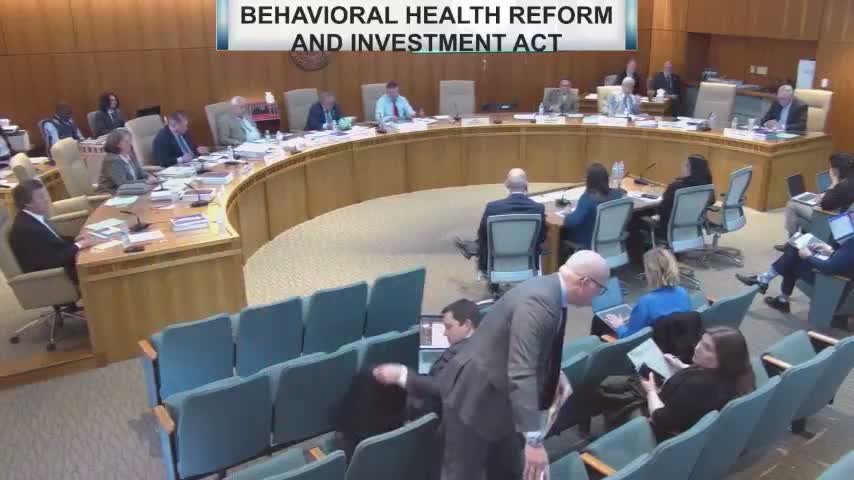
State agencies and university partners provided a detailed briefing on implementing the Behavioral Health Reform and Investment Act (Senate Bill 3), telling the Legislative Finance Committee that regional planning across 13 designated areas is underway and that early-access funding is beginning to flow.
Christy Brooks, director of Behavioral Health Transformation and Innovation at the Health Care Authority, told the committee Senate Bill 3 directs a regional approach: each region may identify up to five behavioral-health priorities and submit plans to a behavioral health executive committee for review. Brooks said the executive committee (which includes HCA, the Administrative Office of the Courts and appointed subject-matter experts) voted Jan. 20 to approve the funding formula that will allocate money across regions based on an equal base allocation and weighted factors including population behavioral-need, service gaps and disproportionate impact.
Brooks said approximately $150 million (she also referenced about $155 million in House Bill 2 appropriations specifically related to regional plans) was earmarked for regional planning and implementation. To speed delivery of time-limited funds, HCA ran an early-access Notice of Funding Opportunity that closed Dec. 19; all 13 regions applied and the executive committee approved awards totaling $24,400,000. Brooks said award letters are expected to go out next week and contracting is planned for February.
Brooks described other SB3 components: a work group on provider licensing and credentialing that met Dec. 16, interoperability work on coordinating 988 crisis lines with 911/PSAPs and mobile crisis teams, and the delivery of behavioral-health service standards and evaluation guidelines to the Administrative Office of the Courts to support regional workshops. She emphasized that House Bill 2 appropriations are intended to create sustainable infrastructure and to complement Medicaid reimbursement rather than replace it.
Nick Bugas, director for Behavioral Health Services at HCA, updated the committee on programs tied to the broader effort. He said the Linkages housing program will serve 553 vouchers after a recent increase; the CCBHC demonstration now covers 10 of 33 counties; 988 has handled more than 120,000 contacts since 2022 with 53,600 in 2025 (73% phone, 10% chat, 17% text) and that about 91% of 988 contacts are resolved by the initial interaction. Bugas also reported OPRE (the Office of Peer Recovery and Engagement) has certified about 950 peers and HCA has funding to support 15 additional staff positions, with hiring underway.
Esperanza Lucero of the Administrative Office of the Courts described the regional planning process, including an enhanced Sequential Intercept Mapping (eSIM) model that adds a pre-intercept/prevention focus and youth system mapping. Lucero said the AOC has active intergovernmental agreements with all 13 regions and increased the accountable-entity planning grant from $45,000 to $60,000 after feedback. Lucero also described technical assistance contracts, fiscal and performance-measure work and an objective for all 13 regional plans to be submitted by June 30.
University of New Mexico and Project ECHO partners described technical-assistance, training and data work: UNM provides Medicaid snapshot analyses and completed several regional workshop reports; Project ECHO is leading peer learning collaboratives and workforce training and plans a March peer-leadership summit.
Committee members raised implementation questions. Senator Gonzales asked why schools were not more commonly listed among regions' top five priorities and sought help engaging districts; presenters said schools were on stakeholder lists and asked legislators to help ensure local attendance. Gonzales also raised recurring local suicides at a Taos bridge; HCA said it has provided mental-health-first-aid trainings and is working to support mobile crisis capacity. Senator Brandt asked about award criteria and performance measures; HCA said applications required performance data and reporting plans. Several members, including the committee chair, cautioned the rollout is highly layered and requested a concise follow-up briefing that lays out measurable outcomes and clearer tracking of where the state is 'moving the needle.'
Next steps: award letters and contracting for early-access funds are expected in the coming weeks; HCA and AOC said they will continue workshops and technical assistance and return to the committee with clearer, condensed progress reports.
Christy Brooks, director of Behavioral Health Transformation and Innovation at the Health Care Authority, told the committee Senate Bill 3 directs a regional approach: each region may identify up to five behavioral-health priorities and submit plans to a behavioral health executive committee for review. Brooks said the executive committee (which includes HCA, the Administrative Office of the Courts and appointed subject-matter experts) voted Jan. 20 to approve the funding formula that will allocate money across regions based on an equal base allocation and weighted factors including population behavioral-need, service gaps and disproportionate impact.
Brooks said approximately $150 million (she also referenced about $155 million in House Bill 2 appropriations specifically related to regional plans) was earmarked for regional planning and implementation. To speed delivery of time-limited funds, HCA ran an early-access Notice of Funding Opportunity that closed Dec. 19; all 13 regions applied and the executive committee approved awards totaling $24,400,000. Brooks said award letters are expected to go out next week and contracting is planned for February.
Brooks described other SB3 components: a work group on provider licensing and credentialing that met Dec. 16, interoperability work on coordinating 988 crisis lines with 911/PSAPs and mobile crisis teams, and the delivery of behavioral-health service standards and evaluation guidelines to the Administrative Office of the Courts to support regional workshops. She emphasized that House Bill 2 appropriations are intended to create sustainable infrastructure and to complement Medicaid reimbursement rather than replace it.
Nick Bugas, director for Behavioral Health Services at HCA, updated the committee on programs tied to the broader effort. He said the Linkages housing program will serve 553 vouchers after a recent increase; the CCBHC demonstration now covers 10 of 33 counties; 988 has handled more than 120,000 contacts since 2022 with 53,600 in 2025 (73% phone, 10% chat, 17% text) and that about 91% of 988 contacts are resolved by the initial interaction. Bugas also reported OPRE (the Office of Peer Recovery and Engagement) has certified about 950 peers and HCA has funding to support 15 additional staff positions, with hiring underway.
Esperanza Lucero of the Administrative Office of the Courts described the regional planning process, including an enhanced Sequential Intercept Mapping (eSIM) model that adds a pre-intercept/prevention focus and youth system mapping. Lucero said the AOC has active intergovernmental agreements with all 13 regions and increased the accountable-entity planning grant from $45,000 to $60,000 after feedback. Lucero also described technical assistance contracts, fiscal and performance-measure work and an objective for all 13 regional plans to be submitted by June 30.
University of New Mexico and Project ECHO partners described technical-assistance, training and data work: UNM provides Medicaid snapshot analyses and completed several regional workshop reports; Project ECHO is leading peer learning collaboratives and workforce training and plans a March peer-leadership summit.
Committee members raised implementation questions. Senator Gonzales asked why schools were not more commonly listed among regions' top five priorities and sought help engaging districts; presenters said schools were on stakeholder lists and asked legislators to help ensure local attendance. Gonzales also raised recurring local suicides at a Taos bridge; HCA said it has provided mental-health-first-aid trainings and is working to support mobile crisis capacity. Senator Brandt asked about award criteria and performance measures; HCA said applications required performance data and reporting plans. Several members, including the committee chair, cautioned the rollout is highly layered and requested a concise follow-up briefing that lays out measurable outcomes and clearer tracking of where the state is 'moving the needle.'
Next steps: award letters and contracting for early-access funds are expected in the coming weeks; HCA and AOC said they will continue workshops and technical assistance and return to the committee with clearer, condensed progress reports.
View the Full Meeting & All Its Details
This article offers just a summary. Unlock complete video, transcripts, and insights as a Founder Member.
✓
Watch full, unedited meeting videos
✓
Search every word spoken in unlimited transcripts
✓
AI summaries & real-time alerts (all government levels)
✓
Permanent access to expanding government content
30-day money-back guarantee
