Lawmakers debate tougher penalties for felons with guns as officials point to system saturation
January 26, 2026 | Judiciary, Senate, Committees, Legislative, New Mexico
This article was created by AI summarizing key points discussed. AI makes mistakes, so for full details and context, please refer to the video of the full meeting. Please report any errors so we can fix them. Report an error »
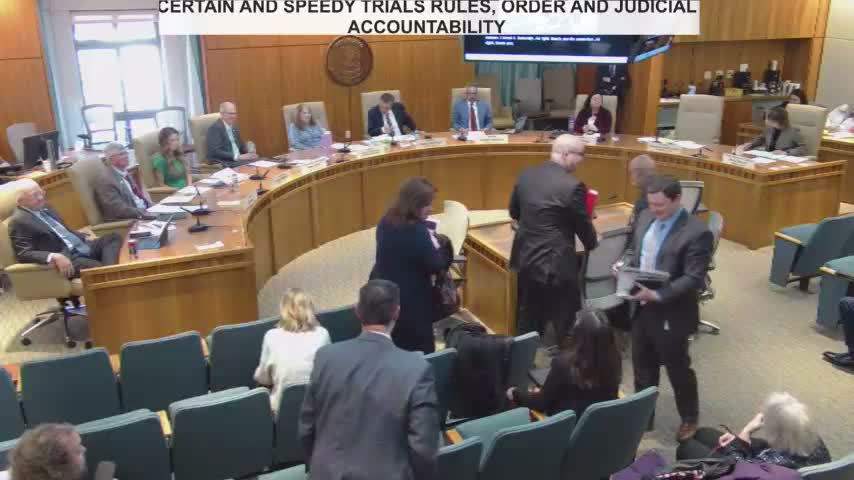
The Senate Judiciary Committee heard competing perspectives on proposals to increase penalties for "felon in possession" offenses as the governor's office and criminal‑justice experts described both the scale of the problem and the constraints of court and jail capacity.
Ben Baker, speaking for the governor, told the committee he expects legislation this session that will seek tougher sentences for people who repeatedly possess firearms after felony convictions. "As we sit here this afternoon, there are over 4,700 outstanding felony warrants," Baker said, using that figure to illustrate the saturation of local justice systems and the limited detention capacity in larger counties.
Kim Chavez Cook, who briefed the committee on sentencing mechanics and data, said the crime of felon in possession is technically nonviolent and that when it is the lead charge most defendants have nonviolent prior felonies. "When someone is committing the crime of felon in possession by using it, they are also committing another crime," she said, explaining how enhancements and habitual‑offender rules can stack and produce very long total sentences when gun use accompanies another offense.
Chavez Cook cited sentencing‑commission data: in 2024 there were 516 cases where felon in possession was the top charge; those cases do not all dispose within the year, but her office estimates roughly 30% of those top‑charge cases resulted in convictions in the short run and a large share (she estimated 60–70%) were dismissed or otherwise not disposed that year. She warned senators that the legislature has amended the statute multiple times in recent years (noting changes in 2019 and again in 2022) and that frequent statutory shifts can create prosecutorial and procedural confusion.
Senators pressed whether the problem is insufficient laws or gaps in enforcement and system capacity. Committee members suggested options ranging from increasing funding for forensic labs and data systems to targeted statutory increases for repeat offenders. Baker and others signaled bills that could raise the degree of the offense for some felon‑in‑possession instances and add higher penalties for repeat offenders; one proposal discussed would elevate the offense in some circumstances to a second‑degree felony so judges could impose longer sentences.
The committee did not vote. Several senators asked the Legislative Finance Committee and prosecutors' offices for deeper data on why dismissals occur in specific districts and for information on how many dismissed matters are refiled and ultimately prosecuted. Senators also requested follow‑up hearings to examine the interplay of sentencing changes, prosecution practices, and system capacity before moving forward on mandatory minimums or removing judicial discretion.
Ben Baker, speaking for the governor, told the committee he expects legislation this session that will seek tougher sentences for people who repeatedly possess firearms after felony convictions. "As we sit here this afternoon, there are over 4,700 outstanding felony warrants," Baker said, using that figure to illustrate the saturation of local justice systems and the limited detention capacity in larger counties.
Kim Chavez Cook, who briefed the committee on sentencing mechanics and data, said the crime of felon in possession is technically nonviolent and that when it is the lead charge most defendants have nonviolent prior felonies. "When someone is committing the crime of felon in possession by using it, they are also committing another crime," she said, explaining how enhancements and habitual‑offender rules can stack and produce very long total sentences when gun use accompanies another offense.
Chavez Cook cited sentencing‑commission data: in 2024 there were 516 cases where felon in possession was the top charge; those cases do not all dispose within the year, but her office estimates roughly 30% of those top‑charge cases resulted in convictions in the short run and a large share (she estimated 60–70%) were dismissed or otherwise not disposed that year. She warned senators that the legislature has amended the statute multiple times in recent years (noting changes in 2019 and again in 2022) and that frequent statutory shifts can create prosecutorial and procedural confusion.
Senators pressed whether the problem is insufficient laws or gaps in enforcement and system capacity. Committee members suggested options ranging from increasing funding for forensic labs and data systems to targeted statutory increases for repeat offenders. Baker and others signaled bills that could raise the degree of the offense for some felon‑in‑possession instances and add higher penalties for repeat offenders; one proposal discussed would elevate the offense in some circumstances to a second‑degree felony so judges could impose longer sentences.
The committee did not vote. Several senators asked the Legislative Finance Committee and prosecutors' offices for deeper data on why dismissals occur in specific districts and for information on how many dismissed matters are refiled and ultimately prosecuted. Senators also requested follow‑up hearings to examine the interplay of sentencing changes, prosecution practices, and system capacity before moving forward on mandatory minimums or removing judicial discretion.
View the Full Meeting & All Its Details
This article offers just a summary. Unlock complete video, transcripts, and insights as a Founder Member.
✓
Watch full, unedited meeting videos
✓
Search every word spoken in unlimited transcripts
✓
AI summaries & real-time alerts (all government levels)
✓
Permanent access to expanding government content
30-day money-back guarantee
