Bill to let sewer districts use first-class mail sparks split in committee
January 21, 2026 | 2026 Legislature MO, Missouri
This article was created by AI summarizing key points discussed. AI makes mistakes, so for full details and context, please refer to the video of the full meeting. Please report any errors so we can fix them. Report an error »
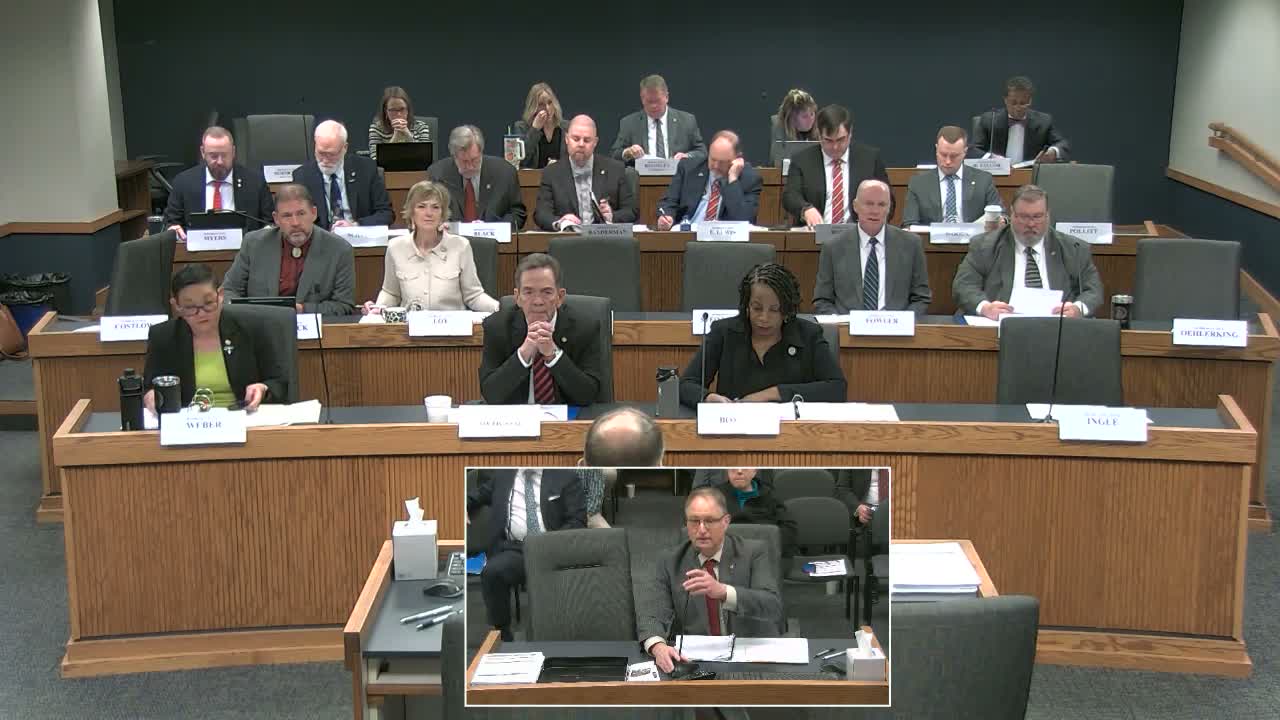
Representative John Martin (District 44) introduced House Bill 2000 to allow a public sewer district to use first-class mail, rather than certified mail, to notify customers of unpaid sewer charges before disconnecting service. Martin said the change would save districts and customers money and improve the effectiveness of notice because many certified letters go unclaimed.
"This bill allows for notification by first class mail," Martin said, arguing first-class mail can be tracked and costs substantially less than certified mail. He said it would create a level playing field between sewer and associated water districts that currently use first-class notice.
Supporters included district officials who testified that shifting to first-class mail reduces per-letter costs and staff time. Don Daniel, district administrator for Rock Creek Public Sewer District and president of the Missouri Association of Sewer Districts, said certified-mail charges are added to customers' accounts and estimated his district sends hundreds of certified letters each quarter; changing to first-class would save customers money and district staff time.
Opponents focused on consumer-protection concerns. Jeanette Monoxford, board president of the Consumer Council of Missouri, said utilities are social determinants of health and that certified notice functions as an alarm for households in crisis. "The certified veil is an important alarm system," Monoxford said, arguing that people in crisis are less likely to open regular mail and that certified notice better communicates urgency. She also described postal-service reliability problems she has observed.
Committee members pressed witnesses on operational details: whether first-class tracking is free or an optional paid service, how many certified letters go unclaimed (witnesses estimated 90% returned in some districts), and what "disconnecting" sewer service entails. Witnesses and members clarified that many sewer districts contract with local water providers under statute (cited by witnesses) to shut off water service after extended arrears, that lien notices are typically filed with counties (and not necessarily sent by certified mail), and that actual disconnect costs vary by district.
The committee closed the hearing on HB2000 without a recorded committee vote on the measure. The chair asked sponsors and staff to confirm technical drafting items (tracking language and statutory references) for possible revisions.
"This bill allows for notification by first class mail," Martin said, arguing first-class mail can be tracked and costs substantially less than certified mail. He said it would create a level playing field between sewer and associated water districts that currently use first-class notice.
Supporters included district officials who testified that shifting to first-class mail reduces per-letter costs and staff time. Don Daniel, district administrator for Rock Creek Public Sewer District and president of the Missouri Association of Sewer Districts, said certified-mail charges are added to customers' accounts and estimated his district sends hundreds of certified letters each quarter; changing to first-class would save customers money and district staff time.
Opponents focused on consumer-protection concerns. Jeanette Monoxford, board president of the Consumer Council of Missouri, said utilities are social determinants of health and that certified notice functions as an alarm for households in crisis. "The certified veil is an important alarm system," Monoxford said, arguing that people in crisis are less likely to open regular mail and that certified notice better communicates urgency. She also described postal-service reliability problems she has observed.
Committee members pressed witnesses on operational details: whether first-class tracking is free or an optional paid service, how many certified letters go unclaimed (witnesses estimated 90% returned in some districts), and what "disconnecting" sewer service entails. Witnesses and members clarified that many sewer districts contract with local water providers under statute (cited by witnesses) to shut off water service after extended arrears, that lien notices are typically filed with counties (and not necessarily sent by certified mail), and that actual disconnect costs vary by district.
The committee closed the hearing on HB2000 without a recorded committee vote on the measure. The chair asked sponsors and staff to confirm technical drafting items (tracking language and statutory references) for possible revisions.
View the Full Meeting & All Its Details
This article offers just a summary. Unlock complete video, transcripts, and insights as a Founder Member.
✓
Watch full, unedited meeting videos
✓
Search every word spoken in unlimited transcripts
✓
AI summaries & real-time alerts (all government levels)
✓
Permanent access to expanding government content
30-day money-back guarantee
