Lengthy hearing on HB 2776: advocates tout AAS teacher pathway, higher education urges caution
January 21, 2026 | 2026 Legislature MO, Missouri
This article was created by AI summarizing key points discussed. AI makes mistakes, so for full details and context, please refer to the video of the full meeting. Please report any errors so we can fix them. Report an error »
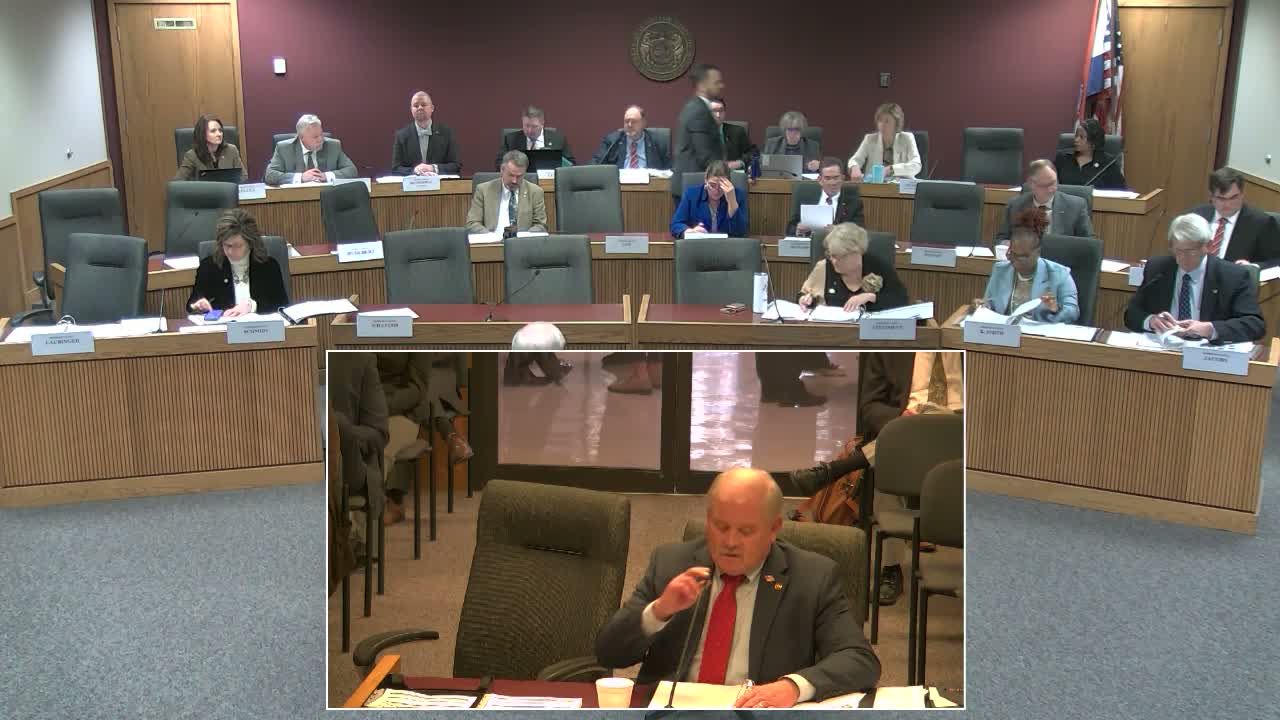
The House Elementary and Secondary Education Committee held an extended hearing on House Bill 2776, a proposal to create an Associate of Applied Science (AAS) pathway that would qualify graduates for a temporary two-year teaching authorization. Representative Willard Haley, sponsor of the bill, framed the AAS route as an additional pathway intended for career changers, veterans and others who cannot complete a traditional four-year program, and cited statewide shortages: he said roughly 6–10% of classrooms are staffed by substitutes, retired teachers, or teachers without full credentials.
Haley described the proposed AAS as a 60-credit-hour program with at least 45 credits concentrated in pedagogy and supervised field experience; AAS graduates would be hired with temporary authorization and paired with mentors for two years with the expectation of continued progression toward a bachelor’s degree and full certification. He said community colleges and DESE would collaborate on curriculum and that districts would not be compelled to hire from the pathway.
Proponents included community-college leaders such as Brent Bates (State Fair Community College) and Brian Milner (Missouri Community College Association), and district superintendents such as Jared Wheeler, who emphasized rural shortages, recruitment, retention and reduced student debt if local students can stay and train close to home. Supporters urged the committee to consider the AAS as one tool among others (apprenticeships, grow-your-own programs, alternative certification).
Opponents included representatives of Missouri State University and other educator-preparation programs (Barry Tiegler, Paul Wagner, and Tim Wall). They cautioned the committee that a two-year credential risks insufficient content and pedagogical preparation—especially for elementary teachers who cover all content areas—and could place heavy mentoring and resource burdens on districts that lack capacity. Higher-education witnesses urged using or expanding existing models (paraprofessional pathways, apprenticeships, Fast Track grants, 2+2 transfer arrangements) rather than creating a lower-preparation track that could undercut existing programs.
Committee discussion covered potential pay differentials, whether a distinct certification label should be used (so candidates are not conflated with fully licensed teachers), how mentorship and progression to a bachelor’s degree would be monitored, and how the pathway would interface with teacher-retirement/PSRS and salary schedules. Witnesses suggested multiple possible improvements, including guaranteed pathways for AAS credits to transfer to bachelor's degrees, salary minimums to attract candidates, and limits or timelines to encourage progress toward a bachelor’s degree.
Chair closed the hearing after hearing pro and con testimony and acknowledging the complexity of certification, workforce and quality concerns. No committee vote on HB 2776 was recorded in the hearing transcript; members asked for further collaboration among community colleges, four-year institutions and DESE.
Haley described the proposed AAS as a 60-credit-hour program with at least 45 credits concentrated in pedagogy and supervised field experience; AAS graduates would be hired with temporary authorization and paired with mentors for two years with the expectation of continued progression toward a bachelor’s degree and full certification. He said community colleges and DESE would collaborate on curriculum and that districts would not be compelled to hire from the pathway.
Proponents included community-college leaders such as Brent Bates (State Fair Community College) and Brian Milner (Missouri Community College Association), and district superintendents such as Jared Wheeler, who emphasized rural shortages, recruitment, retention and reduced student debt if local students can stay and train close to home. Supporters urged the committee to consider the AAS as one tool among others (apprenticeships, grow-your-own programs, alternative certification).
Opponents included representatives of Missouri State University and other educator-preparation programs (Barry Tiegler, Paul Wagner, and Tim Wall). They cautioned the committee that a two-year credential risks insufficient content and pedagogical preparation—especially for elementary teachers who cover all content areas—and could place heavy mentoring and resource burdens on districts that lack capacity. Higher-education witnesses urged using or expanding existing models (paraprofessional pathways, apprenticeships, Fast Track grants, 2+2 transfer arrangements) rather than creating a lower-preparation track that could undercut existing programs.
Committee discussion covered potential pay differentials, whether a distinct certification label should be used (so candidates are not conflated with fully licensed teachers), how mentorship and progression to a bachelor’s degree would be monitored, and how the pathway would interface with teacher-retirement/PSRS and salary schedules. Witnesses suggested multiple possible improvements, including guaranteed pathways for AAS credits to transfer to bachelor's degrees, salary minimums to attract candidates, and limits or timelines to encourage progress toward a bachelor’s degree.
Chair closed the hearing after hearing pro and con testimony and acknowledging the complexity of certification, workforce and quality concerns. No committee vote on HB 2776 was recorded in the hearing transcript; members asked for further collaboration among community colleges, four-year institutions and DESE.
View the Full Meeting & All Its Details
This article offers just a summary. Unlock complete video, transcripts, and insights as a Founder Member.
✓
Watch full, unedited meeting videos
✓
Search every word spoken in unlimited transcripts
✓
AI summaries & real-time alerts (all government levels)
✓
Permanent access to expanding government content
30-day money-back guarantee
