Local volunteers warn fuel-break work must be funded and maintained; estimate $1.5 million a year to sustain progress
November 22, 2025 | Calaveras County, California
This article was created by AI summarizing key points discussed. AI makes mistakes, so for full details and context, please refer to the video of the full meeting. Please report any errors so we can fix them. Report an error »
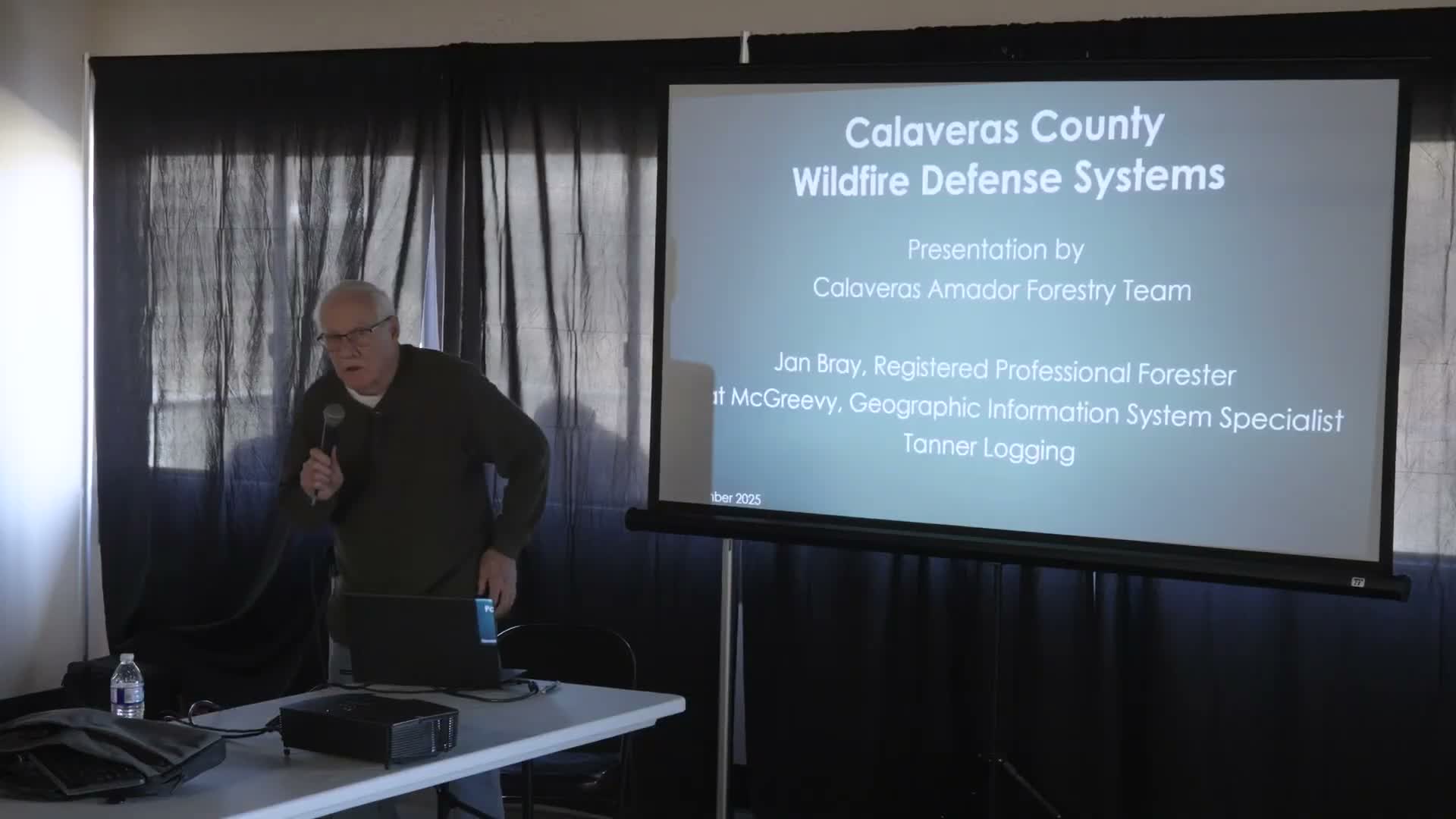
Pat Ruby, a member of a Calaveras County forest-team volunteer group, presented results from local fuel-break and restoration projects and warned that the initial treatments require rapid follow-up or the work will be lost to regrowth.
Ruby summarized historical fire patterns in Calaveras County, outlined the toolbox of treatments (logging, mastication, chipping, piling/burns, herbicide and grazing) and described before-and-after examples. He said the county's Highway 4 corridor projects aim to protect roughly 8,500 structures at build-out and estimated the expected completion date for planned corridor work as 2028 (which he called "way too optimistic"). He gave maintenance math: if 10,000 acres are in place at build-out and maintenance occurs on a 10-year cycle, the county must treat about 1,000 acres per year.
Ruby provided cost figures and treatment prescriptions: "…we could, get the job done for, 1000 dollars an acre to come back and masticate again," he said, and later stated a maintenance burden of roughly $1,500,000 per year for Calaveras County's fuel breaks unless maintenance prescriptions or funding models change.
He stressed changing prescriptions to include earlier spot herbicide treatments and other low-cost follow-ups, and highlighted local examples where private landowners used grazing and careful maintenance to keep treated parcels functional. As an example, Ruby described a vineyard treated with goats: "They have a 145 goats… the grass the goats have eaten the grass so thin that it won't carry a fire anymore," which he said helped the property survive a nearby wildfire.
Ruby argued the grant-to-contractor pipeline is too slow for maintenance: environmental review and contracting can take years while regrowth returns quickly. He urged the county to consider pooled maintenance funds or faster, locally controlled maintenance mechanisms and noted he was working with the county on that concept.
The presentation closed with a call for maintenance programs designed for quick response and practical prescriptions that prioritize long-term functionality of fuel breaks.
Ruby summarized historical fire patterns in Calaveras County, outlined the toolbox of treatments (logging, mastication, chipping, piling/burns, herbicide and grazing) and described before-and-after examples. He said the county's Highway 4 corridor projects aim to protect roughly 8,500 structures at build-out and estimated the expected completion date for planned corridor work as 2028 (which he called "way too optimistic"). He gave maintenance math: if 10,000 acres are in place at build-out and maintenance occurs on a 10-year cycle, the county must treat about 1,000 acres per year.
Ruby provided cost figures and treatment prescriptions: "…we could, get the job done for, 1000 dollars an acre to come back and masticate again," he said, and later stated a maintenance burden of roughly $1,500,000 per year for Calaveras County's fuel breaks unless maintenance prescriptions or funding models change.
He stressed changing prescriptions to include earlier spot herbicide treatments and other low-cost follow-ups, and highlighted local examples where private landowners used grazing and careful maintenance to keep treated parcels functional. As an example, Ruby described a vineyard treated with goats: "They have a 145 goats… the grass the goats have eaten the grass so thin that it won't carry a fire anymore," which he said helped the property survive a nearby wildfire.
Ruby argued the grant-to-contractor pipeline is too slow for maintenance: environmental review and contracting can take years while regrowth returns quickly. He urged the county to consider pooled maintenance funds or faster, locally controlled maintenance mechanisms and noted he was working with the county on that concept.
The presentation closed with a call for maintenance programs designed for quick response and practical prescriptions that prioritize long-term functionality of fuel breaks.
View the Full Meeting & All Its Details
This article offers just a summary. Unlock complete video, transcripts, and insights as a Founder Member.
✓
Watch full, unedited meeting videos
✓
Search every word spoken in unlimited transcripts
✓
AI summaries & real-time alerts (all government levels)
✓
Permanent access to expanding government content
30-day money-back guarantee
