Michigan panel reviews $173 million federal rural health award and how it will be spent
January 22, 2026 | 2025-2026 House Legislature MI, Michigan
This article was created by AI summarizing key points discussed. AI makes mistakes, so for full details and context, please refer to the video of the full meeting. Please report any errors so we can fix them. Report an error »
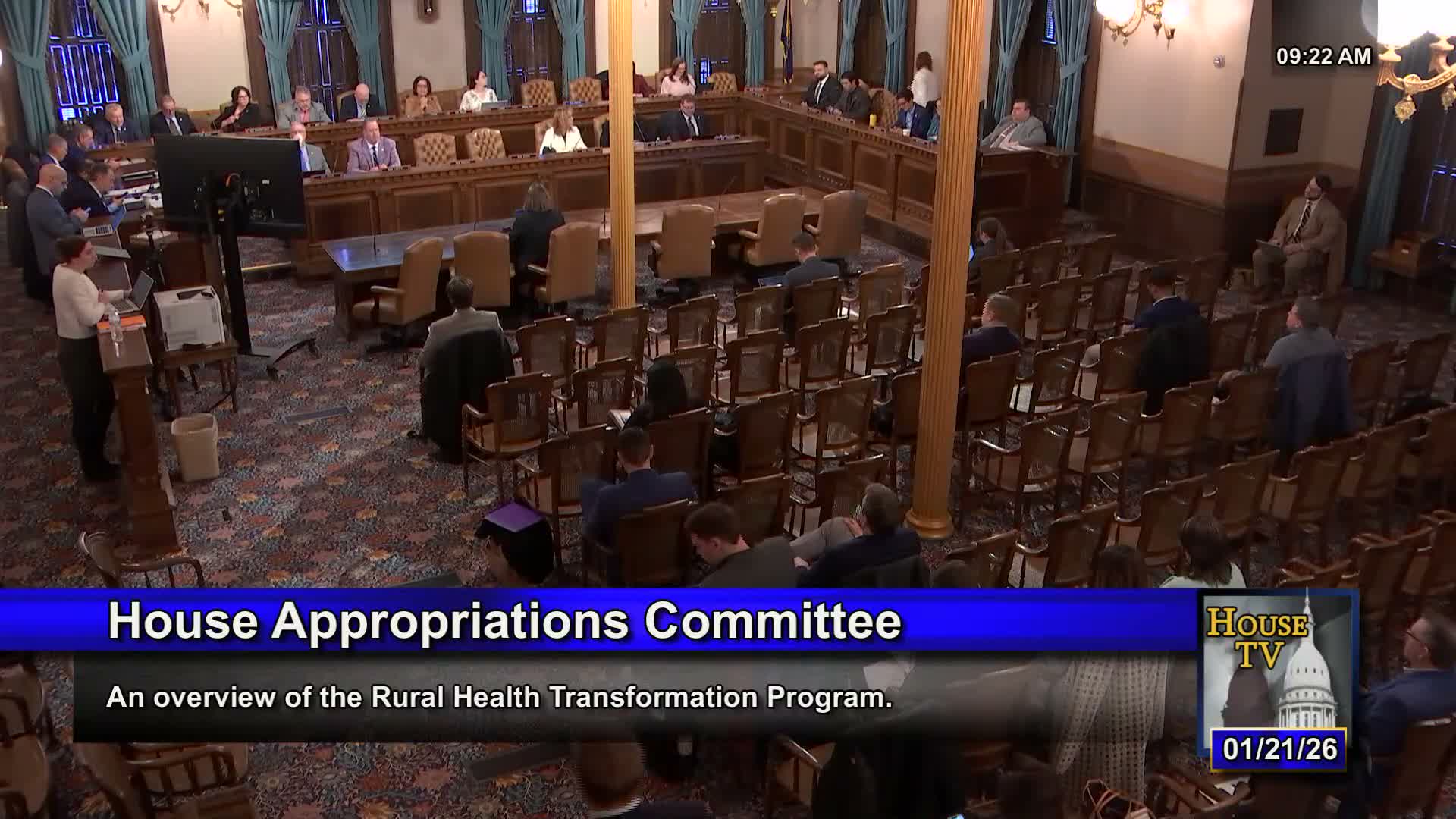
Michigan Department of Health and Human Services officials told a House Appropriations Committee hearing on Jan. 21 that the state received a first‑year award of federal Rural Health Transformation funding and described how it plans to use the money to bolster care in rural communities.
"We received $173,128,201 for our first year of this program," said Beth Nagel, senior deputy director of policy, planning and operational support at MDHHS, during a presentation that summarized CMS guidance, the state application process and proposed program goals. Nagel said the federal program sets five policy areas — prevention and chronic‑disease work, sustainable access, workforce development, innovative care models and technology — and that grants must support new or transformative programs rather than duplicate Medicaid services.
The House Fiscal Agency’s briefing table lists the award as $173,100,000 and notes that Michigan’s award is lower than the state’s application, requiring a revised budget submission to CMS. The HFA told the committee that CMS distributed an initial national pool of $10 billion for the first year as part of a $50 billion, five‑year program.
Why it matters: Committee members said the distribution method and program design will determine whether money reaches small hospitals, community health centers, tribal partners and other rural providers that lack grant‑writing resources. Several members urged MDHHS to prioritize fully rural census tracts and to provide clear timelines for contracting and awards.
What officials proposed: Nagel outlined four focus initiatives in Michigan’s application: transforming rural health through partnerships, a "Workforce for Wellness" recruitment and retention initiative, interoperability and technology investments to reduce duplicative services, and a "Care Closer to Home Blueprint" to build community‑based care pathways. She also said the state carved out 5% of the award specifically for tribal governments following consultation.
On administrative costs and end‑user share: Nagel and HFA staff reiterated that CMS imposed a 10% cap on administrative and indirect expenses. "There is a 10% cap on administrative and indirect," Nagel said, adding that the CMS design intends the bulk of funds to support direct initiatives though MDHHS cannot yet give a firm dollar amount that will reach local providers.
Provider concerns: Ben Frederick of Memorial Healthcare, speaking for a rural hospital perspective, urged the committee to protect funding for immediate stabilization (for example obstetrics and anesthesia coverage) and criticized the state application for emphasizing new administrative infrastructure and competitive grant models over direct stabilization payments. "This outcome, I believe, misses the mark related to prevention of further hospital closure and economic instability," Frederick said, noting long‑standing structural disadvantages at independent rural hospitals.
Behavioral‑health and community clinic views: Alan Bolter of the Community Mental Health Association and Philip Bergquist of the Michigan Primary Care Association both urged reduced administrative burdens, stronger workforce pipelines (stipends, scholarships and practice commitments) and investments in interoperable electronic health records and telehealth to extend access.
Next steps: MDHHS told the committee it will seek CMS budget approval before releasing solicitations and estimated that contracting and award lists will likely be ready in the second quarter, while acknowledging dates are not firm. Ken Dell of the House Fiscal Agency said because the award was smaller than the state’s application the department must submit a revised budget to CMS.
The committee did not take final votes on program design during the hearing; members signaled intent to continue oversight and to coordinate with appropriations staff on next steps.
"We received $173,128,201 for our first year of this program," said Beth Nagel, senior deputy director of policy, planning and operational support at MDHHS, during a presentation that summarized CMS guidance, the state application process and proposed program goals. Nagel said the federal program sets five policy areas — prevention and chronic‑disease work, sustainable access, workforce development, innovative care models and technology — and that grants must support new or transformative programs rather than duplicate Medicaid services.
The House Fiscal Agency’s briefing table lists the award as $173,100,000 and notes that Michigan’s award is lower than the state’s application, requiring a revised budget submission to CMS. The HFA told the committee that CMS distributed an initial national pool of $10 billion for the first year as part of a $50 billion, five‑year program.
Why it matters: Committee members said the distribution method and program design will determine whether money reaches small hospitals, community health centers, tribal partners and other rural providers that lack grant‑writing resources. Several members urged MDHHS to prioritize fully rural census tracts and to provide clear timelines for contracting and awards.
What officials proposed: Nagel outlined four focus initiatives in Michigan’s application: transforming rural health through partnerships, a "Workforce for Wellness" recruitment and retention initiative, interoperability and technology investments to reduce duplicative services, and a "Care Closer to Home Blueprint" to build community‑based care pathways. She also said the state carved out 5% of the award specifically for tribal governments following consultation.
On administrative costs and end‑user share: Nagel and HFA staff reiterated that CMS imposed a 10% cap on administrative and indirect expenses. "There is a 10% cap on administrative and indirect," Nagel said, adding that the CMS design intends the bulk of funds to support direct initiatives though MDHHS cannot yet give a firm dollar amount that will reach local providers.
Provider concerns: Ben Frederick of Memorial Healthcare, speaking for a rural hospital perspective, urged the committee to protect funding for immediate stabilization (for example obstetrics and anesthesia coverage) and criticized the state application for emphasizing new administrative infrastructure and competitive grant models over direct stabilization payments. "This outcome, I believe, misses the mark related to prevention of further hospital closure and economic instability," Frederick said, noting long‑standing structural disadvantages at independent rural hospitals.
Behavioral‑health and community clinic views: Alan Bolter of the Community Mental Health Association and Philip Bergquist of the Michigan Primary Care Association both urged reduced administrative burdens, stronger workforce pipelines (stipends, scholarships and practice commitments) and investments in interoperable electronic health records and telehealth to extend access.
Next steps: MDHHS told the committee it will seek CMS budget approval before releasing solicitations and estimated that contracting and award lists will likely be ready in the second quarter, while acknowledging dates are not firm. Ken Dell of the House Fiscal Agency said because the award was smaller than the state’s application the department must submit a revised budget to CMS.
The committee did not take final votes on program design during the hearing; members signaled intent to continue oversight and to coordinate with appropriations staff on next steps.
View the Full Meeting & All Its Details
This article offers just a summary. Unlock complete video, transcripts, and insights as a Founder Member.
✓
Watch full, unedited meeting videos
✓
Search every word spoken in unlimited transcripts
✓
AI summaries & real-time alerts (all government levels)
✓
Permanent access to expanding government content
30-day money-back guarantee
