Committee hears broad support and questions for bill to dedicate license revenue to Michigan fisheries
January 22, 2026 | 2025-2026 House Legislature MI, Michigan
This article was created by AI summarizing key points discussed. AI makes mistakes, so for full details and context, please refer to the video of the full meeting. Please report any errors so we can fix them. Report an error »
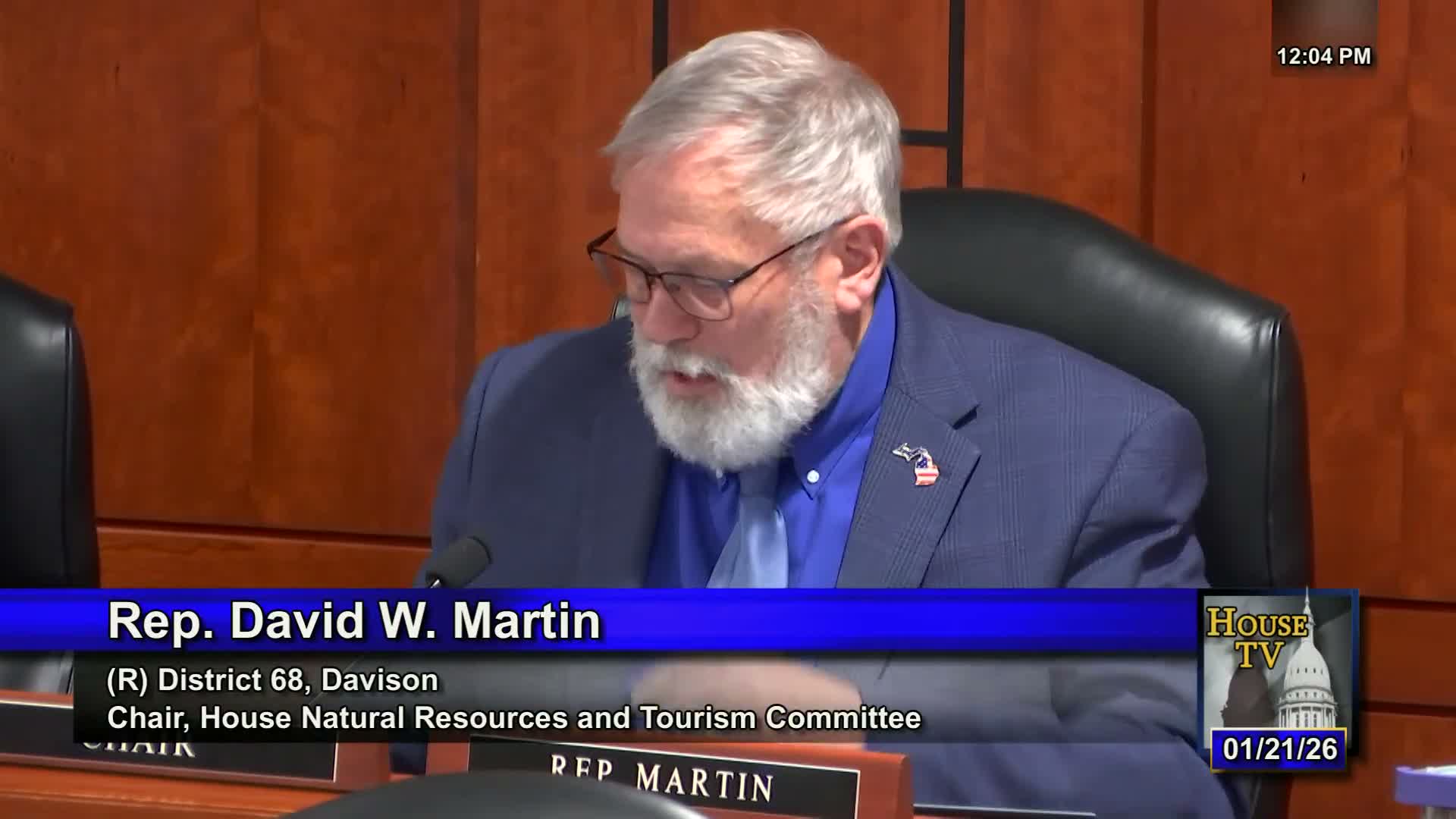
Representative VanderWaal introduced House Bill 5093 to the House Natural Resources and Tourism Committee, saying the bill would create a stable, dedicated funding model for Michigan fisheries by directing fishing license revenue to fisheries programs, adding a $3 license increase and a $5 hatchery stamp, and establishing an anglers-based fisheries oversight committee.
The bill’s sponsor framed the measure as a response to long-standing funding shortfalls. "For years, our fisheries have been underfunded," Representative VanderWaal said, saying the proposal would spend license dollars on stocking, habitat restoration, invasive-species control and hatchery maintenance. He described the changes as modest adjustments rather than a major new tax.
Why it matters: Supporters told committee members that healthy fisheries underpin recreation and local economies. Mark Williams, who spoke as a statewide anglers’ representative, told the panel that Michigan’s sport-fishery sector supports roughly $4 billion in economic activity and that hatchery infrastructure and staffing have declined over decades. "We are number 7 in the U.S. for number of angler licenses," Williams said during testimony in support of the bill. Witnesses estimated the $5 hatchery stamp could generate several million dollars annually, though they acknowledged that exact figures depend on license breakdowns and how Great Lakes versus inland anglers are counted.
DNR officials generally expressed conditional support but flagged technical concerns. Taylor Ritterbush, chief of staff for the Department of Natural Resources, said the department agrees with much of the bill’s goal but cautioned that license receipts currently fund shared services across fisheries and wildlife divisions, including licensing software, law enforcement and marketing. "There are shared expenses that go into the same pot," Ritterbush said, urging the committee to ensure shared administrative costs are accounted for if fisheries funds are separated. Randy Claremont, fisheries chief, said Michigan currently rears about 20 million fish annually, down from about 40 million historically, and described staffing shortfalls that limit survey and management capacity.
Lawmakers pressed sponsors and agency witnesses on several specifics. Representative Preston, drawing on prior experience as a license retailer, said a required youth license could deter participation and warned that seniors on fixed incomes could be harmed by steeper discounts being reduced; Preston cited four studies he said showed youth licenses sometimes depress recruitment. Representative Hoadley asked for guardrails to prevent the fisheries director or an oversight body from supplanting legislative authority; sponsors said they intend legislative oversight to remain and offered to refine language.
Several members sought more precise numbers and design details. Representative Altman asked for a current breakdown of where a license dollar goes; the sponsor gave an approximate figure that about 60–64% now flows to fisheries but deferred to departmental experts for exact accounting. Witnesses and DNR staff acknowledged that the department does not currently separate some categories (for example, Great Lakes-specific anglers) in a way that produces definitive revenue estimates, and agreed to follow up with more detailed figures.
No formal vote was taken on HB 5093 at the hearing. The committee accepted written testimony into the record from additional supporters and scheduled follow-up committee work for Jan. 28. Representatives also approved routine minutes and a motion to excuse absent members by unanimous consent.
What’s next: DNR and stakeholders will provide more detailed revenue estimates and proposed statutory language addressing shared administrative costs and oversight composition. The committee plans to reconvene on Jan. 28 to continue consideration of the proposal.
The bill’s sponsor framed the measure as a response to long-standing funding shortfalls. "For years, our fisheries have been underfunded," Representative VanderWaal said, saying the proposal would spend license dollars on stocking, habitat restoration, invasive-species control and hatchery maintenance. He described the changes as modest adjustments rather than a major new tax.
Why it matters: Supporters told committee members that healthy fisheries underpin recreation and local economies. Mark Williams, who spoke as a statewide anglers’ representative, told the panel that Michigan’s sport-fishery sector supports roughly $4 billion in economic activity and that hatchery infrastructure and staffing have declined over decades. "We are number 7 in the U.S. for number of angler licenses," Williams said during testimony in support of the bill. Witnesses estimated the $5 hatchery stamp could generate several million dollars annually, though they acknowledged that exact figures depend on license breakdowns and how Great Lakes versus inland anglers are counted.
DNR officials generally expressed conditional support but flagged technical concerns. Taylor Ritterbush, chief of staff for the Department of Natural Resources, said the department agrees with much of the bill’s goal but cautioned that license receipts currently fund shared services across fisheries and wildlife divisions, including licensing software, law enforcement and marketing. "There are shared expenses that go into the same pot," Ritterbush said, urging the committee to ensure shared administrative costs are accounted for if fisheries funds are separated. Randy Claremont, fisheries chief, said Michigan currently rears about 20 million fish annually, down from about 40 million historically, and described staffing shortfalls that limit survey and management capacity.
Lawmakers pressed sponsors and agency witnesses on several specifics. Representative Preston, drawing on prior experience as a license retailer, said a required youth license could deter participation and warned that seniors on fixed incomes could be harmed by steeper discounts being reduced; Preston cited four studies he said showed youth licenses sometimes depress recruitment. Representative Hoadley asked for guardrails to prevent the fisheries director or an oversight body from supplanting legislative authority; sponsors said they intend legislative oversight to remain and offered to refine language.
Several members sought more precise numbers and design details. Representative Altman asked for a current breakdown of where a license dollar goes; the sponsor gave an approximate figure that about 60–64% now flows to fisheries but deferred to departmental experts for exact accounting. Witnesses and DNR staff acknowledged that the department does not currently separate some categories (for example, Great Lakes-specific anglers) in a way that produces definitive revenue estimates, and agreed to follow up with more detailed figures.
No formal vote was taken on HB 5093 at the hearing. The committee accepted written testimony into the record from additional supporters and scheduled follow-up committee work for Jan. 28. Representatives also approved routine minutes and a motion to excuse absent members by unanimous consent.
What’s next: DNR and stakeholders will provide more detailed revenue estimates and proposed statutory language addressing shared administrative costs and oversight composition. The committee plans to reconvene on Jan. 28 to continue consideration of the proposal.
View the Full Meeting & All Its Details
This article offers just a summary. Unlock complete video, transcripts, and insights as a Founder Member.
✓
Watch full, unedited meeting videos
✓
Search every word spoken in unlimited transcripts
✓
AI summaries & real-time alerts (all government levels)
✓
Permanent access to expanding government content
30-day money-back guarantee
