Lawmakers weigh broad 'Shield' drone package: no‑drone zones, geofencing, registry, and limited mitigation authority
January 26, 2026 | 2025-2026 House Legislature MI, Michigan
This article was created by AI summarizing key points discussed. AI makes mistakes, so for full details and context, please refer to the video of the full meeting. Please report any errors so we can fix them. Report an error »
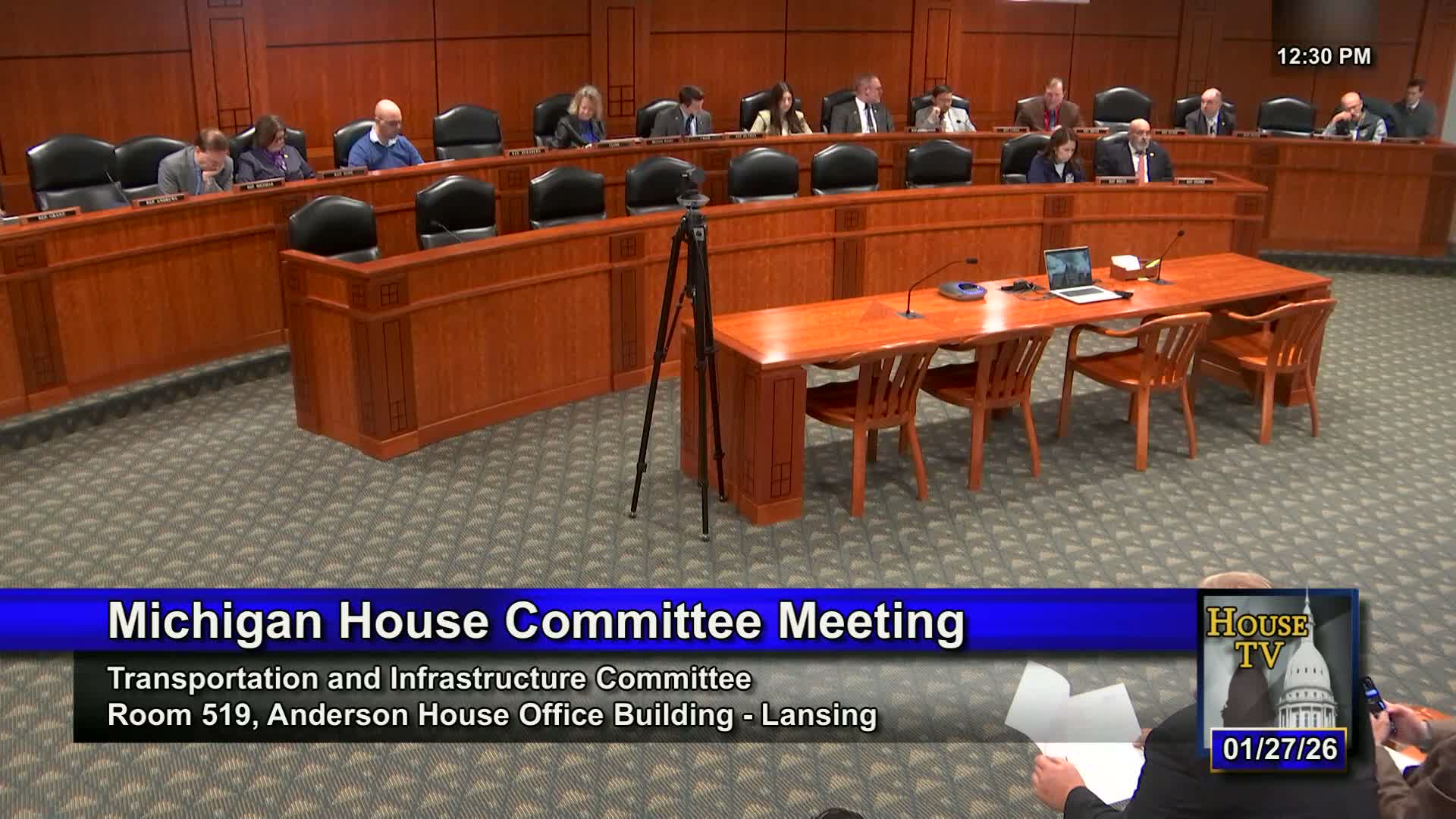
Representative William Bruck (30th District) presented a multi-bill package the sponsors described as the "Shield" plan, aimed at securing critical infrastructure and enabling drone management and mitigation. The package includes bills to designate no‑drone zones for key facilities, authorize geofencing and a state registry with the Michigan Department of Transportation (MDOT), permit detection technologies and limited mitigation at state buildings, and restrict purchase/use of drones from specified foreign manufacturers.
Bruck framed the package around homeland-security concerns and played a short clip labeled "Operation Spiderweb" to illustrate how coordinated drone attacks overseas destroyed aircraft. "We are in the wild, wild West right now in The US," he said, arguing that detection, geofencing, and limited mitigation tools are needed to protect power plants, stadiums, and other critical sites.
Sponsor Representative Mike Harris described House Bill 53‑23 as an authorization for the Department of Technology, Management & Budget (DTMB) to install drone-detection devices and coordinate with MDOT for geofencing, explicitly limiting state action to areas not preempted by federal law. "In short, this bill respects the FAA’s authority while ensuring that Michigan is not standing still," Harris said.
Industry and public-safety stakeholders testified with mixed support. Matt Rybar of the Michigan Drone Association said the association supports many elements "with amendments," urging clearer distinctions between negligent and nefarious operators, additional civil‑infraction options for negligent flights, and careful alignment with FAA preemption to avoid legal conflicts. Rybar also warned that MDOT Aeronautics is a small, largely unfunded operation and that some proposals could create unfunded mandates.
Members raised privacy and implementation concerns: Representative Miller urged warning-first approaches for non‑malicious hobbyists and questioned whether an app-based warning system could invade privacy; sponsors said the proposed app is intended to provide warnings and that penalties for non‑malicious violations would be calibrated. Representative Frisbie recommended flexibility on designating MDOT as the sole custodian and urged that implementation should prioritize response capacity among MSP or the National Guard.
On enforcement and mitigation, witnesses and sponsors emphasized that federal law still governs national airspace and that private citizens would not be authorized to disable aircraft. Testimony noted the limited federal training slots for counter‑UAS mitigation and signaled implementation constraints even if mitigation authority is authorized at the state level.
What happens next: Sponsors said the package will be considered across multiple hearings and that amendments addressing FAA preemption, civil‑infraction options, and implementation funding are expected. No committee votes were taken at this session.
Bruck framed the package around homeland-security concerns and played a short clip labeled "Operation Spiderweb" to illustrate how coordinated drone attacks overseas destroyed aircraft. "We are in the wild, wild West right now in The US," he said, arguing that detection, geofencing, and limited mitigation tools are needed to protect power plants, stadiums, and other critical sites.
Sponsor Representative Mike Harris described House Bill 53‑23 as an authorization for the Department of Technology, Management & Budget (DTMB) to install drone-detection devices and coordinate with MDOT for geofencing, explicitly limiting state action to areas not preempted by federal law. "In short, this bill respects the FAA’s authority while ensuring that Michigan is not standing still," Harris said.
Industry and public-safety stakeholders testified with mixed support. Matt Rybar of the Michigan Drone Association said the association supports many elements "with amendments," urging clearer distinctions between negligent and nefarious operators, additional civil‑infraction options for negligent flights, and careful alignment with FAA preemption to avoid legal conflicts. Rybar also warned that MDOT Aeronautics is a small, largely unfunded operation and that some proposals could create unfunded mandates.
Members raised privacy and implementation concerns: Representative Miller urged warning-first approaches for non‑malicious hobbyists and questioned whether an app-based warning system could invade privacy; sponsors said the proposed app is intended to provide warnings and that penalties for non‑malicious violations would be calibrated. Representative Frisbie recommended flexibility on designating MDOT as the sole custodian and urged that implementation should prioritize response capacity among MSP or the National Guard.
On enforcement and mitigation, witnesses and sponsors emphasized that federal law still governs national airspace and that private citizens would not be authorized to disable aircraft. Testimony noted the limited federal training slots for counter‑UAS mitigation and signaled implementation constraints even if mitigation authority is authorized at the state level.
What happens next: Sponsors said the package will be considered across multiple hearings and that amendments addressing FAA preemption, civil‑infraction options, and implementation funding are expected. No committee votes were taken at this session.
View the Full Meeting & All Its Details
This article offers just a summary. Unlock complete video, transcripts, and insights as a Founder Member.
✓
Watch full, unedited meeting videos
✓
Search every word spoken in unlimited transcripts
✓
AI summaries & real-time alerts (all government levels)
✓
Permanent access to expanding government content
30-day money-back guarantee
