What water‑right owners should know: nonuse protections, title updates and where to find the Provo Canyon PD
January 26, 2026 | Utah Water Rights, Utah Department of Natural Resources, Offices, Departments, and Divisions, Organizations, Utah Executive Branch, Utah
This article was created by AI summarizing key points discussed. AI makes mistakes, so for full details and context, please refer to the video of the full meeting. Please report any errors so we can fix them. Report an error »
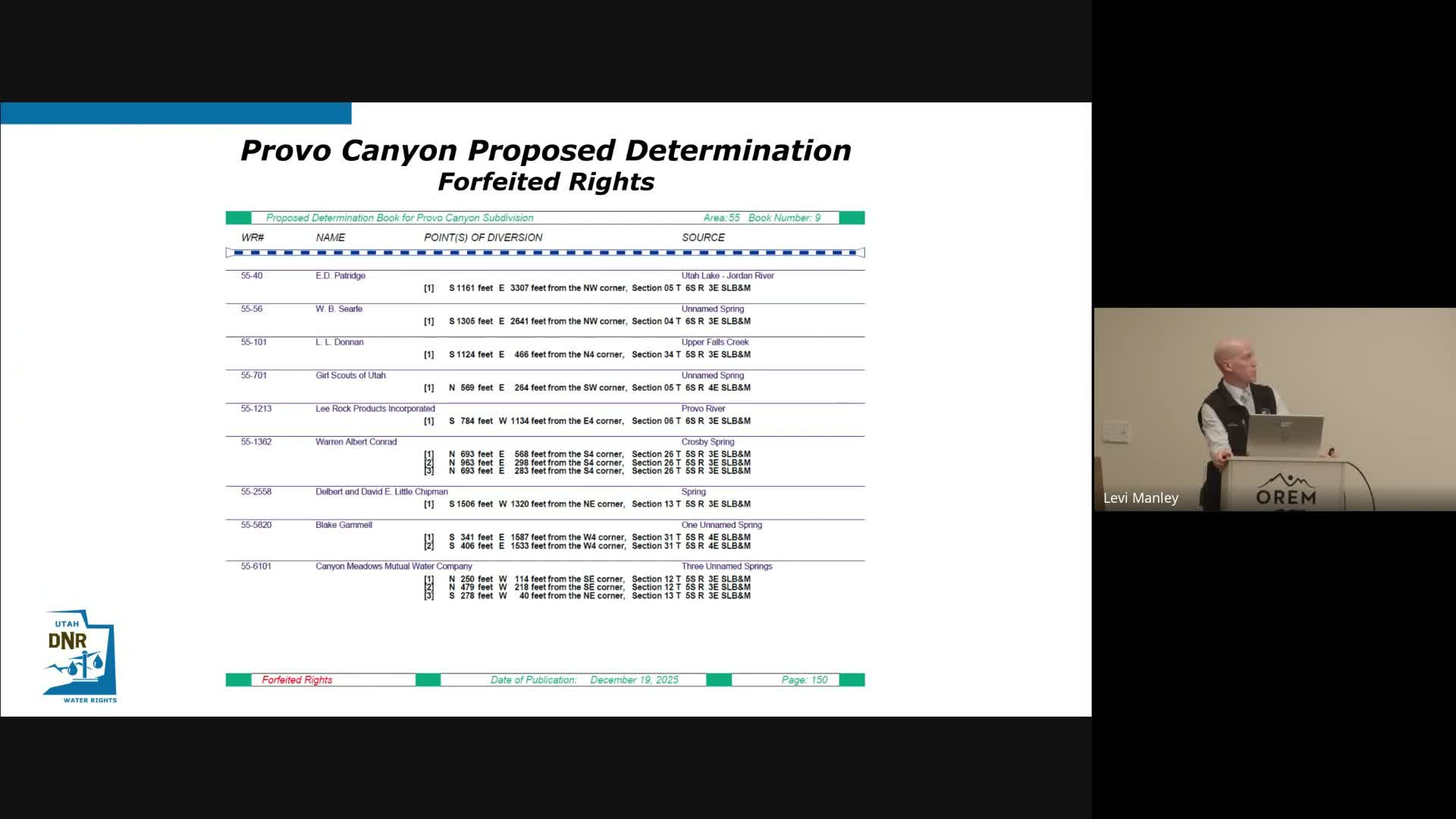
At a recorded public meeting about the Provo Canyon Subdivision proposed determination, Assistant State Engineer Chase McDonald explained practical steps water‑right owners can take to protect rights and find Division records.
Nonuse and forfeiture: McDonald said the Division evaluates nonuse and may recommend forfeiture when a right has not been put to beneficial use for seven or more years. He explained statutory protections exist when water is not physically available (for example, a dry spring or drought year), and said a right protected by statute during dry conditions should not be forfeited: "There are protections from forfeiture through nonuse ... during dry years or if the water is not available," he said.
Nonuse and change applications: McDonald described two administrative mechanisms owners commonly use. A nonuse application asks the Division to temporarily protect a right (typically approved for seven years) when the owner intends to preserve the right for future use; a change application requests repurposing of quantity, use, or place of use and is processed by the Division.
Title and ownership records: McDonald emphasized that the county recorder is the official office of record for ownership and that the Division’s owner field reflects what is on the Division’s records. Recording a deed with the county does not automatically update Division title; owners should submit recorded deeds to the Division to update title information. He told attendees that title updates are not required to be completed within the PD objection 90‑day window.
Finding your records: McDonald demonstrated the Division’s WaterEye map search on waterrights.utah.gov, showed how to turn on adjudication book layers (Area 559 for Provo Canyon), click water‑right icons to see status flags and links to scanned documents, and use the 'PDF of all documents' function to download a complete package of file documents. He also pointed to the hydrographic survey maps (32 pages for this subdivision) and said both the PD and maps are available via the Division’s adjudication status page or the district court.
Why this matters for owners: Understanding nonuse rules and the title update process is essential when reviewing the PD; owners who disagree with a Division recommendation should either file a district‑court objection (for a PD dispute) or contact Division staff about title, nonuse or change applications. McDonald and staff remained after the recorded portion of the meeting to address individual questions and provide assistance navigating scanned records.
Nonuse and forfeiture: McDonald said the Division evaluates nonuse and may recommend forfeiture when a right has not been put to beneficial use for seven or more years. He explained statutory protections exist when water is not physically available (for example, a dry spring or drought year), and said a right protected by statute during dry conditions should not be forfeited: "There are protections from forfeiture through nonuse ... during dry years or if the water is not available," he said.
Nonuse and change applications: McDonald described two administrative mechanisms owners commonly use. A nonuse application asks the Division to temporarily protect a right (typically approved for seven years) when the owner intends to preserve the right for future use; a change application requests repurposing of quantity, use, or place of use and is processed by the Division.
Title and ownership records: McDonald emphasized that the county recorder is the official office of record for ownership and that the Division’s owner field reflects what is on the Division’s records. Recording a deed with the county does not automatically update Division title; owners should submit recorded deeds to the Division to update title information. He told attendees that title updates are not required to be completed within the PD objection 90‑day window.
Finding your records: McDonald demonstrated the Division’s WaterEye map search on waterrights.utah.gov, showed how to turn on adjudication book layers (Area 559 for Provo Canyon), click water‑right icons to see status flags and links to scanned documents, and use the 'PDF of all documents' function to download a complete package of file documents. He also pointed to the hydrographic survey maps (32 pages for this subdivision) and said both the PD and maps are available via the Division’s adjudication status page or the district court.
Why this matters for owners: Understanding nonuse rules and the title update process is essential when reviewing the PD; owners who disagree with a Division recommendation should either file a district‑court objection (for a PD dispute) or contact Division staff about title, nonuse or change applications. McDonald and staff remained after the recorded portion of the meeting to address individual questions and provide assistance navigating scanned records.
View the Full Meeting & All Its Details
This article offers just a summary. Unlock complete video, transcripts, and insights as a Founder Member.
✓
Watch full, unedited meeting videos
✓
Search every word spoken in unlimited transcripts
✓
AI summaries & real-time alerts (all government levels)
✓
Permanent access to expanding government content
30-day money-back guarantee
