Riverside LAFCO adopts one-year limit on voter-initiated annexation petitions
January 22, 2026 | Riverside County, California
This article was created by AI summarizing key points discussed. AI makes mistakes, so for full details and context, please refer to the video of the full meeting. Please report any errors so we can fix them. Report an error »
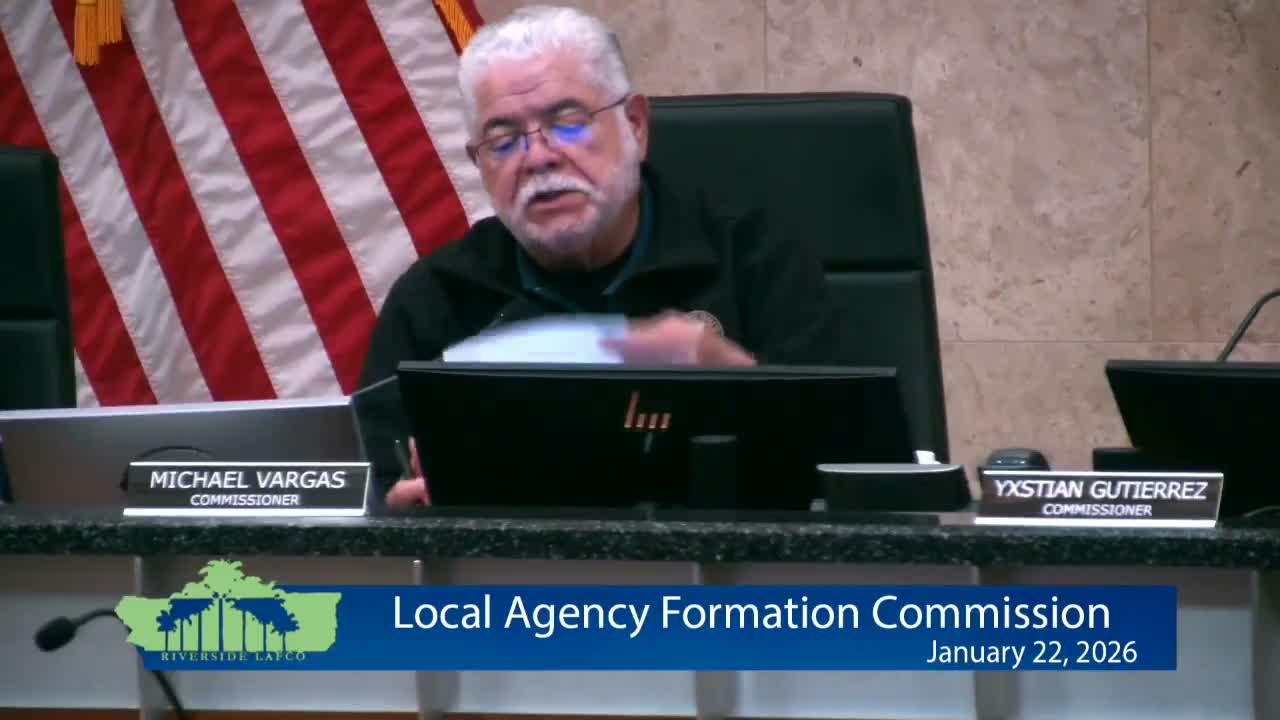
Riverside Local Agency Formation Commission on Thursday adopted Policy B4, setting a one-year maximum period for certified voter-initiated annexation petitions to result in a submitted, complete application.
Assistant Executive Officer Crystal Craig told the commission that state law and the Cortese-Knox-Hertzberg (CKH) framework do not specify how long certified petitions remain valid. Craig said two pending petition-initiated proposals—one certified about 3½ years ago and another certified four years ago—illustrated the problem of signatures and community support becoming stale over time. "Registered voters change over time," Craig said, arguing the one-year window encourages proponents to prepare fiscal impact reports and plans of service before circulating petitions.
Commissioners questioned whether one year was too short and whether extensions should be allowed. Commissioner Underwood asked why not two years; Gary Thompson, the executive officer, clarified the policy’s one-year clock would start when the registrar issues a certificate of sufficiency. Thompson and Craig said the requirement is to submit a complete application (including a fiscal impact report and plan of service), not to finish the entire annexation process within a year.
Several commissioners said extensions can be requested. Crystal Craig explained staff currently accepts administrative time extensions and that proponents may submit a written request to the commission for additional time before the one-year expiration. "You would have to come in within that one year to request an extension," counsel explained during the discussion.
Commissioner Perez moved to adopt staff’s recommendation to set petition validity at one year (with the ability for proponents to request extensions); Commissioner Areola seconded. The commission approved the motion 6-0. Staff said it will notify impacted petition proponents that their prior petitions are deemed invalid under the new policy and that interested groups must recirculate petitions if they wish to proceed.
The commission directed staff to reflect in the policy that the one-year clock begins when the registrar of voters issues the certificate of sufficiency and to clarify that extension requests must be filed before the one-year expiration. Thompson said he also plans to propose statutory changes through CALAFCO to codify similar timelines at the state level.
Next steps: staff will update the policy wording to clarify timing and extension procedures and will notify affected petitioners.
Assistant Executive Officer Crystal Craig told the commission that state law and the Cortese-Knox-Hertzberg (CKH) framework do not specify how long certified petitions remain valid. Craig said two pending petition-initiated proposals—one certified about 3½ years ago and another certified four years ago—illustrated the problem of signatures and community support becoming stale over time. "Registered voters change over time," Craig said, arguing the one-year window encourages proponents to prepare fiscal impact reports and plans of service before circulating petitions.
Commissioners questioned whether one year was too short and whether extensions should be allowed. Commissioner Underwood asked why not two years; Gary Thompson, the executive officer, clarified the policy’s one-year clock would start when the registrar issues a certificate of sufficiency. Thompson and Craig said the requirement is to submit a complete application (including a fiscal impact report and plan of service), not to finish the entire annexation process within a year.
Several commissioners said extensions can be requested. Crystal Craig explained staff currently accepts administrative time extensions and that proponents may submit a written request to the commission for additional time before the one-year expiration. "You would have to come in within that one year to request an extension," counsel explained during the discussion.
Commissioner Perez moved to adopt staff’s recommendation to set petition validity at one year (with the ability for proponents to request extensions); Commissioner Areola seconded. The commission approved the motion 6-0. Staff said it will notify impacted petition proponents that their prior petitions are deemed invalid under the new policy and that interested groups must recirculate petitions if they wish to proceed.
The commission directed staff to reflect in the policy that the one-year clock begins when the registrar of voters issues the certificate of sufficiency and to clarify that extension requests must be filed before the one-year expiration. Thompson said he also plans to propose statutory changes through CALAFCO to codify similar timelines at the state level.
Next steps: staff will update the policy wording to clarify timing and extension procedures and will notify affected petitioners.
View the Full Meeting & All Its Details
This article offers just a summary. Unlock complete video, transcripts, and insights as a Founder Member.
✓
Watch full, unedited meeting videos
✓
Search every word spoken in unlimited transcripts
✓
AI summaries & real-time alerts (all government levels)
✓
Permanent access to expanding government content
30-day money-back guarantee
