RTA hears federal funding update as redistricting expands member representation
January 22, 2026 | Riverside County, California
This article was created by AI summarizing key points discussed. AI makes mistakes, so for full details and context, please refer to the video of the full meeting. Please report any errors so we can fix them. Report an error »
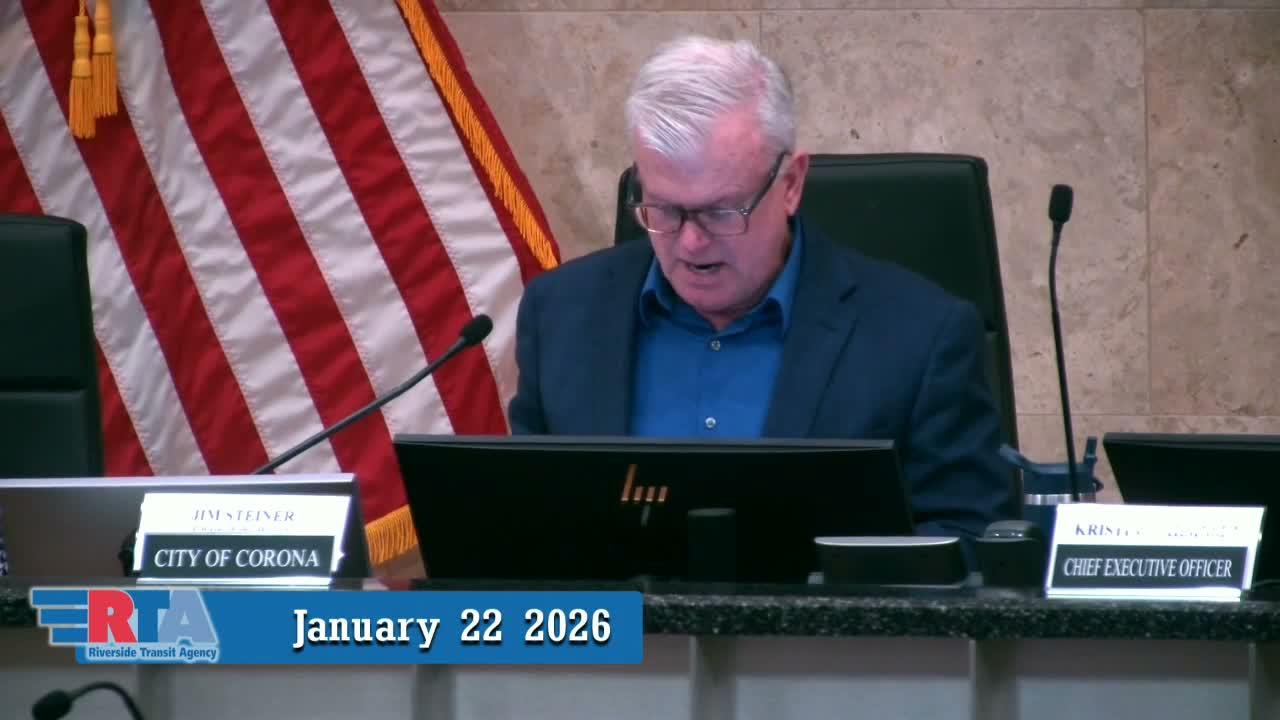
Alka Mihart Piersma, a federal advocate with Cardinal Infrastructure, told the Riverside Transit Agency board on a legislative update that recent California redistricting increases the number of congressional districts overlapping the RTA service area and could complicate but also expand opportunities for community project funding.
"You now have seven districts in the RTA service area," Piersma said, noting members may prioritize projects in their own districts. She added that members can "stack" community project requests across districts to build larger funding pots for regional projects.
Piersma also walked directors through the surface transportation reauthorization process in Congress and the timing risks. "There's a decent chance, probably 90% chance, that they won't finish this year," she said, calling 2026 an election year that could delay passage past the House's May timeline.
She outlined how the likely shift toward formula programs could benefit agencies with high vehicle revenue miles, but disadvantage small agencies that rely on competitive grants. Piersma warned that the Federal Transit Administration's Low-No (low- and no-emission vehicle) program faces cuts or elimination in some bills and urged the board to monitor set-aside protections for California agencies.
On project delivery rules, Piersma described bipartisan bills that would allow trained transit agencies to declare certain small projects as categorical exclusions under NEPA so agencies can perform their own environmental work and avoid prolonged federal reviews. "It gives the power of the transit agencies to move more quickly," she said of the proposal.
She also raised regulatory streamlining topics the agency is pursuing, including narrowing the scope of periodic review processes to reduce staff burden, and noted ongoing advocacy to allow federal funds to cover certain operating expenses related to crime prevention such as contracted security or ambassador programs.
Why it matters: the combination of new congressional representation and an uncertain reauthorization outlook will shape RTA's federal advocacy strategy, competitive grant prospects and planning for a transition to more zero-emission bus requirements in California.
What's next: Piersma said RTA expects to travel to Washington, D.C., in May to meet the congressional delegation and the Federal Transit Administration; board members were invited to participate.
"You now have seven districts in the RTA service area," Piersma said, noting members may prioritize projects in their own districts. She added that members can "stack" community project requests across districts to build larger funding pots for regional projects.
Piersma also walked directors through the surface transportation reauthorization process in Congress and the timing risks. "There's a decent chance, probably 90% chance, that they won't finish this year," she said, calling 2026 an election year that could delay passage past the House's May timeline.
She outlined how the likely shift toward formula programs could benefit agencies with high vehicle revenue miles, but disadvantage small agencies that rely on competitive grants. Piersma warned that the Federal Transit Administration's Low-No (low- and no-emission vehicle) program faces cuts or elimination in some bills and urged the board to monitor set-aside protections for California agencies.
On project delivery rules, Piersma described bipartisan bills that would allow trained transit agencies to declare certain small projects as categorical exclusions under NEPA so agencies can perform their own environmental work and avoid prolonged federal reviews. "It gives the power of the transit agencies to move more quickly," she said of the proposal.
She also raised regulatory streamlining topics the agency is pursuing, including narrowing the scope of periodic review processes to reduce staff burden, and noted ongoing advocacy to allow federal funds to cover certain operating expenses related to crime prevention such as contracted security or ambassador programs.
Why it matters: the combination of new congressional representation and an uncertain reauthorization outlook will shape RTA's federal advocacy strategy, competitive grant prospects and planning for a transition to more zero-emission bus requirements in California.
What's next: Piersma said RTA expects to travel to Washington, D.C., in May to meet the congressional delegation and the Federal Transit Administration; board members were invited to participate.
Don't Miss a Word: See the Full Meeting!
Go beyond summaries. Unlock every video, transcript, and key insight with a Founder Membership.
✓
Get instant access to full meeting videos
✓
Search and clip any phrase from complete transcripts
✓
Receive AI-powered summaries & custom alerts
✓
Enjoy lifetime, unrestricted access to government data
30-day money-back guarantee
