County outlines diversion and transitional rent rollout as housing bottleneck slows treatment placements
January 24, 2026 | Santa Clara County, California
This article was created by AI summarizing key points discussed. AI makes mistakes, so for full details and context, please refer to the video of the full meeting. Please report any errors so we can fix them. Report an error »
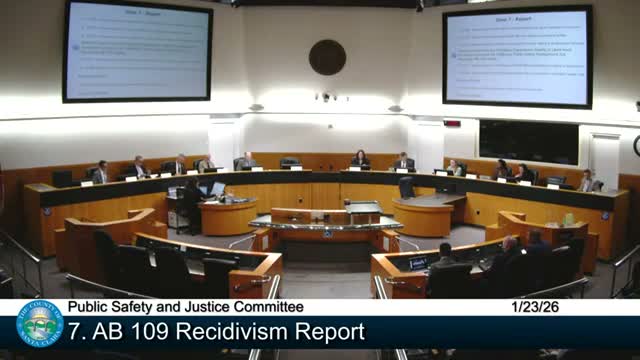
Santa Clara County behavioral health officials told the Public Safety and Justice Committee that collaborative court and reintegration efforts continue to expand, but a shortage of housing remains a major bottleneck for diverting individuals from custody into treatment.
Deputy Director Megan Wheelyhand and colleagues presented data and recommendations on collaborative court and reintegration services. The board focused on the fact that more than a third of clients directed by the court into treatment are still waiting for stable housing placements.
Staff described the county’s rental assistance architecture: a permanent or indefinite housing program serving roughly 500–600 individuals annually, and a temporary housing component serving about 300 people at a time; these programs were funded with the Mental Health Services Act and a one‑time Behavioral Health Bridge Housing allocation. To sustain temporary assistance, staff said the county planned to use transitional rent funding implemented through managed care plans.
Officials said Santa Clara Family Health Plan has an agreement effective Jan. 1, 2026 to provide transitional rent for beneficiaries with serious mental illness, and that some referrals are underway though execution of payment contracts and operational processes remain in progress; staff hoped to start issuing rent payments by the end of January or in February and agreed to return to the committee with an April update on implementation and counts of clients receiving benefits.
Supervisors asked staff to include in the February public health crisis quarterly report a consolidated list of grants and funding streams recently lost or reduced (e.g., Prop 47, SAMHSA) and to return in April with an update on managed‑care implementation and client counts. The committee received the report and added a direction to form or augment work groups focused on substance use treatment pathways and reducing delays to residential treatment placements.
Deputy Director Megan Wheelyhand and colleagues presented data and recommendations on collaborative court and reintegration services. The board focused on the fact that more than a third of clients directed by the court into treatment are still waiting for stable housing placements.
Staff described the county’s rental assistance architecture: a permanent or indefinite housing program serving roughly 500–600 individuals annually, and a temporary housing component serving about 300 people at a time; these programs were funded with the Mental Health Services Act and a one‑time Behavioral Health Bridge Housing allocation. To sustain temporary assistance, staff said the county planned to use transitional rent funding implemented through managed care plans.
Officials said Santa Clara Family Health Plan has an agreement effective Jan. 1, 2026 to provide transitional rent for beneficiaries with serious mental illness, and that some referrals are underway though execution of payment contracts and operational processes remain in progress; staff hoped to start issuing rent payments by the end of January or in February and agreed to return to the committee with an April update on implementation and counts of clients receiving benefits.
Supervisors asked staff to include in the February public health crisis quarterly report a consolidated list of grants and funding streams recently lost or reduced (e.g., Prop 47, SAMHSA) and to return in April with an update on managed‑care implementation and client counts. The committee received the report and added a direction to form or augment work groups focused on substance use treatment pathways and reducing delays to residential treatment placements.
View the Full Meeting & All Its Details
This article offers just a summary. Unlock complete video, transcripts, and insights as a Founder Member.
✓
Watch full, unedited meeting videos
✓
Search every word spoken in unlimited transcripts
✓
AI summaries & real-time alerts (all government levels)
✓
Permanent access to expanding government content
30-day money-back guarantee
