Committee unanimously approves expanded pharmacist authorities, with carve‑outs and safeguards
January 21, 2026 | 2026 Legislature ND, North Dakota
This article was created by AI summarizing key points discussed. AI makes mistakes, so for full details and context, please refer to the video of the full meeting. Please report any errors so we can fix them. Report an error »
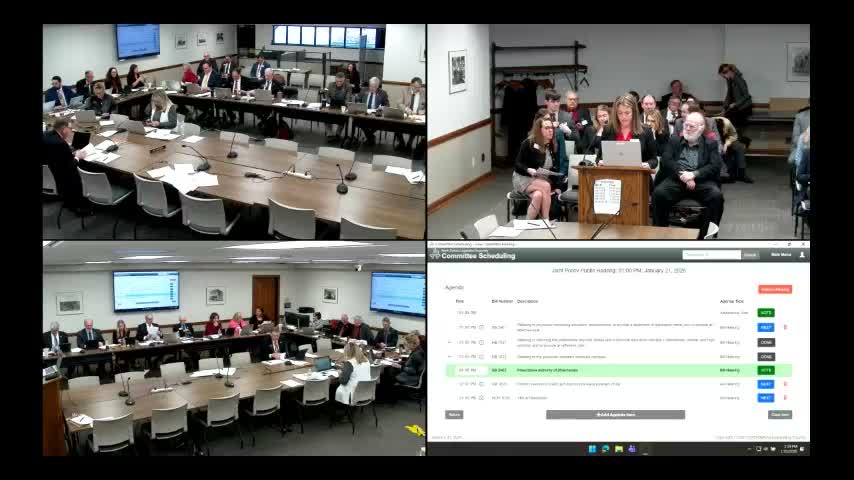
The joint policy committee unanimously voted to recommend Senate Bill 2402 as amended, a compromise package that expands certain pharmacist authorities while carving out drug classes and adding procedural safeguards.
Senator Rohrs presented an amendment developed in consultation with the North Dakota State Board of Pharmacy and the Board of Medicine. The amendment narrows the scope of pharmacist prescriptive authority and therapeutic substitution from the bill’s initial draft: it removes 'uncomplicated urinary tract infections' from the independent prescriptive list, limits therapeutic substitution (excluding antidepressants, antipsychotics, chemotherapy agents, Schedule II controlled substances and defined biological products), and requires pharmacists to determine whether a substitution provides cost or access benefit and to notify a patient’s primary provider of testing and prescriptions made under the authority.
Mark Hardy, executive director of the State Board of Pharmacy, described the amendment as modeled on other states’ approaches and said it included requirements for protocols, documentation, patient consent and notification to the prescribing provider. Proponents, including the North Dakota Pharmacists Association, argued the changes will improve rural access, shorten waits for basic treatment and reduce costly emergency visits when primary care is unavailable.
The Board of Medicine, physicians and some hospital representatives raised concerns about clinicians not having full access to patient records, pregnancy and pediatric special cases, and how therapeutic substitution could affect complex patients. The Board of Medicine worked with Senator Rohrs to produce the exclusion list and the notification/documentation language that addressed many of those concerns.
One disputed clause — a sentence stating that the prescribing provider "is not liable for a substitution made by a pharmacist" — was clarified by legislative counsel and adjusted in the final amendment by adding limiting language ("under this section") so the liability protection applied narrowly to substitutions made under the therapeutic‑substitution authority. Lawmakers said that change was meant to preserve patient remedies and to make responsibility for substitution decisions legally clearer.
After the negotiated amendment was adopted by the committee, the clerk recorded a roll‑call vote and the committee advanced the amended bill unanimously. Sponsors in both chambers were named as carriers to shepherd the bill forward.
Senator Rohrs presented an amendment developed in consultation with the North Dakota State Board of Pharmacy and the Board of Medicine. The amendment narrows the scope of pharmacist prescriptive authority and therapeutic substitution from the bill’s initial draft: it removes 'uncomplicated urinary tract infections' from the independent prescriptive list, limits therapeutic substitution (excluding antidepressants, antipsychotics, chemotherapy agents, Schedule II controlled substances and defined biological products), and requires pharmacists to determine whether a substitution provides cost or access benefit and to notify a patient’s primary provider of testing and prescriptions made under the authority.
Mark Hardy, executive director of the State Board of Pharmacy, described the amendment as modeled on other states’ approaches and said it included requirements for protocols, documentation, patient consent and notification to the prescribing provider. Proponents, including the North Dakota Pharmacists Association, argued the changes will improve rural access, shorten waits for basic treatment and reduce costly emergency visits when primary care is unavailable.
The Board of Medicine, physicians and some hospital representatives raised concerns about clinicians not having full access to patient records, pregnancy and pediatric special cases, and how therapeutic substitution could affect complex patients. The Board of Medicine worked with Senator Rohrs to produce the exclusion list and the notification/documentation language that addressed many of those concerns.
One disputed clause — a sentence stating that the prescribing provider "is not liable for a substitution made by a pharmacist" — was clarified by legislative counsel and adjusted in the final amendment by adding limiting language ("under this section") so the liability protection applied narrowly to substitutions made under the therapeutic‑substitution authority. Lawmakers said that change was meant to preserve patient remedies and to make responsibility for substitution decisions legally clearer.
After the negotiated amendment was adopted by the committee, the clerk recorded a roll‑call vote and the committee advanced the amended bill unanimously. Sponsors in both chambers were named as carriers to shepherd the bill forward.
Don't Miss a Word: See the Full Meeting!
Go beyond summaries. Unlock every video, transcript, and key insight with a Founder Membership.
✓
Get instant access to full meeting videos
✓
Search and clip any phrase from complete transcripts
✓
Receive AI-powered summaries & custom alerts
✓
Enjoy lifetime, unrestricted access to government data
30-day money-back guarantee
