Lawmakers press HHS on reimbursement model and how cash‑strapped rural hospitals will pay upfront costs
January 21, 2026 | 2026 Legislature ND, North Dakota
This article was created by AI summarizing key points discussed. AI makes mistakes, so for full details and context, please refer to the video of the full meeting. Please report any errors so we can fix them. Report an error »
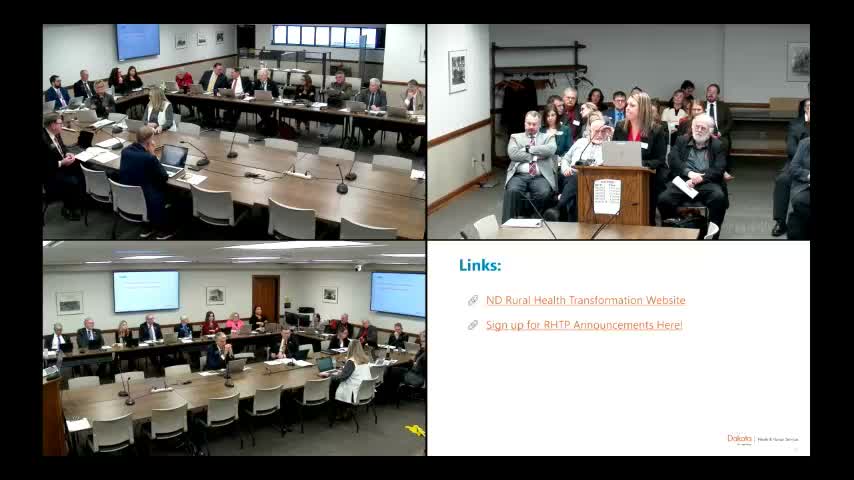
During the HHS presentation on the Rural Health Transformation Program, legislators repeatedly raised concerns about the reimbursement structure and the ability of rural providers—especially critical access hospitals—to finance projects before receiving federal reimbursement.
Senator Rummel asked whether critical access hospitals that lack upfront financing would have options to make projects bankable under a reimbursement grant. Courtney Peterson, deputy CFO, acknowledged the challenge and said HHS is "working with CMS currently to kind of try to address that potential problem." She cited potential options under discussion, including state purchase and pass-through models and phased contracting that could make projects more assignable and accessible to lenders.
Members warned vendor readiness and cash flow are significant risks. HHS staff said they will prioritize technical assistance, subject-matter experts and procurement flexibilities (working with OMB and NDIT) to reduce administrative burden and accelerate contracting. Several legislators requested training sessions for prospective applicants; staff said they expect to provide application training and technical support in the coming weeks.
On procurement constraints, Courtney Peterson and other staff highlighted that CMS has identified unallowable costs (for example, supplanting previously started programs and some new construction) and that some technology costs and meals are restricted. HHS said it will submit procurement approaches to CMS for approval and that quarterly reporting and compliance monitoring will be required.
HHS emphasized the need for projects to be sustainable and to meet CMS performance metrics; staff cautioned that speed and compliance must be balanced to avoid later recoveries of funds. The department asked legislators to help identify providers and community partners that are ready to move quickly and to share information about HHS’s outreach and technical assistance offerings.
Senator Rummel asked whether critical access hospitals that lack upfront financing would have options to make projects bankable under a reimbursement grant. Courtney Peterson, deputy CFO, acknowledged the challenge and said HHS is "working with CMS currently to kind of try to address that potential problem." She cited potential options under discussion, including state purchase and pass-through models and phased contracting that could make projects more assignable and accessible to lenders.
Members warned vendor readiness and cash flow are significant risks. HHS staff said they will prioritize technical assistance, subject-matter experts and procurement flexibilities (working with OMB and NDIT) to reduce administrative burden and accelerate contracting. Several legislators requested training sessions for prospective applicants; staff said they expect to provide application training and technical support in the coming weeks.
On procurement constraints, Courtney Peterson and other staff highlighted that CMS has identified unallowable costs (for example, supplanting previously started programs and some new construction) and that some technology costs and meals are restricted. HHS said it will submit procurement approaches to CMS for approval and that quarterly reporting and compliance monitoring will be required.
HHS emphasized the need for projects to be sustainable and to meet CMS performance metrics; staff cautioned that speed and compliance must be balanced to avoid later recoveries of funds. The department asked legislators to help identify providers and community partners that are ready to move quickly and to share information about HHS’s outreach and technical assistance offerings.
View the Full Meeting & All Its Details
This article offers just a summary. Unlock complete video, transcripts, and insights as a Founder Member.
✓
Watch full, unedited meeting videos
✓
Search every word spoken in unlimited transcripts
✓
AI summaries & real-time alerts (all government levels)
✓
Permanent access to expanding government content
30-day money-back guarantee
