HHS links four policy actions to CMS scoring; legislators ask whether requirements would apply statewide
January 21, 2026 | 2026 Legislature ND, North Dakota
This article was created by AI summarizing key points discussed. AI makes mistakes, so for full details and context, please refer to the video of the full meeting. Please report any errors so we can fix them. Report an error »
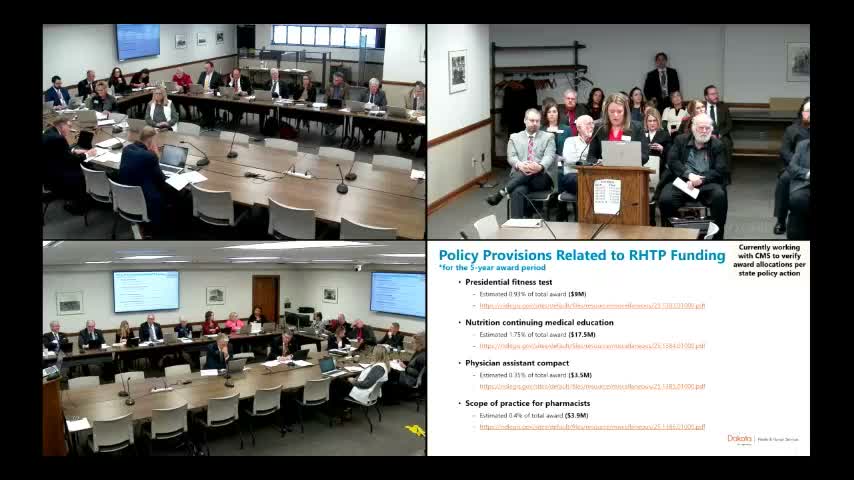
HHS staff told the joint policy committee that part of North Dakota’s Rural Health Transformation application included commitments to take several policy actions that increase the state’s score in CMS’s review. Staff listed four policy items and gave estimated values to the five‑year award: a presidential fitness test for students (estimated around $9 million), nutrition continuing medical education for physicians (estimated about $17.5 million), the physician assistant compact (estimated $3.48 million), and pharmacist scope‑of‑practice changes (estimated $3.9 million).
Legislators sought clarification on scope and perceived cost. A senator asked why the nutrition continuing medical education estimate was comparatively large; HHS explained that CMS allocated scoring weight to certain policy actions in the notice of funding opportunity and that the dollar figures shown to the committee reflected that scoring weight rather than direct program spending. "That's not how much we need to spend on that topic — that's how much we got because we're going to do it," one legislator observed during questioning.
Members also asked whether the policy provisions would be universal across urban and rural providers. HHS staff said that, if enacted as written, provisions such as a nutrition CME requirement for physicians would apply to all physicians licensed in North Dakota; a fitness testing requirement in schools would likewise be statewide if the bill language requires it. Staff noted their CMS application earned partial points for committing to take these policy actions and that HHS cannot claim full points until the policies are passed by the Legislature.
HHS cautioned that the estimated dollar values and point allocations are provisional pending final CMS guidance and that failing to pass the policies could reduce future funding tied to those scoring areas. The committee paused this policy discussion to take a lunch recess and planned to address the bills in more detail after the break.
Legislators sought clarification on scope and perceived cost. A senator asked why the nutrition continuing medical education estimate was comparatively large; HHS explained that CMS allocated scoring weight to certain policy actions in the notice of funding opportunity and that the dollar figures shown to the committee reflected that scoring weight rather than direct program spending. "That's not how much we need to spend on that topic — that's how much we got because we're going to do it," one legislator observed during questioning.
Members also asked whether the policy provisions would be universal across urban and rural providers. HHS staff said that, if enacted as written, provisions such as a nutrition CME requirement for physicians would apply to all physicians licensed in North Dakota; a fitness testing requirement in schools would likewise be statewide if the bill language requires it. Staff noted their CMS application earned partial points for committing to take these policy actions and that HHS cannot claim full points until the policies are passed by the Legislature.
HHS cautioned that the estimated dollar values and point allocations are provisional pending final CMS guidance and that failing to pass the policies could reduce future funding tied to those scoring areas. The committee paused this policy discussion to take a lunch recess and planned to address the bills in more detail after the break.
View the Full Meeting & All Its Details
This article offers just a summary. Unlock complete video, transcripts, and insights as a Founder Member.
✓
Watch full, unedited meeting videos
✓
Search every word spoken in unlimited transcripts
✓
AI summaries & real-time alerts (all government levels)
✓
Permanent access to expanding government content
30-day money-back guarantee
