Committee hears DHHS plan to spend roughly $199M in federal rural health transformation funds
January 21, 2026 | 2026 Legislature ND, North Dakota
This article was created by AI summarizing key points discussed. AI makes mistakes, so for full details and context, please refer to the video of the full meeting. Please report any errors so we can fix them. Report an error »
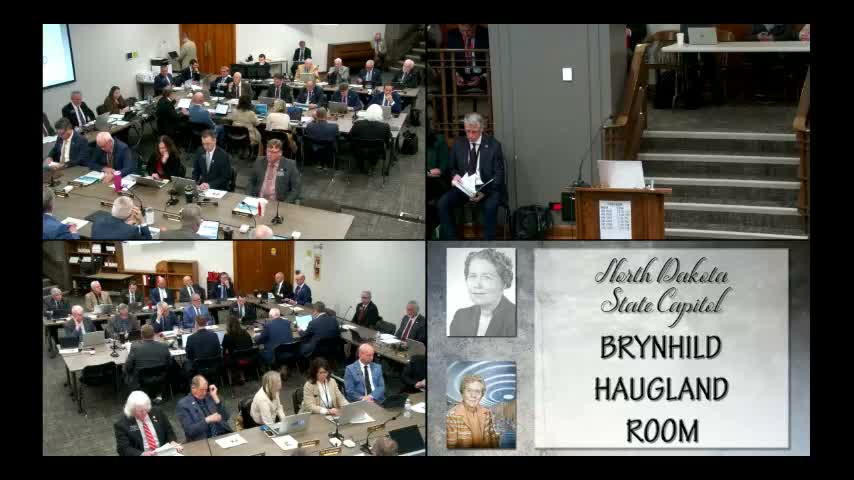
The Joint Appropriations Committee on Jan. 27 heard a presentation on House Bill 16-23, a measure to authorize the state to accept and distribute roughly $199 million in federal Rural Health Transformation funding for fiscal year 2026. Senator Brad Beckettall, who introduced the bill, and Department of Health and Human Services officials described program priorities, spending limits and a deadline to obligate projects this year to avoid federal clawbacks.
Beckettall said the funding stems from a federal appropriation and that North Dakota’s first-year award is just under $200 million. “This is a result of the 1 big beautiful bill that was passed, federally appropriating $50,000,000,000 to states for rural healthcare transformation,” he said, and described four priority pillars in the state application: care closer to home, technology and data, workforce recruitment and retention, and prevention/wellness. Initial target allocations in the application were cited at about 58% for care closer to home, 16.8% for tech and data, 16.2% for workforce, and 8.6% for prevention-oriented initiatives.
Department officials warned the committee that the funds are conditional on meeting federal requirements and on the state’s implementation. “Future awards will be determined by the Centers for Medicare & Medicaid Services based on our progress in how we implement the provisions and the spending in the bill,” Beckettall said. He and DHHS staff stressed that certain costs are explicitly unallowable under the federal grant — pre-award costs, matching other federal funds, supplanting existing state or local obligations and new construction are prohibited — and that some categories have hard caps (administrative costs capped at 10% of awards, provider payments capped at 15%, and replacement of an electronic health record limited to 5% if a certified system already existed as of Sept. 1, 2025).
Commissioner Pat Treanor of the Department of Health and Human Services described implementation plans and an aggressive timeline. He said the department plans to provide extensive technical assistance, templates and listening sessions to help rural providers and community organizations apply, but noted that many projects will be structured as reimbursements tied to approved applications. “These are reimbursable grants,” Treanor said, adding that the department is exploring short-term gap-financing options for small providers that cannot front large purchases. He told legislators the department will staff coordinators for each initiative, a tribal liaison and an Office of Data and Performance Measures to monitor outcomes and compliance.
Committee members pressed DHHS on practical details. Senators and representatives asked how awards would flow to local clinics, whether providers would have to pay upfront costs, and whether DHHS or CMS controls reimbursement timing. DHHS officials explained that DHHS will approve applications which are then forwarded to CMS for federal approval; once CMS approves an award, DHHS can disburse funds and reimburse approved expenses. Lawmakers also asked about verifying outcomes; Larson of the Legislative Council said section 5 of the bill allows DHHS to require recipients to submit process and outcome measures, though the bill uses permissive language (“may require”), which some legislators pressed the department to enforce diligently.
Mental-health and provider groups testified in support. Carlotta McClary of Mental Health America of North Dakota urged investment in children’s mental health, mobile crisis teams and regional crisis-stabilization beds, citing SAMHSA prevalence estimates when describing need for expanded services. Tracy Capron of HIA Health, which operates home-based and hospice services, told the committee her organization can scale care in the home but cautioned that small providers face heavy upfront costs and workforce constraints; she urged the committee to fund workforce, nonmedical supports (transportation, caregiver training) and models that enable long-term sustainability. John Nagel of Beck Communications urged explicit funding for cybersecurity and professional services to manage rapidly evolving AI and data systems.
There was no committee vote on HB16-23 during the hearing; the chair closed the record after receiving no opposition testimony and scheduled a follow-up work session to consider amendments and additional questions. The department committed to be available for further technical briefings and said it will provide reports to any legislative committee that requests them.
What’s next: Committee members said DHHS staff will remain available in a work session for follow-up questions and potential amendments. Legislators and DHHS staff emphasized the October obligation deadline for first-year projects and the need for local providers to sign up for technical assistance and apply promptly.
Beckettall said the funding stems from a federal appropriation and that North Dakota’s first-year award is just under $200 million. “This is a result of the 1 big beautiful bill that was passed, federally appropriating $50,000,000,000 to states for rural healthcare transformation,” he said, and described four priority pillars in the state application: care closer to home, technology and data, workforce recruitment and retention, and prevention/wellness. Initial target allocations in the application were cited at about 58% for care closer to home, 16.8% for tech and data, 16.2% for workforce, and 8.6% for prevention-oriented initiatives.
Department officials warned the committee that the funds are conditional on meeting federal requirements and on the state’s implementation. “Future awards will be determined by the Centers for Medicare & Medicaid Services based on our progress in how we implement the provisions and the spending in the bill,” Beckettall said. He and DHHS staff stressed that certain costs are explicitly unallowable under the federal grant — pre-award costs, matching other federal funds, supplanting existing state or local obligations and new construction are prohibited — and that some categories have hard caps (administrative costs capped at 10% of awards, provider payments capped at 15%, and replacement of an electronic health record limited to 5% if a certified system already existed as of Sept. 1, 2025).
Commissioner Pat Treanor of the Department of Health and Human Services described implementation plans and an aggressive timeline. He said the department plans to provide extensive technical assistance, templates and listening sessions to help rural providers and community organizations apply, but noted that many projects will be structured as reimbursements tied to approved applications. “These are reimbursable grants,” Treanor said, adding that the department is exploring short-term gap-financing options for small providers that cannot front large purchases. He told legislators the department will staff coordinators for each initiative, a tribal liaison and an Office of Data and Performance Measures to monitor outcomes and compliance.
Committee members pressed DHHS on practical details. Senators and representatives asked how awards would flow to local clinics, whether providers would have to pay upfront costs, and whether DHHS or CMS controls reimbursement timing. DHHS officials explained that DHHS will approve applications which are then forwarded to CMS for federal approval; once CMS approves an award, DHHS can disburse funds and reimburse approved expenses. Lawmakers also asked about verifying outcomes; Larson of the Legislative Council said section 5 of the bill allows DHHS to require recipients to submit process and outcome measures, though the bill uses permissive language (“may require”), which some legislators pressed the department to enforce diligently.
Mental-health and provider groups testified in support. Carlotta McClary of Mental Health America of North Dakota urged investment in children’s mental health, mobile crisis teams and regional crisis-stabilization beds, citing SAMHSA prevalence estimates when describing need for expanded services. Tracy Capron of HIA Health, which operates home-based and hospice services, told the committee her organization can scale care in the home but cautioned that small providers face heavy upfront costs and workforce constraints; she urged the committee to fund workforce, nonmedical supports (transportation, caregiver training) and models that enable long-term sustainability. John Nagel of Beck Communications urged explicit funding for cybersecurity and professional services to manage rapidly evolving AI and data systems.
There was no committee vote on HB16-23 during the hearing; the chair closed the record after receiving no opposition testimony and scheduled a follow-up work session to consider amendments and additional questions. The department committed to be available for further technical briefings and said it will provide reports to any legislative committee that requests them.
What’s next: Committee members said DHHS staff will remain available in a work session for follow-up questions and potential amendments. Legislators and DHHS staff emphasized the October obligation deadline for first-year projects and the need for local providers to sign up for technical assistance and apply promptly.
Don't Miss a Word: See the Full Meeting!
Go beyond summaries. Unlock every video, transcript, and key insight with a Founder Membership.
✓
Get instant access to full meeting videos
✓
Search and clip any phrase from complete transcripts
✓
Receive AI-powered summaries & custom alerts
✓
Enjoy lifetime, unrestricted access to government data
30-day money-back guarantee
