Senate budget committee hears governor's 2026–27 proposal as LAO warns of revenue downside risk
January 21, 2026 | California State Senate, Senate, Legislative, California
This article was created by AI summarizing key points discussed. AI makes mistakes, so for full details and context, please refer to the video of the full meeting. Please report any errors so we can fix them. Report an error »
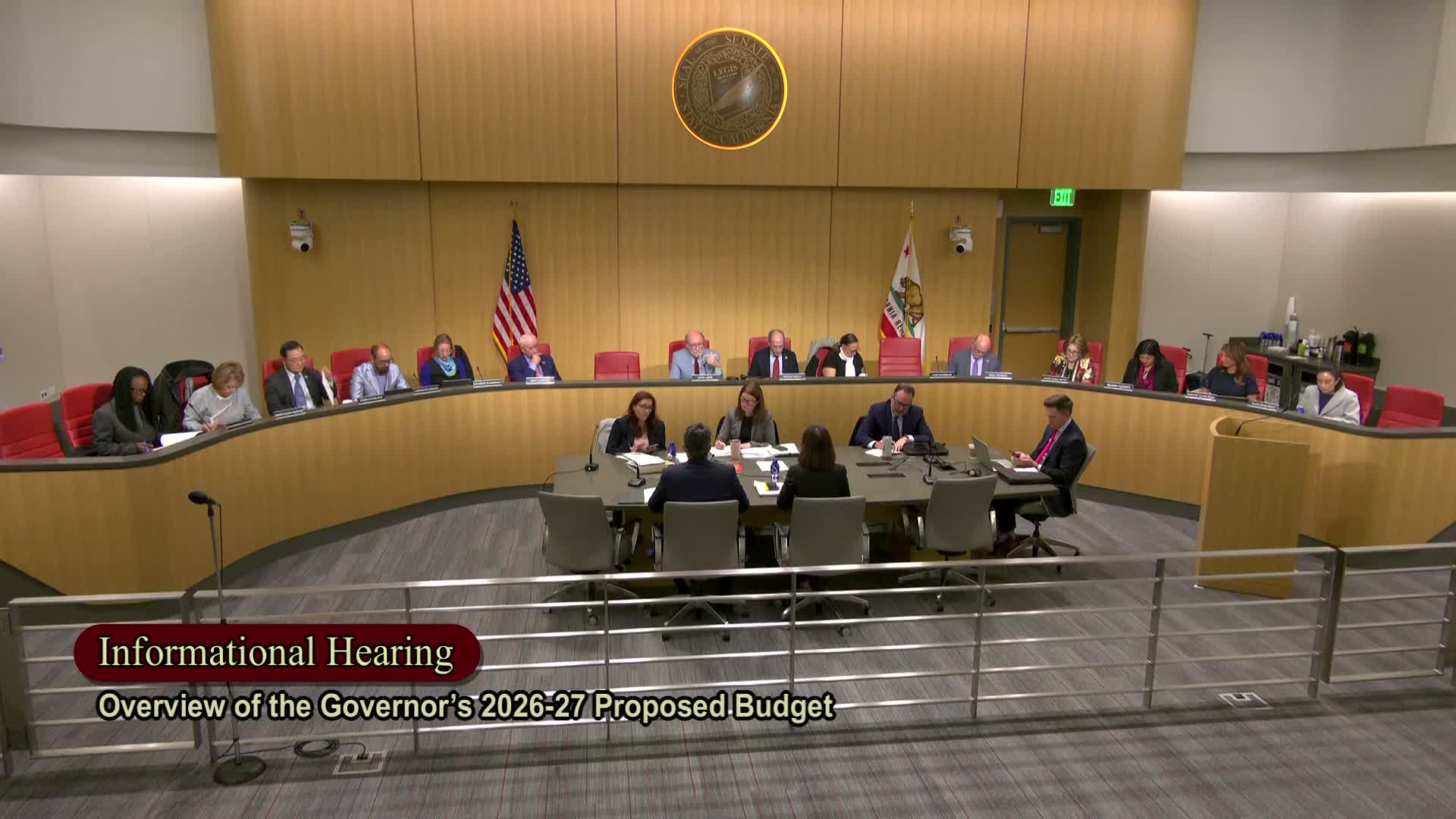
The California State Senate Committee on Budget and Fiscal Review on Jan. 27 heard the Department of Finance and the Legislative Analyst's Office present the governor's proposed 2026–27 budget and field questions from members. Chair John Laird opened the hearing and emphasized public participation and an accelerated subcommittee schedule to consider the plan.
Erica Lee, chief deputy director at the Department of Finance, told the committee the governor's proposal would include about $350 billion in total expenditures, roughly $250 billion of that from the general fund, and carry a budget‑year shortfall of about $2.9 billion while holding approximately $23 billion in reserves. "The budget this year includes about $350,000,000,000 in expenditures, of which about $250,000,000,000 is general fund," Lee said. She said roughly $42 billion in upgraded revenue estimates underlie much of the administration's capacity to propose limited new spending and larger reserves, but constitutional obligations including Proposition 98 (education) and Proposition 2 (rainy day requirements) absorb significant shares of those gains.
The presentation highlighted policy proposals and tradeoffs across education, higher education base increases, climate and wildfire investments, a one‑time $200 million light‑duty zero‑emission vehicle incentive, childcare and selective infrastructure projects, and several tax provisions aimed at improving compliance and incentivizing renewable aviation fuels.
The Legislative Analyst's Office, appearing after DOF, said it views the near‑term revenue picture more conservatively. The LAO's presenter warned of "considerable downside risk" to the administration's revenue estimates, attributing much recent growth to concentrated stock‑market gains and margin debt indicators that have historically preceded downturns. The LAO reiterated it was not assuming a downturn but that its forecast incorporates downside scenarios; the office recommended the Legislature adopt more conservative revenue assumptions for planning and urged that the proposed Proposition 98 settle‑up not be built into recurring spending but instead held as a reserve.
The hearing featured extended member questioning on several consequential choices: whether to suspend the Proposition 2 true‑up deposit (the administration proposed suspending roughly $2.8 billion for the current year), how to treat a proposed $5.6 billion Proposition 98 settle‑up, hospital financing tied to the MCO tax, and how federal policy changes (HR 1) will affect Medi‑Cal and CalFresh enrollment and state costs. On HR 1, DOF said it expects roughly $1.4 billion in additional general‑fund costs in 2026–27 and cautioned those costs could grow in later years; members pressed whether the state can or should backfill federal funding losses for programs that serve vulnerable Californians.
Several senators used the hearing to urge earlier, transparent work on the structural, multiyear deficit the LAO and DOF both described. The LAO suggested legislative leaders consider a more conservative revenue baseline and incremental plans to close the longer‑term gap, while multiple senators proposed preparing alternate budget scenarios to bracket likely outcomes. Committee leadership said subcommittees will follow up and requested written detail from DOF and LAO on outstanding technical questions the departments could not address within time constraints.
The committee did not take formal votes on policy changes; Chair Laird said the panel will prioritize public comment and schedule follow‑up hearings in mid‑February. The hearing adjourned with requests from members for timely written responses from Department of Finance and the LAO on specific program impacts and cost estimates.
Erica Lee, chief deputy director at the Department of Finance, told the committee the governor's proposal would include about $350 billion in total expenditures, roughly $250 billion of that from the general fund, and carry a budget‑year shortfall of about $2.9 billion while holding approximately $23 billion in reserves. "The budget this year includes about $350,000,000,000 in expenditures, of which about $250,000,000,000 is general fund," Lee said. She said roughly $42 billion in upgraded revenue estimates underlie much of the administration's capacity to propose limited new spending and larger reserves, but constitutional obligations including Proposition 98 (education) and Proposition 2 (rainy day requirements) absorb significant shares of those gains.
The presentation highlighted policy proposals and tradeoffs across education, higher education base increases, climate and wildfire investments, a one‑time $200 million light‑duty zero‑emission vehicle incentive, childcare and selective infrastructure projects, and several tax provisions aimed at improving compliance and incentivizing renewable aviation fuels.
The Legislative Analyst's Office, appearing after DOF, said it views the near‑term revenue picture more conservatively. The LAO's presenter warned of "considerable downside risk" to the administration's revenue estimates, attributing much recent growth to concentrated stock‑market gains and margin debt indicators that have historically preceded downturns. The LAO reiterated it was not assuming a downturn but that its forecast incorporates downside scenarios; the office recommended the Legislature adopt more conservative revenue assumptions for planning and urged that the proposed Proposition 98 settle‑up not be built into recurring spending but instead held as a reserve.
The hearing featured extended member questioning on several consequential choices: whether to suspend the Proposition 2 true‑up deposit (the administration proposed suspending roughly $2.8 billion for the current year), how to treat a proposed $5.6 billion Proposition 98 settle‑up, hospital financing tied to the MCO tax, and how federal policy changes (HR 1) will affect Medi‑Cal and CalFresh enrollment and state costs. On HR 1, DOF said it expects roughly $1.4 billion in additional general‑fund costs in 2026–27 and cautioned those costs could grow in later years; members pressed whether the state can or should backfill federal funding losses for programs that serve vulnerable Californians.
Several senators used the hearing to urge earlier, transparent work on the structural, multiyear deficit the LAO and DOF both described. The LAO suggested legislative leaders consider a more conservative revenue baseline and incremental plans to close the longer‑term gap, while multiple senators proposed preparing alternate budget scenarios to bracket likely outcomes. Committee leadership said subcommittees will follow up and requested written detail from DOF and LAO on outstanding technical questions the departments could not address within time constraints.
The committee did not take formal votes on policy changes; Chair Laird said the panel will prioritize public comment and schedule follow‑up hearings in mid‑February. The hearing adjourned with requests from members for timely written responses from Department of Finance and the LAO on specific program impacts and cost estimates.
View the Full Meeting & All Its Details
This article offers just a summary. Unlock complete video, transcripts, and insights as a Founder Member.
✓
Watch full, unedited meeting videos
✓
Search every word spoken in unlimited transcripts
✓
AI summaries & real-time alerts (all government levels)
✓
Permanent access to expanding government content
30-day money-back guarantee
