Assembly hearing spotlights funding shortfalls, staff gaps for California wildlife coexistence programs
January 27, 2026 | California State Assembly, House, Legislative, California
This article was created by AI summarizing key points discussed. AI makes mistakes, so for full details and context, please refer to the video of the full meeting. Please report any errors so we can fix them. Report an error »
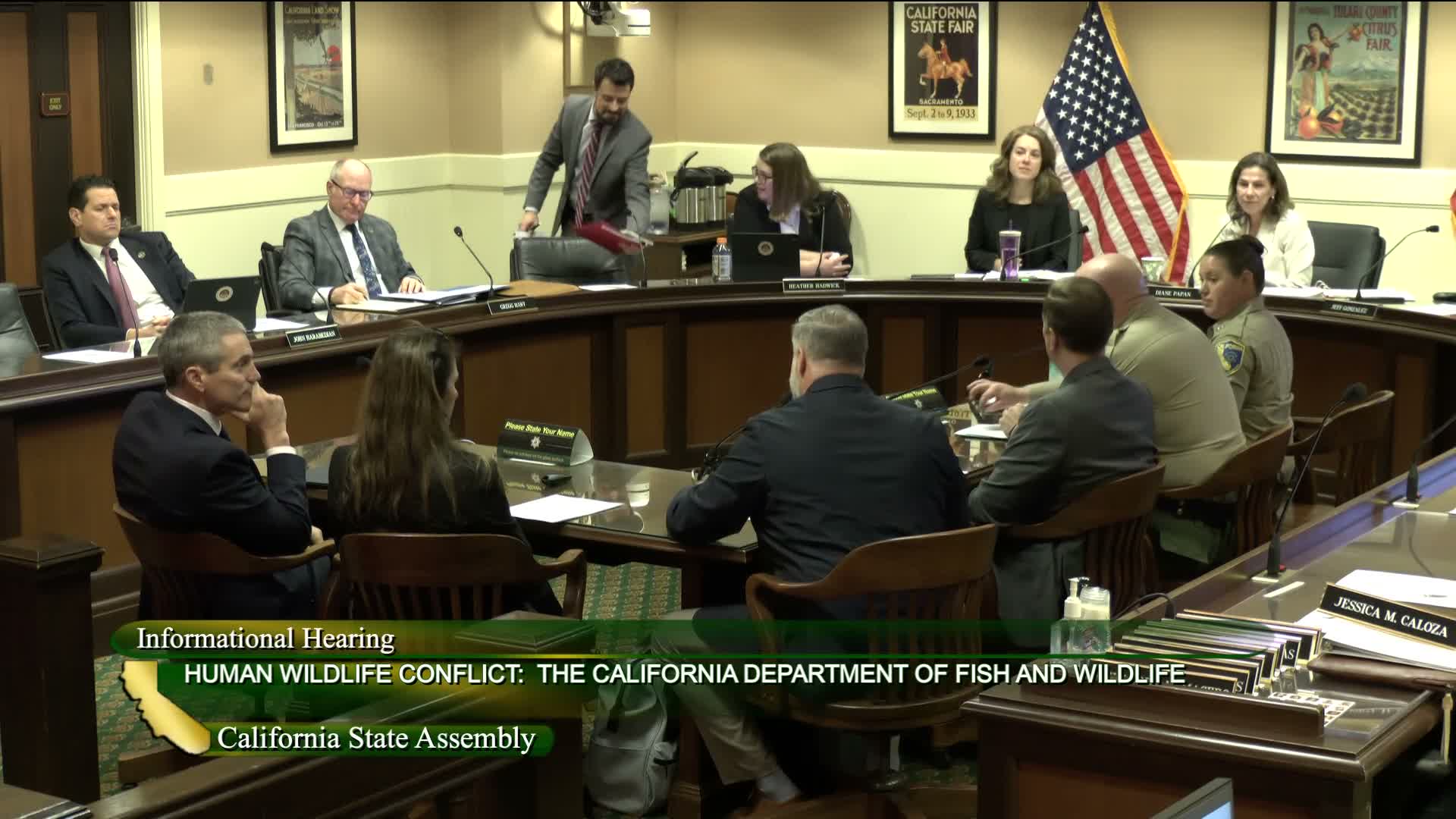
Assembly members and wildlife officials on Tuesday discussed the strain on California’s wildlife conflict programs and urged longer‑term funding and staffing to support prevention, rapid response and community outreach.
Secretary Crowfoot and acting Department of Fish and Wildlife (CDFW) officials outlined the department’s efforts to prevent and respond to predator conflicts, citing an uptick in incidents statewide and the need to balance public safety with wildlife conservation. Acting Director Valerie Trini described prevention priorities — habitat restoration, education, and partnerships — and said the department is eager to expand collaborative work with counties, sheriffs and nonprofit partners.
CDFW deputy director Chad Dibble told the committee the department developed a human–wildlife conflict program after drought‑era spikes in incidents. The department created an online toolkit and the wildlife incident reporting system (WEIR) to track reports; Dibble said WEIR logs about 6,000 reports yearly while the department fields some 30,000–45,000 calls a year about wildlife incidents, indicating substantial underreporting in some communities.
Panelists reviewed the recent pattern of one‑time budget surges that expanded response capacity but left limited‑term positions vulnerable when funds expired. Dibble summarized recent appropriations he said supported this work: roughly $7 million in 2021–22, $5 million in 2023, a separate $3 million legislative allocation to start a wolf compensation pilot (followed by $600,000 and a $2 million addition in later budgets). CDFW staff characterized much of this money as one‑time and said it funded roughly 20 limited‑term positions that now risk attrition.
Stakeholders across the hearing urged durable funding. Kirk Wilbur of the California Cattlemen’s Association asked the Legislature to continue oversight and consider sustained appropriations to restore staffing and expand on‑the‑ground liaisons. Multiple conservation groups asked the committee to fund a statewide coexistence program that would create permanent positions for prevention, rapid response, and research coordination.
Assembly members pressed CDFW on concrete next steps: institutionalizing county liaisons and data‑sharing agreements, expanding DNA and forensic capacity to speed depredation confirmation, and costing technology investments that could improve efficiency. CDFW acknowledged gaps and said it is pursuing targeted partnerships, pilot programs and stakeholder input as it develops longer‑term recommendations.
The hearing concluded with broad agreement among agency officials, scientists and stakeholders that more stable funding and staffing — paired with community education and locally tailored prevention — are central to limiting conflict and protecting both Californians and wildlife.
Secretary Crowfoot and acting Department of Fish and Wildlife (CDFW) officials outlined the department’s efforts to prevent and respond to predator conflicts, citing an uptick in incidents statewide and the need to balance public safety with wildlife conservation. Acting Director Valerie Trini described prevention priorities — habitat restoration, education, and partnerships — and said the department is eager to expand collaborative work with counties, sheriffs and nonprofit partners.
CDFW deputy director Chad Dibble told the committee the department developed a human–wildlife conflict program after drought‑era spikes in incidents. The department created an online toolkit and the wildlife incident reporting system (WEIR) to track reports; Dibble said WEIR logs about 6,000 reports yearly while the department fields some 30,000–45,000 calls a year about wildlife incidents, indicating substantial underreporting in some communities.
Panelists reviewed the recent pattern of one‑time budget surges that expanded response capacity but left limited‑term positions vulnerable when funds expired. Dibble summarized recent appropriations he said supported this work: roughly $7 million in 2021–22, $5 million in 2023, a separate $3 million legislative allocation to start a wolf compensation pilot (followed by $600,000 and a $2 million addition in later budgets). CDFW staff characterized much of this money as one‑time and said it funded roughly 20 limited‑term positions that now risk attrition.
Stakeholders across the hearing urged durable funding. Kirk Wilbur of the California Cattlemen’s Association asked the Legislature to continue oversight and consider sustained appropriations to restore staffing and expand on‑the‑ground liaisons. Multiple conservation groups asked the committee to fund a statewide coexistence program that would create permanent positions for prevention, rapid response, and research coordination.
Assembly members pressed CDFW on concrete next steps: institutionalizing county liaisons and data‑sharing agreements, expanding DNA and forensic capacity to speed depredation confirmation, and costing technology investments that could improve efficiency. CDFW acknowledged gaps and said it is pursuing targeted partnerships, pilot programs and stakeholder input as it develops longer‑term recommendations.
The hearing concluded with broad agreement among agency officials, scientists and stakeholders that more stable funding and staffing — paired with community education and locally tailored prevention — are central to limiting conflict and protecting both Californians and wildlife.
View the Full Meeting & All Its Details
This article offers just a summary. Unlock complete video, transcripts, and insights as a Founder Member.
✓
Watch full, unedited meeting videos
✓
Search every word spoken in unlimited transcripts
✓
AI summaries & real-time alerts (all government levels)
✓
Permanent access to expanding government content
30-day money-back guarantee
