Ranchers press for faster depredation response as wolves expand across California
January 27, 2026 | California State Assembly, House, Legislative, California
This article was created by AI summarizing key points discussed. AI makes mistakes, so for full details and context, please refer to the video of the full meeting. Please report any errors so we can fix them. Report an error »
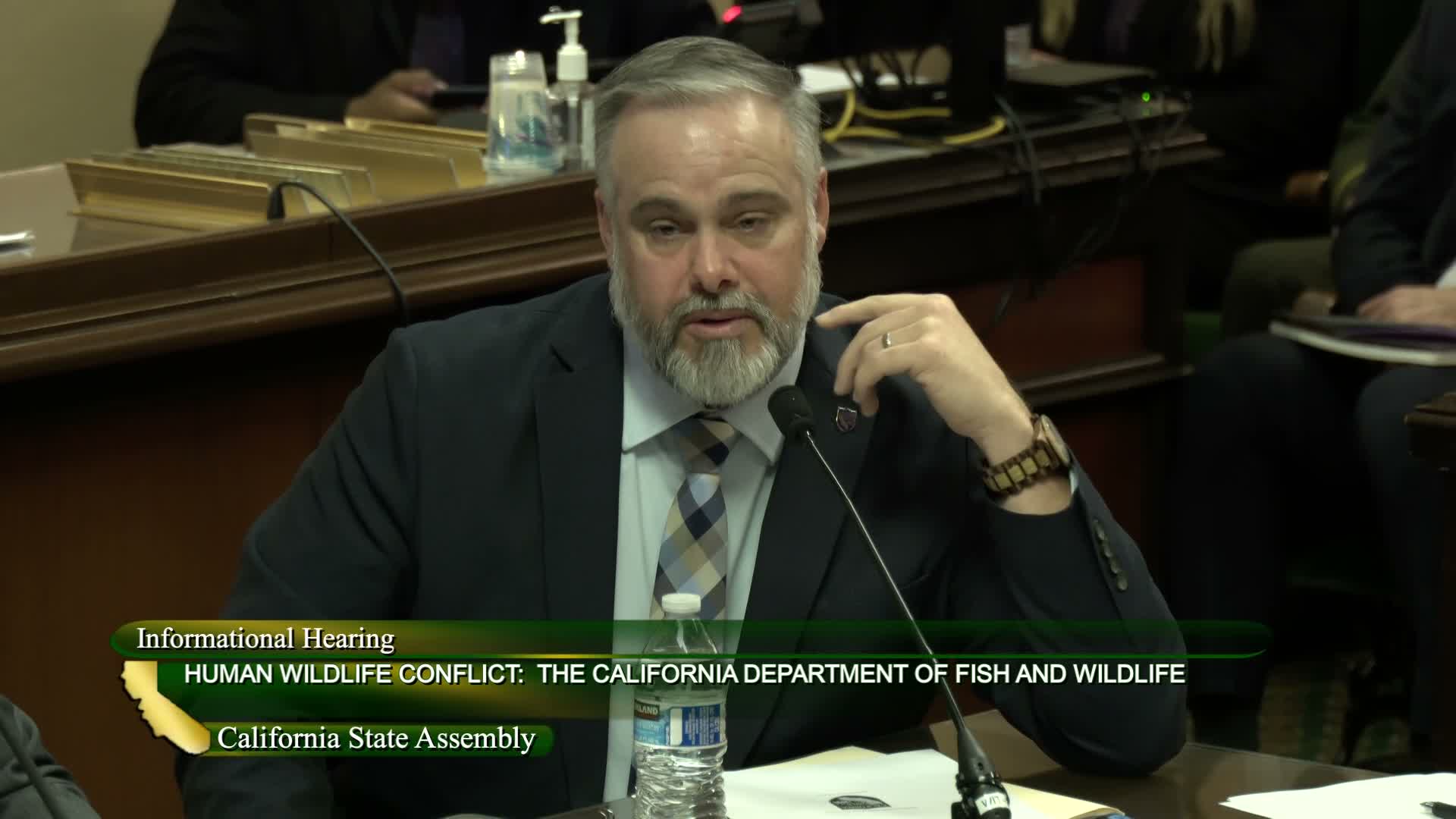
Ranchers and local law enforcement told an Assembly informational hearing that state wildlife managers need more resources and clearer procedures to respond to wolf depredations, while CDFW outlined current tools and recent pilot funding.
Kirk Wilbur of the California Cattlemen’s Association recounted escalating livestock losses and urged sustained funding and operational changes, including more GPS collars on wolves, improved telemetry and an appeals process when depredation determinations are inconclusive. Wilbur said ranchers experience both direct loss and significant indirect costs — lower weight gain, stress and aborted pregnancies — and called for stable program funding to support nonlethal deterrents and compensation.
CDFW staff described a three‑pronged wolf compensation program: (1) reimbursement for direct loss at fair market value, (2) grants for nonlethal measures (fladry, range riders, lights), and (3) pay‑for‑presence to offset indirect economic impacts. Chad Dibble and other agency witnesses said the Legislature initially provided roughly $3 million to launch a pilot compensation program and later added smaller tranches; agency staff said they are holding a subset of funds for direct loss while exploring strategic uses of remaining allocations.
Agency witnesses also outlined data tools and procedural limits. CDFW has published a wolf tracking map driven by satellite collars that creates daily polygons of recent locations; agency staff said they are pursuing county liaisons and data‑sharing agreements to get timely information to ranchers. CDFW emphasized that depredation conclusions require evidence and DNA confirmation in many cases, and said that delays in lab processing and staff capacity can slow determinations.
Sheriff Mike Fisher described the human and community toll of repeated, proximate predator incidents in Sierra Valley and argued for clearer public‑safety thresholds and earlier, more robust responses when communities face sustained risk. Conservation and scientific witnesses urged prioritizing early nonlethal intervention and community co‑designed programs to reduce habituation and long‑term impacts.
The hearing left open key questions about appeals processes for inconclusive investigations, the scale of funding needed for statewide rollout, and how to balance endangered‑species protections with rancher needs. Stakeholders agreed to continue dialogue with CDFW on collars, data sharing and compensation guidelines.
Kirk Wilbur of the California Cattlemen’s Association recounted escalating livestock losses and urged sustained funding and operational changes, including more GPS collars on wolves, improved telemetry and an appeals process when depredation determinations are inconclusive. Wilbur said ranchers experience both direct loss and significant indirect costs — lower weight gain, stress and aborted pregnancies — and called for stable program funding to support nonlethal deterrents and compensation.
CDFW staff described a three‑pronged wolf compensation program: (1) reimbursement for direct loss at fair market value, (2) grants for nonlethal measures (fladry, range riders, lights), and (3) pay‑for‑presence to offset indirect economic impacts. Chad Dibble and other agency witnesses said the Legislature initially provided roughly $3 million to launch a pilot compensation program and later added smaller tranches; agency staff said they are holding a subset of funds for direct loss while exploring strategic uses of remaining allocations.
Agency witnesses also outlined data tools and procedural limits. CDFW has published a wolf tracking map driven by satellite collars that creates daily polygons of recent locations; agency staff said they are pursuing county liaisons and data‑sharing agreements to get timely information to ranchers. CDFW emphasized that depredation conclusions require evidence and DNA confirmation in many cases, and said that delays in lab processing and staff capacity can slow determinations.
Sheriff Mike Fisher described the human and community toll of repeated, proximate predator incidents in Sierra Valley and argued for clearer public‑safety thresholds and earlier, more robust responses when communities face sustained risk. Conservation and scientific witnesses urged prioritizing early nonlethal intervention and community co‑designed programs to reduce habituation and long‑term impacts.
The hearing left open key questions about appeals processes for inconclusive investigations, the scale of funding needed for statewide rollout, and how to balance endangered‑species protections with rancher needs. Stakeholders agreed to continue dialogue with CDFW on collars, data sharing and compensation guidelines.
Don't Miss a Word: See the Full Meeting!
Go beyond summaries. Unlock every video, transcript, and key insight with a Founder Membership.
✓
Get instant access to full meeting videos
✓
Search and clip any phrase from complete transcripts
✓
Receive AI-powered summaries & custom alerts
✓
Enjoy lifetime, unrestricted access to government data
30-day money-back guarantee
