California Assembly Adopts Resolution Declaring January 2026 Human Trafficking Awareness Month
January 20, 2026 | California State Assembly, House, Legislative, California
This article was created by AI summarizing key points discussed. AI makes mistakes, so for full details and context, please refer to the video of the full meeting. Please report any errors so we can fix them. Report an error »
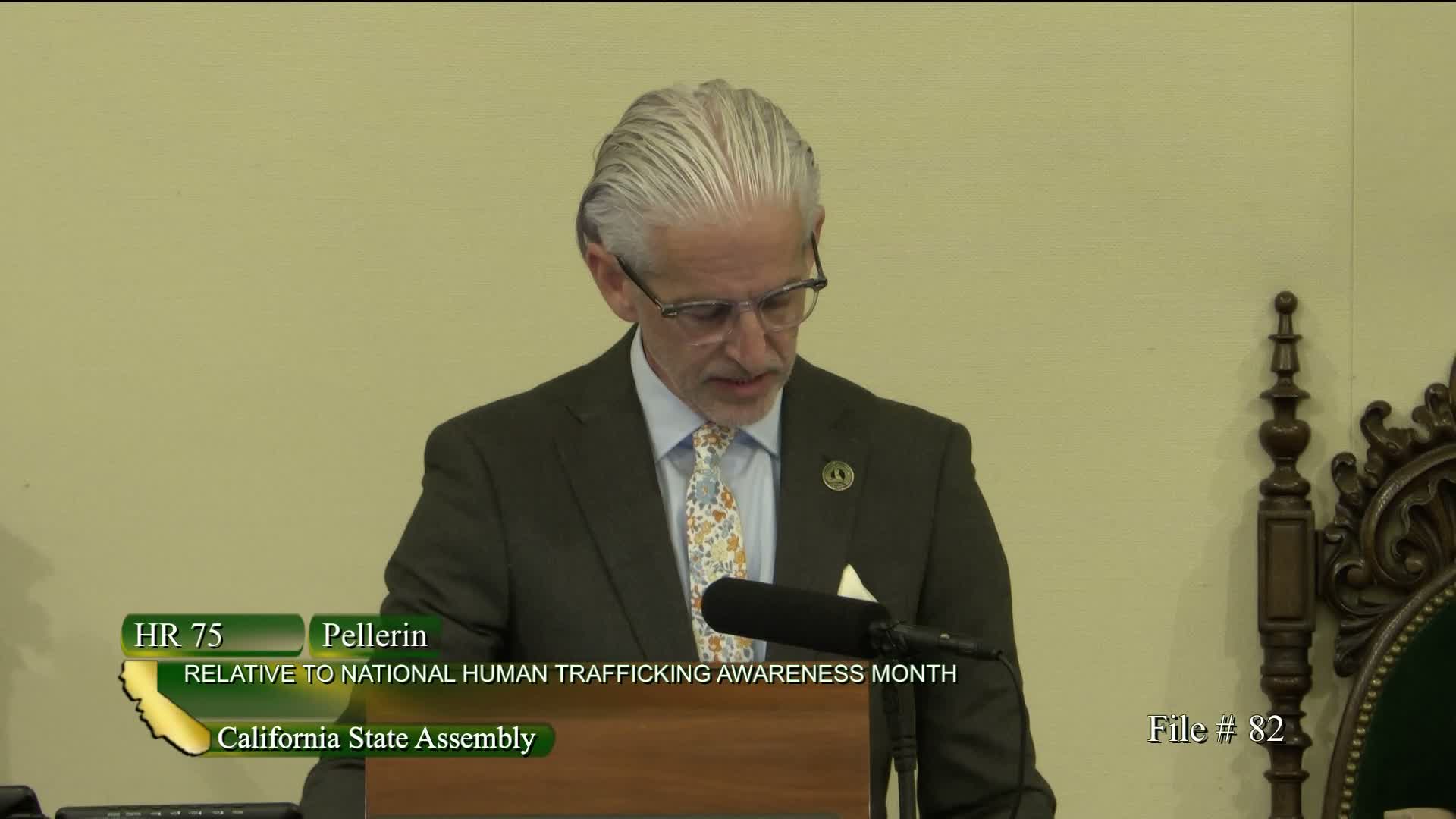
The California State Assembly on Wednesday adopted House Resolution 75, designating January 2026 as National Human Trafficking Awareness Month and affirming a survivor‑centered approach to prevention and recovery.
Assemblymember Mia Pellerin, who introduced HR 75, told colleagues the resolution was “written by survivors of human trafficking from across the state.” She said the measure centers survivors “as leaders in the anti‑trafficking movement” and calls for coordinated, survivor‑informed strategies ahead of large events that can increase vulnerability.
Why it matters: supporters said the designation raises public awareness, reinforces prevention and victim‑support efforts, and signals the Legislature’s intent to prioritize services and coordinated responses across counties and agencies. Multiple members tied the need for action to recent local cases and to the expected influx of visitors for major sporting events.
Several members described both the human toll and policy gaps. Assemblymember Gibson recounted a 2022 homicide involving a 16‑year‑old and said such cases illustrate the immediate harms trafficking causes; she urged colleagues to treat survivors’ perspectives as central to policy solutions. Assemblymember Dixon highlighted past legislation that extended foster care support to children of trafficking victims and described ongoing efforts to improve statewide data collection on human‑trafficking incidents. Assemblymember Ramos emphasized attention to missing and murdered Indigenous people and the need for resources when survivors return home.
The clerk opened a roll for co‑authors; the assembly added 64 co‑authors without objection. The chamber then took a voice vote; the presiding officer declared, “The ayes have it,” and the resolution was adopted.
Following adoption, Pellerin invited survivors and anti‑trafficking advocates to the floor, naming guests including Jess Torres of Rising Worldwide and Josie Femster of the Child and Family Policy Institute of California. Pellerin said the resolution reaffirms California’s commitment to combating trafficking, supporting survivors’ recovery, and holding perpetrators accountable.
The resolution is a formal expression of the assembly’s position; it does not itself create new statutory authority or funding. Members who raised legislative gaps and data shortfalls signaled intentions to pursue further statutory or budgetary measures in subsequent bills and hearings.
Assemblymember Mia Pellerin, who introduced HR 75, told colleagues the resolution was “written by survivors of human trafficking from across the state.” She said the measure centers survivors “as leaders in the anti‑trafficking movement” and calls for coordinated, survivor‑informed strategies ahead of large events that can increase vulnerability.
Why it matters: supporters said the designation raises public awareness, reinforces prevention and victim‑support efforts, and signals the Legislature’s intent to prioritize services and coordinated responses across counties and agencies. Multiple members tied the need for action to recent local cases and to the expected influx of visitors for major sporting events.
Several members described both the human toll and policy gaps. Assemblymember Gibson recounted a 2022 homicide involving a 16‑year‑old and said such cases illustrate the immediate harms trafficking causes; she urged colleagues to treat survivors’ perspectives as central to policy solutions. Assemblymember Dixon highlighted past legislation that extended foster care support to children of trafficking victims and described ongoing efforts to improve statewide data collection on human‑trafficking incidents. Assemblymember Ramos emphasized attention to missing and murdered Indigenous people and the need for resources when survivors return home.
The clerk opened a roll for co‑authors; the assembly added 64 co‑authors without objection. The chamber then took a voice vote; the presiding officer declared, “The ayes have it,” and the resolution was adopted.
Following adoption, Pellerin invited survivors and anti‑trafficking advocates to the floor, naming guests including Jess Torres of Rising Worldwide and Josie Femster of the Child and Family Policy Institute of California. Pellerin said the resolution reaffirms California’s commitment to combating trafficking, supporting survivors’ recovery, and holding perpetrators accountable.
The resolution is a formal expression of the assembly’s position; it does not itself create new statutory authority or funding. Members who raised legislative gaps and data shortfalls signaled intentions to pursue further statutory or budgetary measures in subsequent bills and hearings.
Don't Miss a Word: See the Full Meeting!
Go beyond summaries. Unlock every video, transcript, and key insight with a Founder Membership.
✓
Get instant access to full meeting videos
✓
Search and clip any phrase from complete transcripts
✓
Receive AI-powered summaries & custom alerts
✓
Enjoy lifetime, unrestricted access to government data
30-day money-back guarantee
