Merrimack budget committee outlines review strategy and presses for breakdown of proposed budget increases
December 13, 2024 | Merrimack School District, School Districts, New Hampshire
This article was created by AI summarizing key points discussed. AI makes mistakes, so for full details and context, please refer to the video of the full meeting. Please report any errors so we can fix them. Report an error »
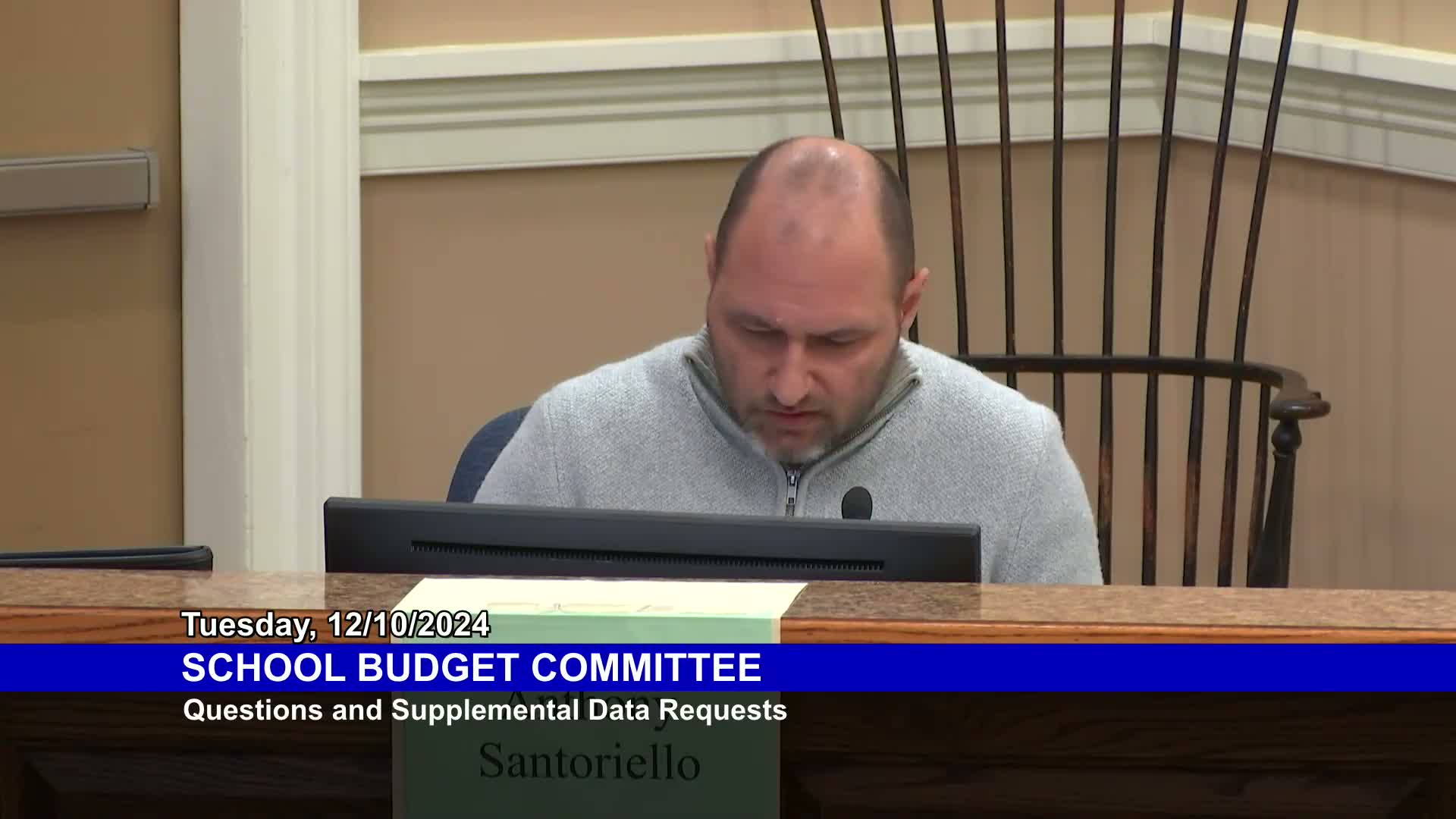
The Merrimack School Budget Committee adopted a strategy for reviewing the district’s fiscal 2025–26 budget that emphasizes liaison-team fact-finding, pre-meeting review of recorded school-board presentations and short working sessions at regular meetings to avoid repetitive, hour-long presentations.
Chair Jennifer told members they would receive department budget books and that the committee will focus on departments scheduled for each January meeting (Jan. 7: district administration; Jan. 14: elementary through high school; Jan. 28: technology, food service, maintenance, special services). Liaison-team leads will gather questions in advance, meet with department heads, complete a simple minutes template and forward summaries to the full committee in supplemental materials.
Members also drilled into numbers. Speaker 12 flagged a slide from the administration’s Dec. 2 presentation showing an administration-requested FY26 budget of $96.8 million and questioned why the default budget, reported elsewhere, has risen by roughly $4.5–$5.5 million year over year. He asked for a detailed explanation of the drivers behind the increase and historical spending trends. The committee requested clarity on the default budget figure, the components of that growth and documentation on recurring vs. one-time costs.
Business-manager-level commentary (speaker 8) attributed the majority of the increase to contractual obligations—teacher and support-staff contracts approved by voters in recent years—and a projected health-insurance premium increase (speaker 8 cited a large guaranteed-maximum rate hike). Speaker 8 also said the district is experiencing increased costs from state-level “unfunded mandates,” which shift new requirements to local budgets without additional state funding.
Committee follow-ups and data requests included: historical five-year trends for free-and-reduced-price lunch participation; line-item breakout and trend analysis for health insurance and retirement costs; contracts and special-education service-provider agreements; a full listing (the 'decoder') explaining budget codes and object/unit numbers; and an explanation of the district surplus levels and how they are being managed.
Quotes:
"For some reason [the slide] said the approved budget is 93 [million], that's not true," Speaker 12 said, pressing for accuracy and for the administration to explain how default numbers were calculated.
"Health insurance is the bulk of it," speaker 8 said, pointing to a projected guaranteed-maximum rate increase as a major driver of the default-budget growth.
Why it matters: The committee must recommend a bottom-line budget for voters; understanding whether increases stem from contractual obligations, rising insurance costs or new programmatic investments affects whether and how the committee will adjust its recommended figure before the deliberative session.
What’s next: Chair will collect and circulate requested supplemental data and a schedule of liaison meetings; members will review recorded school-board presentations and submit targeted questions to liaison-team leads ahead of department meetings.
Chair Jennifer told members they would receive department budget books and that the committee will focus on departments scheduled for each January meeting (Jan. 7: district administration; Jan. 14: elementary through high school; Jan. 28: technology, food service, maintenance, special services). Liaison-team leads will gather questions in advance, meet with department heads, complete a simple minutes template and forward summaries to the full committee in supplemental materials.
Members also drilled into numbers. Speaker 12 flagged a slide from the administration’s Dec. 2 presentation showing an administration-requested FY26 budget of $96.8 million and questioned why the default budget, reported elsewhere, has risen by roughly $4.5–$5.5 million year over year. He asked for a detailed explanation of the drivers behind the increase and historical spending trends. The committee requested clarity on the default budget figure, the components of that growth and documentation on recurring vs. one-time costs.
Business-manager-level commentary (speaker 8) attributed the majority of the increase to contractual obligations—teacher and support-staff contracts approved by voters in recent years—and a projected health-insurance premium increase (speaker 8 cited a large guaranteed-maximum rate hike). Speaker 8 also said the district is experiencing increased costs from state-level “unfunded mandates,” which shift new requirements to local budgets without additional state funding.
Committee follow-ups and data requests included: historical five-year trends for free-and-reduced-price lunch participation; line-item breakout and trend analysis for health insurance and retirement costs; contracts and special-education service-provider agreements; a full listing (the 'decoder') explaining budget codes and object/unit numbers; and an explanation of the district surplus levels and how they are being managed.
Quotes:
"For some reason [the slide] said the approved budget is 93 [million], that's not true," Speaker 12 said, pressing for accuracy and for the administration to explain how default numbers were calculated.
"Health insurance is the bulk of it," speaker 8 said, pointing to a projected guaranteed-maximum rate increase as a major driver of the default-budget growth.
Why it matters: The committee must recommend a bottom-line budget for voters; understanding whether increases stem from contractual obligations, rising insurance costs or new programmatic investments affects whether and how the committee will adjust its recommended figure before the deliberative session.
What’s next: Chair will collect and circulate requested supplemental data and a schedule of liaison meetings; members will review recorded school-board presentations and submit targeted questions to liaison-team leads ahead of department meetings.
View the Full Meeting & All Its Details
This article offers just a summary. Unlock complete video, transcripts, and insights as a Founder Member.
✓
Watch full, unedited meeting videos
✓
Search every word spoken in unlimited transcripts
✓
AI summaries & real-time alerts (all government levels)
✓
Permanent access to expanding government content
30-day money-back guarantee
