Library board approves collection policy changes, opts to monitor AI‑generated materials rather than ban them
December 22, 2025 | Iowa City, Johnson County, Iowa
This article was created by AI summarizing key points discussed. AI makes mistakes, so for full details and context, please refer to the video of the full meeting. Please report any errors so we can fix them. Report an error »
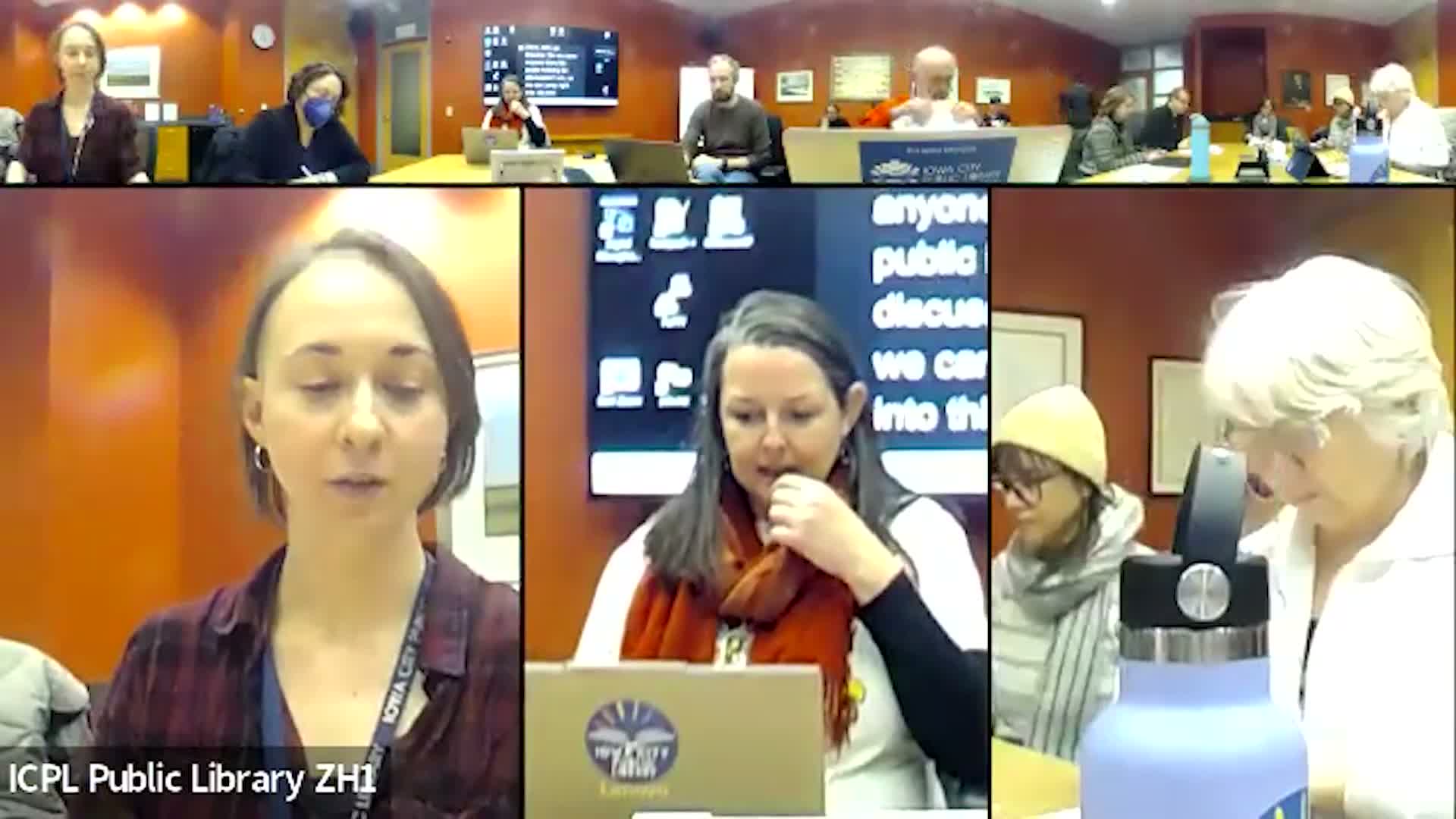
Unidentified Speaker 2, a library staff member, presented proposed updates to the library’s collection development policy and told trustees the selectors had debated two issues at length: whether to adopt a formal reconsideration process and whether to adopt a policy about materials generated with artificial intelligence. "We're not requesting a change for that, but we are, going to monitor that," the staff member said, summarizing the recommendation to avoid a categorical ban on AI content and instead track industry practices.
The staff presentation noted uncertainty about how publishers use AI (cover art, editing, writing) and that there is “no good way of knowing” whether a title has been generated or altered with AI. To address that, staff proposed adding "quality of work" as a criterion trustees and selectors can use to exclude items that are poorly produced, including suspect AI‑generated works, and to apply the standard consistently to independent/self‑published materials.
Board members discussed practical implications. Unidentified Speaker 3 raised concerns about how the board would respond to community recommendations for purchase and how a reconsideration process could be structured so it would not appear politically stacked. One board member described common practice in smaller communities to preselect committee members (for example: two parents, two staff members, one board member, one city council member) so complaints are handled by a predetermined panel. Unidentified Speaker 2 reiterated that this board historically has not maintained a formal reconsideration process, a practice dating to the 1970s meant to avoid creating an expectation that contested titles would be removed.
Before voting, trustees asked staff to clarify language changes intended to improve clarity and remove jargon. The board then considered a motion "to approve the policy with the changes of the word 'Withdrawn' to 'removed.'" The motion was moved and seconded on the record; a voice vote was taken and the motion carried with "Aye" recorded. No roll‑call vote or individual tallies were recorded in the transcript.
Why it matters: The decision steers the library away from an AI‑specific prohibition while giving selectors discretion to exclude materially low‑quality items. That approach leaves room for future policy adjustments if practical methods for identifying AI authorship emerge.
What’s next: Staff will monitor publisher practices and industry norms regarding AI use and bring any recommended policy updates back to the board if identification or labeling of AI‑generated content becomes practicable.
The staff presentation noted uncertainty about how publishers use AI (cover art, editing, writing) and that there is “no good way of knowing” whether a title has been generated or altered with AI. To address that, staff proposed adding "quality of work" as a criterion trustees and selectors can use to exclude items that are poorly produced, including suspect AI‑generated works, and to apply the standard consistently to independent/self‑published materials.
Board members discussed practical implications. Unidentified Speaker 3 raised concerns about how the board would respond to community recommendations for purchase and how a reconsideration process could be structured so it would not appear politically stacked. One board member described common practice in smaller communities to preselect committee members (for example: two parents, two staff members, one board member, one city council member) so complaints are handled by a predetermined panel. Unidentified Speaker 2 reiterated that this board historically has not maintained a formal reconsideration process, a practice dating to the 1970s meant to avoid creating an expectation that contested titles would be removed.
Before voting, trustees asked staff to clarify language changes intended to improve clarity and remove jargon. The board then considered a motion "to approve the policy with the changes of the word 'Withdrawn' to 'removed.'" The motion was moved and seconded on the record; a voice vote was taken and the motion carried with "Aye" recorded. No roll‑call vote or individual tallies were recorded in the transcript.
Why it matters: The decision steers the library away from an AI‑specific prohibition while giving selectors discretion to exclude materially low‑quality items. That approach leaves room for future policy adjustments if practical methods for identifying AI authorship emerge.
What’s next: Staff will monitor publisher practices and industry norms regarding AI use and bring any recommended policy updates back to the board if identification or labeling of AI‑generated content becomes practicable.
View the Full Meeting & All Its Details
This article offers just a summary. Unlock complete video, transcripts, and insights as a Founder Member.
✓
Watch full, unedited meeting videos
✓
Search every word spoken in unlimited transcripts
✓
AI summaries & real-time alerts (all government levels)
✓
Permanent access to expanding government content
30-day money-back guarantee
