Committee Gives SB61 Favorable Report Despite Warnings It Would Increase SNAP, Medicaid Burden
January 22, 2026 | Finance and Taxation General Fund, Senate, Alabama Legislative Sessions, Alabama
This article was created by AI summarizing key points discussed. AI makes mistakes, so for full details and context, please refer to the video of the full meeting. Please report any errors so we can fix them. Report an error »
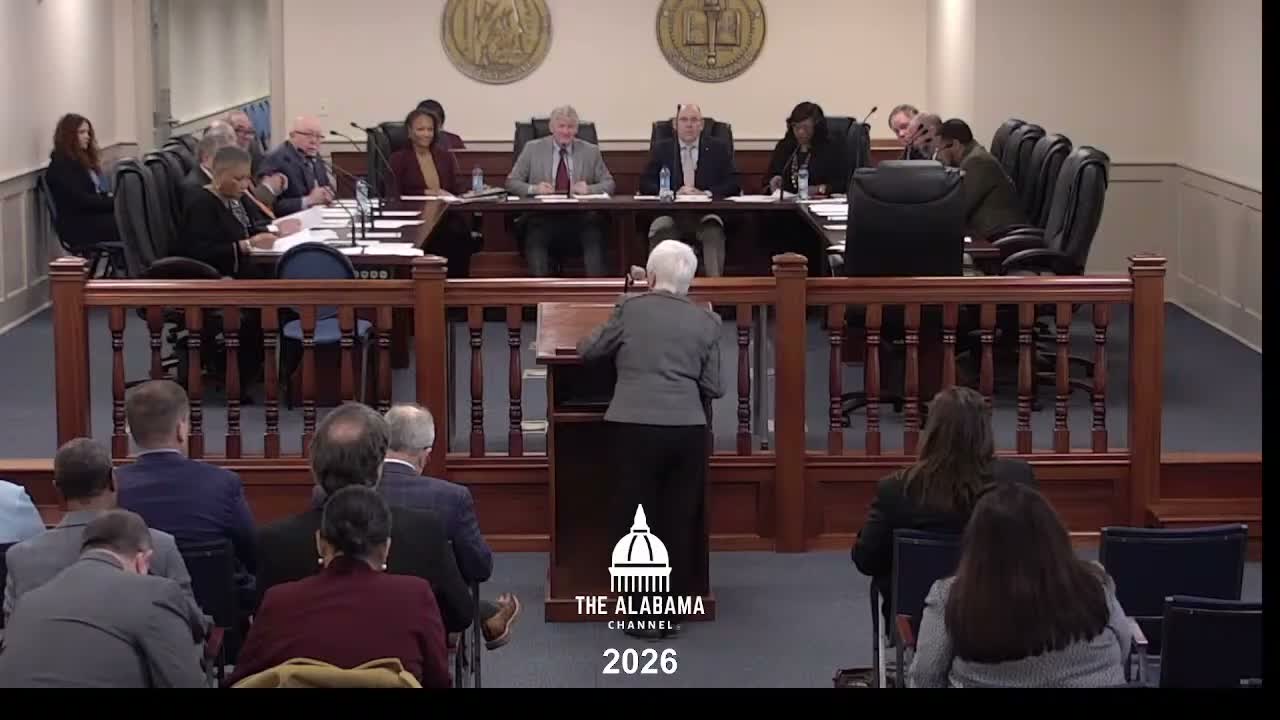
A Senate committee voted to give SB61 a favorable report after public testimony and extended questioning about the bill’s effects on SNAP and Medicaid eligibility.
Supporters of SB61 say the bill tightens eligibility verification, but witnesses from advocacy groups and state agencies told senators it would significantly raise program costs and administrative work. Carol Gunlock, senior policy analyst at Alabama Arise, said the measure “would drive up the administrative burden” for SNAP and likely increase the program’s error rate. Gunlock also warned shorter certification periods would cause churn that leaves families temporarily without benefits.
DHR staff and the Medicaid office described operational challenges if the bill becomes law. Agency staff said Alabama’s error rate is about 9 percent and noted a federal waiver that changes how errors are counted; they also described existing “express lane” data sharing that transfers TANF enrollments to Medicaid to avoid duplicate work. DHR staff told the committee the state runs roughly 702,000 SNAP cases (down from about 740,000), about 330,000 of which are children, and that many recipients are working but underemployed.
Ashley Liarly, senior director of advocacy for the American Lung Association, said the fiscal note posted the same day estimated a $4,000,000 state share impact for Medicaid and at least $12,700,000 for the Department of Human Resources, and predicted the bill would create enrollment barriers and delays in care.
Committee members voiced concern about the cost of additional staffing and technology required for frequent cross‑agency verification. Several senators urged the sponsor to meet with agency leaders to refine the bill’s technical details before moving it further. Despite those concerns, the chair moved for a favorable report, the motion was seconded, and the committee approved SB61 by committee vote, announced as "By 8 4," advancing the bill out of committee.
The committee record shows neither passage nor implementation details beyond the favorable report; senators who objected asked for continued work with DHR and cautioned against creating punitive administrative burdens that could harm elderly and disabled beneficiaries.
Supporters of SB61 say the bill tightens eligibility verification, but witnesses from advocacy groups and state agencies told senators it would significantly raise program costs and administrative work. Carol Gunlock, senior policy analyst at Alabama Arise, said the measure “would drive up the administrative burden” for SNAP and likely increase the program’s error rate. Gunlock also warned shorter certification periods would cause churn that leaves families temporarily without benefits.
DHR staff and the Medicaid office described operational challenges if the bill becomes law. Agency staff said Alabama’s error rate is about 9 percent and noted a federal waiver that changes how errors are counted; they also described existing “express lane” data sharing that transfers TANF enrollments to Medicaid to avoid duplicate work. DHR staff told the committee the state runs roughly 702,000 SNAP cases (down from about 740,000), about 330,000 of which are children, and that many recipients are working but underemployed.
Ashley Liarly, senior director of advocacy for the American Lung Association, said the fiscal note posted the same day estimated a $4,000,000 state share impact for Medicaid and at least $12,700,000 for the Department of Human Resources, and predicted the bill would create enrollment barriers and delays in care.
Committee members voiced concern about the cost of additional staffing and technology required for frequent cross‑agency verification. Several senators urged the sponsor to meet with agency leaders to refine the bill’s technical details before moving it further. Despite those concerns, the chair moved for a favorable report, the motion was seconded, and the committee approved SB61 by committee vote, announced as "By 8 4," advancing the bill out of committee.
The committee record shows neither passage nor implementation details beyond the favorable report; senators who objected asked for continued work with DHR and cautioned against creating punitive administrative burdens that could harm elderly and disabled beneficiaries.
Don't Miss a Word: See the Full Meeting!
Go beyond summaries. Unlock every video, transcript, and key insight with a Founder Membership.
✓
Get instant access to full meeting videos
✓
Search and clip any phrase from complete transcripts
✓
Receive AI-powered summaries & custom alerts
✓
Enjoy lifetime, unrestricted access to government data
30-day money-back guarantee
