House panel reports favorably on constitutional amendment to protect religious expression in schools after intense public testimony
January 22, 2026 | 2026 Legislature FL, Florida
This article was created by AI summarizing key points discussed. AI makes mistakes, so for full details and context, please refer to the video of the full meeting. Please report any errors so we can fix them. Report an error »
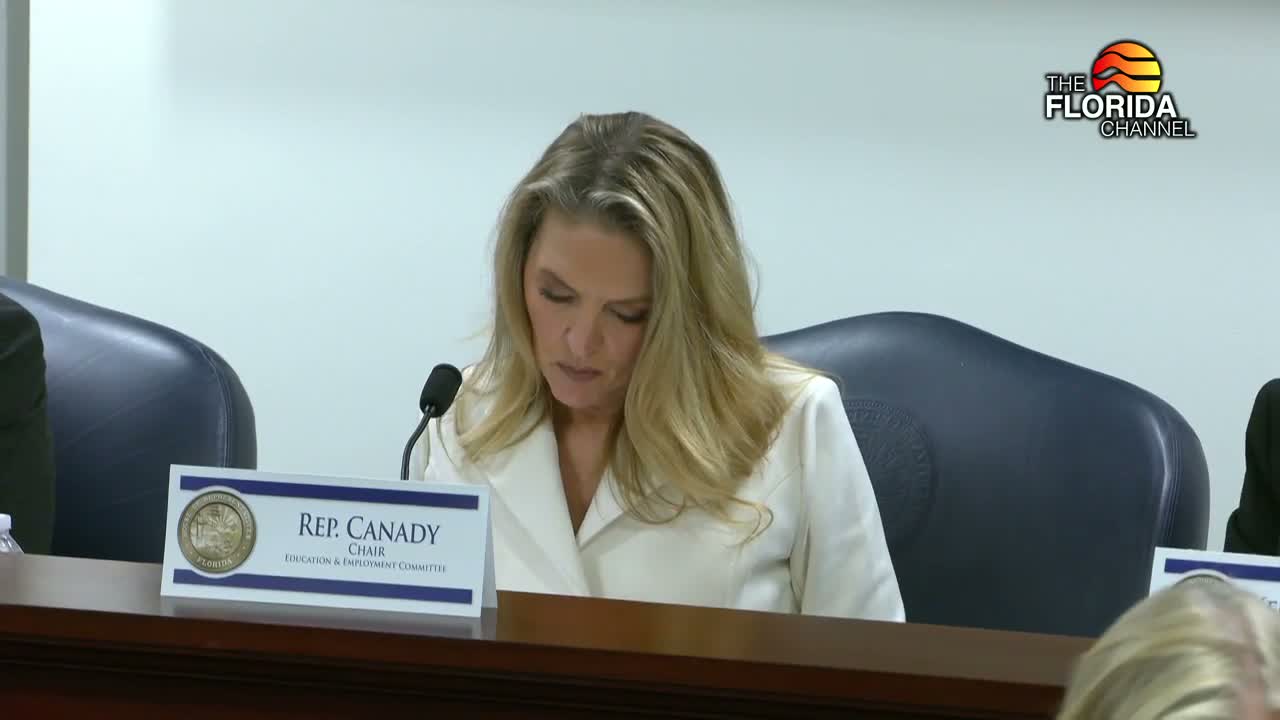
The Education and Employment Committee in Tallahassee reported favorably on House Joint Resolution 583, a proposed constitutional amendment that would enshrine certain protections for religious expression in public schools, including student work, attire, prayer, moments of silence and certain school events. Representative Tremont, the sponsor, told the committee the measure would "codify very specific expressions" into the constitution to protect what he called god‑given rights that statutes alone leave vulnerable to repeal.
Opponents urged caution, arguing the amendment would lock detailed educational policy into the constitution and could reduce local flexibility. Kristen Mushette, presenting herself as a Florida parent and public‑education advocate, said HJR 583 "represents a structural change in how educational policy would be governed in Florida" and warned that constitutionalizing these provisions could leave districts and lawmakers with fewer tools to respond to unintended consequences. "Advance these protections, if desired, through statute, but not through the Constitution," she said.
Religious and civil‑liberties witnesses offered contrasting views. Adwan Whitfield of the Interfaith Alliance said the amendment "will create fear where there should be trust," arguing it could increase division and place burdens on already vulnerable people. Reverend Dr. Russell Meyer of the Florida Council of Churches testified that codifying the language could allow religious opinion to supplant science in coursework and foster coercive pressure on students. By contrast, John Labriola of the Christian Family Coalition said the amendment would clarify statutory protections that, he contended, some districts have misunderstood, and would reassure students their religious freedoms extend into school settings.
Members debated along those lines. Ranking Member Henson, a former principal, pressed the sponsor for specifics and cautioned that protections already exist under state and federal constitutions; she said she wanted clarity for constituents about implementation. Representative Harris said she would vote against the measure, saying the amendment's broad phrasing risks favoring majority religious expression and could marginalize minority‑faith or non‑faith students. Several other members, including Representative Kendall and Representative Dunkley, voiced support and framed the proposal as letting voters decide.
After closing remarks by Representative Tremont, the clerk called the roll. The committee recorded 18 yeas and 1 nay, and HJR 583 was reported favorably to the next stage.
The measure now moves forward in the legislative process for further consideration and, if advanced, would appear on the ballot for voters to approve or reject.
Opponents urged caution, arguing the amendment would lock detailed educational policy into the constitution and could reduce local flexibility. Kristen Mushette, presenting herself as a Florida parent and public‑education advocate, said HJR 583 "represents a structural change in how educational policy would be governed in Florida" and warned that constitutionalizing these provisions could leave districts and lawmakers with fewer tools to respond to unintended consequences. "Advance these protections, if desired, through statute, but not through the Constitution," she said.
Religious and civil‑liberties witnesses offered contrasting views. Adwan Whitfield of the Interfaith Alliance said the amendment "will create fear where there should be trust," arguing it could increase division and place burdens on already vulnerable people. Reverend Dr. Russell Meyer of the Florida Council of Churches testified that codifying the language could allow religious opinion to supplant science in coursework and foster coercive pressure on students. By contrast, John Labriola of the Christian Family Coalition said the amendment would clarify statutory protections that, he contended, some districts have misunderstood, and would reassure students their religious freedoms extend into school settings.
Members debated along those lines. Ranking Member Henson, a former principal, pressed the sponsor for specifics and cautioned that protections already exist under state and federal constitutions; she said she wanted clarity for constituents about implementation. Representative Harris said she would vote against the measure, saying the amendment's broad phrasing risks favoring majority religious expression and could marginalize minority‑faith or non‑faith students. Several other members, including Representative Kendall and Representative Dunkley, voiced support and framed the proposal as letting voters decide.
After closing remarks by Representative Tremont, the clerk called the roll. The committee recorded 18 yeas and 1 nay, and HJR 583 was reported favorably to the next stage.
The measure now moves forward in the legislative process for further consideration and, if advanced, would appear on the ballot for voters to approve or reject.
View the Full Meeting & All Its Details
This article offers just a summary. Unlock complete video, transcripts, and insights as a Founder Member.
✓
Watch full, unedited meeting videos
✓
Search every word spoken in unlimited transcripts
✓
AI summaries & real-time alerts (all government levels)
✓
Permanent access to expanding government content
30-day money-back guarantee
