State superintendent asks Legislature to fund steady support for schools, highlights school security and literacy priorities
January 26, 2026 | 2026 Legislature OK, Oklahoma
This article was created by AI summarizing key points discussed. AI makes mistakes, so for full details and context, please refer to the video of the full meeting. Please report any errors so we can fix them. Report an error »
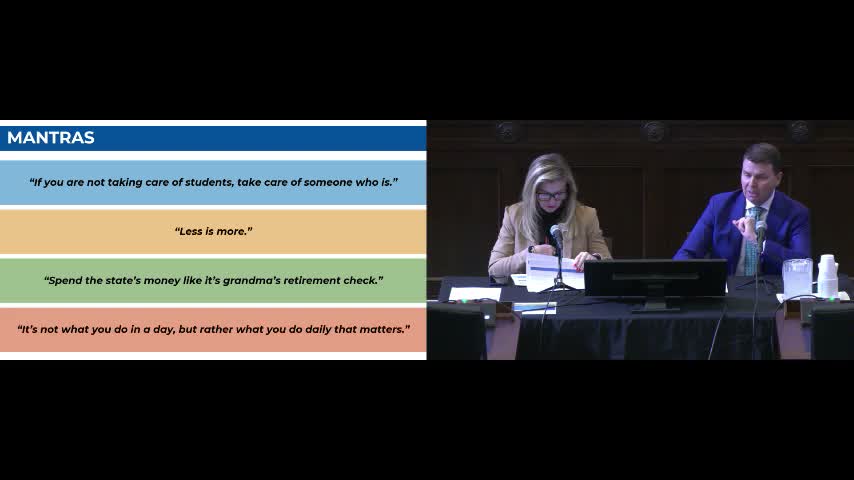
Superintendent Ryan Fields presented the State Department of Education’s FY‑27 appropriation request to a joint House‑Senate budget hearing, asking lawmakers for funding increases intended to provide a ‘‘steady supply’’ of resources to Oklahoma public schools and to advance priorities the department identified as school security, first‑year teacher pay, teacher development, school‑leader training and early literacy.
Fields said the department’s FY‑26 appropriation was about $3.983 billion and the FY‑27 request is just over $4.0 billion, driven mainly by an approximately $23 million increase for the flexible benefit allowance. "When you think about the number of educators, even a $10 a month increase to the flex benefit allowance, over tens of thousands of educators easily adds up quick," Fields told members. Fields emphasized nearly all SDE funding flows through state statute and walked the committee through program line items in the public‑school activities bucket, including Imagination Library, school lunch matching, assessments, early‑childhood initiatives, Strong Readers funding and Sooner Start early‑intervention funds.
Why it matters: Fields framed the request as sustaining core operations and targeted supports rather than one‑off, transformational spending. She repeatedly returned to the analogy that SDE should be the dependable supplier to ‘‘the gas pump’’ — local schools — so those schools can run safely and effectively. Members signaled they intend to weigh that steady funding request against specific goals such as increasing instructional spending and expanding literacy supports.
Key facts and figures: Fields provided a range of statewide metrics to contextualize the request. She said Oklahoma has 541 school districts, 988 elementary schools, 321 middle schools and 473 high schools. The department reported roughly 42,543 certificated teachers, down about 725 year‑over‑year and estimating an 11% non‑return/attrition rate. Per‑pupil expenditures were presented at roughly $12,000, which Fields said ranks Oklahoma near the bottom nationally. Federal funding was reported at about $1,800 per student (roughly 12% of total funding).
On student supports and outcomes, Fields flagged a student–teacher ratio of 16.2:1 (clarifying that is not the same as average class size) and a student–counselor ratio near 332:1, which members noted is above common national guidance. Fields reviewed assessment results, saying Oklahoma’s ACT average is roughly 17.5 (below the national average) and cited low NAEP proficiency rates for fourth‑grade reading and eighth‑grade math. Fields also reported roughly 28,000 students take AP exams and about 17,000 earn scores of 3 or better.
Questions from lawmakers focused on three recurring themes: (1) coding and classification of expenditures — several members pressed why instructional spending declined while non‑instructional spending rose and asked for a clearer and possibly statutory definition of what counts as instructional spending; (2) literacy and scaling the Strong Readers/HEROES effort — members asked what it would take to place reading specialists in more elementary schools and how the HEROES literacy instructional team might be scaled beyond current pilot coverage; (3) compensation, benefits and pipeline — members asked for more granular data on first‑year teacher pay, fringe benefits included in the comparisons, how OMES builds the flex‑benefit rates, and whether incentives or scholarship programs are improving educator pipelines.
Representative questions yielded commitments for follow‑up. Fields said SDE will provide district‑level detail on the instructional/non‑instructional expenditure shift, evidence on emergency and alternative certification counts, outcome data for Sooner Start and preliminary cost estimates to expand reading specialists and principal leadership development. On flex benefits, Fields confirmed the department receives rate and cost information from OMES and that the roughly 4.5% increase this year is driven by those inputs.
What remains unresolved: Lawmakers did not vote on any appropriations during the hearing. Multiple members expressed concern that rising non‑instructional coding appears to be outpacing classroom spending and asked SDE to advise whether that is a coding issue or a substantive trend. Fields said clarifying definitions and producing reliable baseline data is a priority for follow up.
Next steps: Fields said the department will deliver the requested datasets and cost estimates to the committee in the coming days and weeks. The hearing paused after the Q&A to prepare for a later State Regents presentation.
Ending: The hearing closed with the chair thanking Fields and staff for the presentation and work; no legislative action was taken at the session’s close.
Fields said the department’s FY‑26 appropriation was about $3.983 billion and the FY‑27 request is just over $4.0 billion, driven mainly by an approximately $23 million increase for the flexible benefit allowance. "When you think about the number of educators, even a $10 a month increase to the flex benefit allowance, over tens of thousands of educators easily adds up quick," Fields told members. Fields emphasized nearly all SDE funding flows through state statute and walked the committee through program line items in the public‑school activities bucket, including Imagination Library, school lunch matching, assessments, early‑childhood initiatives, Strong Readers funding and Sooner Start early‑intervention funds.
Why it matters: Fields framed the request as sustaining core operations and targeted supports rather than one‑off, transformational spending. She repeatedly returned to the analogy that SDE should be the dependable supplier to ‘‘the gas pump’’ — local schools — so those schools can run safely and effectively. Members signaled they intend to weigh that steady funding request against specific goals such as increasing instructional spending and expanding literacy supports.
Key facts and figures: Fields provided a range of statewide metrics to contextualize the request. She said Oklahoma has 541 school districts, 988 elementary schools, 321 middle schools and 473 high schools. The department reported roughly 42,543 certificated teachers, down about 725 year‑over‑year and estimating an 11% non‑return/attrition rate. Per‑pupil expenditures were presented at roughly $12,000, which Fields said ranks Oklahoma near the bottom nationally. Federal funding was reported at about $1,800 per student (roughly 12% of total funding).
On student supports and outcomes, Fields flagged a student–teacher ratio of 16.2:1 (clarifying that is not the same as average class size) and a student–counselor ratio near 332:1, which members noted is above common national guidance. Fields reviewed assessment results, saying Oklahoma’s ACT average is roughly 17.5 (below the national average) and cited low NAEP proficiency rates for fourth‑grade reading and eighth‑grade math. Fields also reported roughly 28,000 students take AP exams and about 17,000 earn scores of 3 or better.
Questions from lawmakers focused on three recurring themes: (1) coding and classification of expenditures — several members pressed why instructional spending declined while non‑instructional spending rose and asked for a clearer and possibly statutory definition of what counts as instructional spending; (2) literacy and scaling the Strong Readers/HEROES effort — members asked what it would take to place reading specialists in more elementary schools and how the HEROES literacy instructional team might be scaled beyond current pilot coverage; (3) compensation, benefits and pipeline — members asked for more granular data on first‑year teacher pay, fringe benefits included in the comparisons, how OMES builds the flex‑benefit rates, and whether incentives or scholarship programs are improving educator pipelines.
Representative questions yielded commitments for follow‑up. Fields said SDE will provide district‑level detail on the instructional/non‑instructional expenditure shift, evidence on emergency and alternative certification counts, outcome data for Sooner Start and preliminary cost estimates to expand reading specialists and principal leadership development. On flex benefits, Fields confirmed the department receives rate and cost information from OMES and that the roughly 4.5% increase this year is driven by those inputs.
What remains unresolved: Lawmakers did not vote on any appropriations during the hearing. Multiple members expressed concern that rising non‑instructional coding appears to be outpacing classroom spending and asked SDE to advise whether that is a coding issue or a substantive trend. Fields said clarifying definitions and producing reliable baseline data is a priority for follow up.
Next steps: Fields said the department will deliver the requested datasets and cost estimates to the committee in the coming days and weeks. The hearing paused after the Q&A to prepare for a later State Regents presentation.
Ending: The hearing closed with the chair thanking Fields and staff for the presentation and work; no legislative action was taken at the session’s close.
View the Full Meeting & All Its Details
This article offers just a summary. Unlock complete video, transcripts, and insights as a Founder Member.
✓
Watch full, unedited meeting videos
✓
Search every word spoken in unlimited transcripts
✓
AI summaries & real-time alerts (all government levels)
✓
Permanent access to expanding government content
30-day money-back guarantee
