Treasury says Virginia has up to $1.4 billion in advisory debt capacity for 2026'27 but much is already authorized or proposed
January 17, 2026 | 2026 Legislature VA, Virginia
This article was created by AI summarizing key points discussed. AI makes mistakes, so for full details and context, please refer to the video of the full meeting. Please report any errors so we can fix them. Report an error »
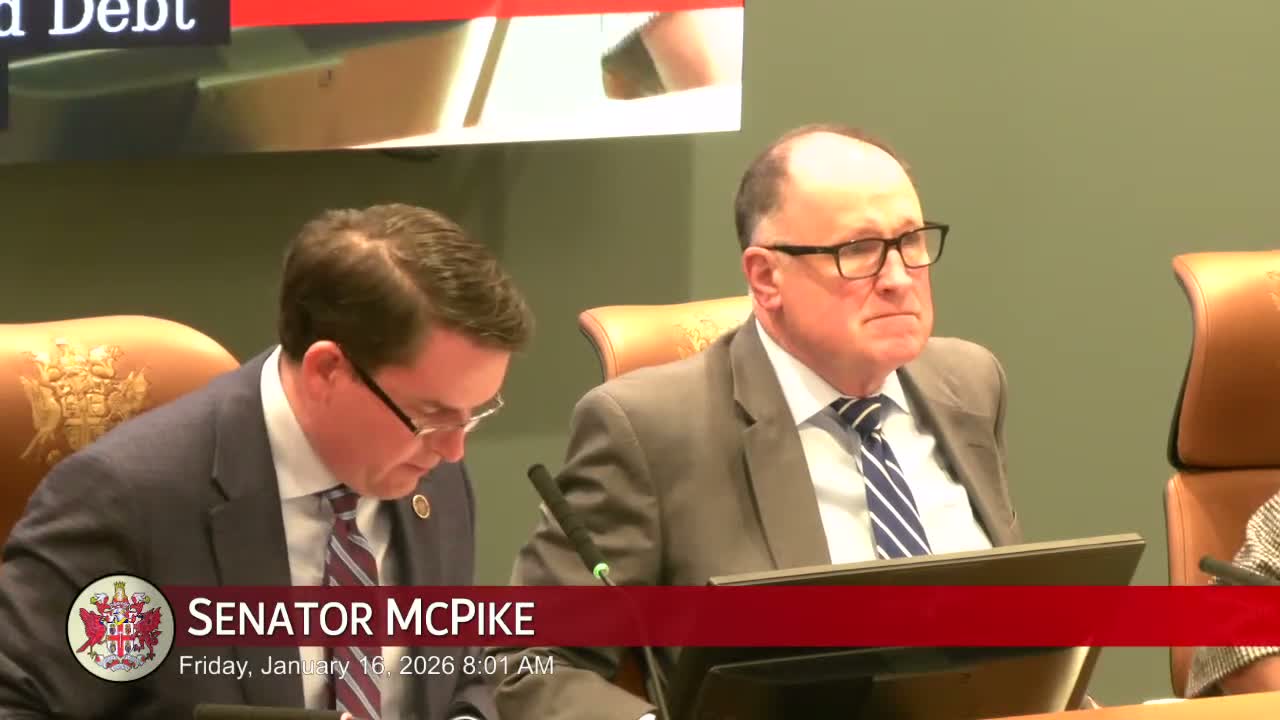
State Treasurer Dave Richardson told the Senate Finance and Appropriations Subcommittee on Capital Outlay and Transportation that the Commonwealth's Debt Capacity Advisory Committee's model found as much as $1.4 billion of additional debt capacity for each of 2026 and 2027, but much of that capacity is already committed or proposed.
Richardson described the three'decade history of Virginia's triple'A (AAA) bond rating and said rating agencies evaluate a range of factors beyond raw debt levels, including revenue diversity, budget management, governance and reserves. "It's not just about the debt load," he said. "They're looking at all kinds of factors." He warned that losing AAA would raise interest spreads and could harm the Commonwealth's competitiveness for economic development.
Richardson explained how debt types and issuers differ: general obligation bonds (9b) require a referendum; self'liquidating higher education bonds (9c) rely on project revenues and require feasibility studies; and subject'to'appropriation debt (9d) is the bulk of commonwealth borrowing. He said the Treasury is scrutinizing some 9c higher education requests and has strengthened feasibility requirements to ensure projects are truly self'liquidating.
On numbers, Richardson said the Commonwealth has "almost $3.7 billion in authorized but not yet issued debt." He said the advisory committee's recommendation, which is not binding on the governor or the General Assembly, identifies up to $1.4 billion in additional issuance capacity for each of 2026 and 2027. He cautioned the figure depends on revenue forecasts and interest rate assumptions and is subject to economic and policy risks.
Richardson noted the governor's proposed budget already includes about $1.31 billion in VCBA/VPBA projects and that a bill filed last week would add $332 million for Route 58, "so we're already up to $1,642,000,000 in proposed debt," reducing the practical amount of new capacity available.
Committee members probed the per'capita comparisons that make Virginia look like a high'debt state; Richardson said median comparisons are skewed by differences in state constitutional limits and accounting practices. A senator asked whether recent accounting standard changes (GASB) will begin to capture long'term lease and contractual obligations; Richardson answered that accounting rules evolve and the Treasury tries to include effectively'debt items where appropriate but the classification can be complicated.
On higher education bonds, Richardson said DCR and Treasury have tightened feasibility study standards and now require clearer documentation'for construction costs, assumed student charges and operating projections before certifying a 9c project to protect the Commonwealth from contingent risk.
The advisory committee's recommendation will remain advisory; the General Assembly and the governor retain authority to authorize or propose debt. The committee asked Treasury staff to follow up on vulnerability in the 9c revenue assumptions and other areas of potential exposure.
Richardson described the three'decade history of Virginia's triple'A (AAA) bond rating and said rating agencies evaluate a range of factors beyond raw debt levels, including revenue diversity, budget management, governance and reserves. "It's not just about the debt load," he said. "They're looking at all kinds of factors." He warned that losing AAA would raise interest spreads and could harm the Commonwealth's competitiveness for economic development.
Richardson explained how debt types and issuers differ: general obligation bonds (9b) require a referendum; self'liquidating higher education bonds (9c) rely on project revenues and require feasibility studies; and subject'to'appropriation debt (9d) is the bulk of commonwealth borrowing. He said the Treasury is scrutinizing some 9c higher education requests and has strengthened feasibility requirements to ensure projects are truly self'liquidating.
On numbers, Richardson said the Commonwealth has "almost $3.7 billion in authorized but not yet issued debt." He said the advisory committee's recommendation, which is not binding on the governor or the General Assembly, identifies up to $1.4 billion in additional issuance capacity for each of 2026 and 2027. He cautioned the figure depends on revenue forecasts and interest rate assumptions and is subject to economic and policy risks.
Richardson noted the governor's proposed budget already includes about $1.31 billion in VCBA/VPBA projects and that a bill filed last week would add $332 million for Route 58, "so we're already up to $1,642,000,000 in proposed debt," reducing the practical amount of new capacity available.
Committee members probed the per'capita comparisons that make Virginia look like a high'debt state; Richardson said median comparisons are skewed by differences in state constitutional limits and accounting practices. A senator asked whether recent accounting standard changes (GASB) will begin to capture long'term lease and contractual obligations; Richardson answered that accounting rules evolve and the Treasury tries to include effectively'debt items where appropriate but the classification can be complicated.
On higher education bonds, Richardson said DCR and Treasury have tightened feasibility study standards and now require clearer documentation'for construction costs, assumed student charges and operating projections before certifying a 9c project to protect the Commonwealth from contingent risk.
The advisory committee's recommendation will remain advisory; the General Assembly and the governor retain authority to authorize or propose debt. The committee asked Treasury staff to follow up on vulnerability in the 9c revenue assumptions and other areas of potential exposure.
View the Full Meeting & All Its Details
This article offers just a summary. Unlock complete video, transcripts, and insights as a Founder Member.
✓
Watch full, unedited meeting videos
✓
Search every word spoken in unlimited transcripts
✓
AI summaries & real-time alerts (all government levels)
✓
Permanent access to expanding government content
30-day money-back guarantee
