Committee gives House Bill 47 a 'do pass' recommendation to require 80/20 school employee health contributions
January 26, 2026 | Education, House of Representatives, Committees, Legislative, New Mexico
This article was created by AI summarizing key points discussed. AI makes mistakes, so for full details and context, please refer to the video of the full meeting. Please report any errors so we can fix them. Report an error »
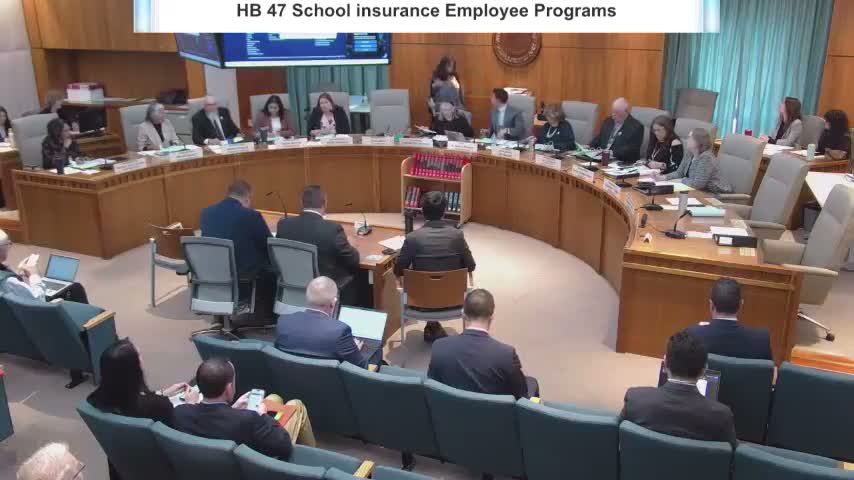
House Bill 47, which would require school districts and charter schools to pay at least 80% of health insurance premiums for public school employees, received a committee 'do pass' recommendation after a hearing in front of the House Education Committee. The bill includes an appropriation of $73,200,000 from the State Education Department to support the change.
Supporters told the committee that the change aims to bring educator benefits into parity with other state employees and help districts recruit and retain teachers. Bethany Jarrell, president of NEA New Mexico, said many educators carry heavy monthly premium bills: "We have members who are paying over $1,000 a month for their premiums." Jennifer Trujillo, an employee of Bernalillo Public Schools, described the personal effect: "There’s times I’m choosing whether I'm gonna go to the doctor or not," she said, urging relief for classroom staff.
The sponsor described the measure as a workforce and fiscal step toward parity with state employees after changes enacted in recent legislation. The bill also directs a collaborative study with education and health agencies to assess affordability, availability and economies of scale ahead of further action. A representative of the fiscal office cited evidence that higher employer contribution rates are associated with increased plan enrollment and retention.
Several education organizations testified in support. John Durch of AFT New Mexico said the policy would help rural districts retain educators; Jamie Gonzales of Public Charter Schools of New Mexico and Lillian Aertis of the New Mexico School Board Association also urged passage and thanked the committee for including funding. Bonnie Lightfoot of the New Mexico Coalition of Educational Leaders supported the bill but cautioned the committee to ensure full appropriation and warned that participation could rise, increasing cost pressure on the program.
The committee adopted a narrowly focused, non-substantive amendment to add language referencing the legislative education study committee; the amendment was moved by Representative Milamias and seconded by Representative Collin and was adopted with no recorded opposition. A committee member then moved that the panel give the bill a 'do pass' recommendation; after no opposition was raised, the committee approved the recommendation and forwarded HB47 as amended.
Next steps: HB47 will move from the Education Committee per the committee's recommendation; any further changes to funding or language would occur in subsequent floor or appropriations action.
Supporters told the committee that the change aims to bring educator benefits into parity with other state employees and help districts recruit and retain teachers. Bethany Jarrell, president of NEA New Mexico, said many educators carry heavy monthly premium bills: "We have members who are paying over $1,000 a month for their premiums." Jennifer Trujillo, an employee of Bernalillo Public Schools, described the personal effect: "There’s times I’m choosing whether I'm gonna go to the doctor or not," she said, urging relief for classroom staff.
The sponsor described the measure as a workforce and fiscal step toward parity with state employees after changes enacted in recent legislation. The bill also directs a collaborative study with education and health agencies to assess affordability, availability and economies of scale ahead of further action. A representative of the fiscal office cited evidence that higher employer contribution rates are associated with increased plan enrollment and retention.
Several education organizations testified in support. John Durch of AFT New Mexico said the policy would help rural districts retain educators; Jamie Gonzales of Public Charter Schools of New Mexico and Lillian Aertis of the New Mexico School Board Association also urged passage and thanked the committee for including funding. Bonnie Lightfoot of the New Mexico Coalition of Educational Leaders supported the bill but cautioned the committee to ensure full appropriation and warned that participation could rise, increasing cost pressure on the program.
The committee adopted a narrowly focused, non-substantive amendment to add language referencing the legislative education study committee; the amendment was moved by Representative Milamias and seconded by Representative Collin and was adopted with no recorded opposition. A committee member then moved that the panel give the bill a 'do pass' recommendation; after no opposition was raised, the committee approved the recommendation and forwarded HB47 as amended.
Next steps: HB47 will move from the Education Committee per the committee's recommendation; any further changes to funding or language would occur in subsequent floor or appropriations action.
Don't Miss a Word: See the Full Meeting!
Go beyond summaries. Unlock every video, transcript, and key insight with a Founder Membership.
✓
Get instant access to full meeting videos
✓
Search and clip any phrase from complete transcripts
✓
Receive AI-powered summaries & custom alerts
✓
Enjoy lifetime, unrestricted access to government data
30-day money-back guarantee
