Senate committee advances resolution letting school districts place bonds on general-election ballot
January 26, 2026 | Rules, Senate, Committees, Legislative, New Mexico
This article was created by AI summarizing key points discussed. AI makes mistakes, so for full details and context, please refer to the video of the full meeting. Please report any errors so we can fix them. Report an error »
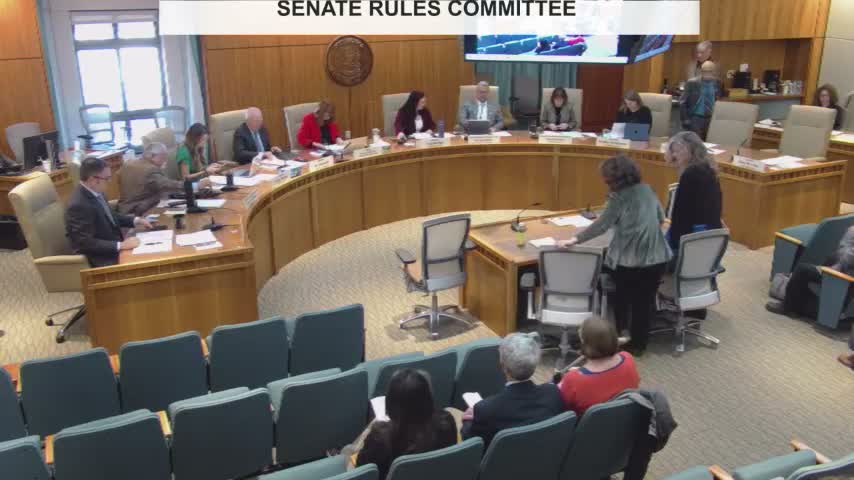
Sen. Linda Trujillo (D-24) told the Senate Rules Committee she reintroduced SJR 1 to allow school districts to place general obligation bond and mill-levy questions on the partisan general-election ballot, saying the current constitutional limitation forces districts into costly special elections. "A general obligation bond question cannot be placed during the general election," Trujillo said, explaining why districts must now schedule special elections or wait until local nonpartisan elections.
Lindsey Bachman, director of legislative and executive affairs for the Secretary of State's office, told the committee that school districts are currently the only local public body within the regular local election (RLE) framework that cannot put such ballot questions on a partisan ballot, which has led to multiple special elections each year. Witnesses and members described administrative burdens and resource strain on county clerks, including use of tabulation equipment and staff, when districts hold stand-alone mail-ballot special elections.
Joe Guillen, executive director of the New Mexico School Boards Association, testified that the change could increase turnout for bond measures, reduce the need for districts to pay for special elections and help districts meet local matching obligations for capital outlay. "This would help districts in quite a few ways," Guillen said, noting that delays in bond passage can increase construction costs.
Committee members raised technical and fiscal questions during discussion. Sen. Stewart pointed out an inconsistency in the FIR language about the next general election year; the Secretary’s office said the agency analysis anticipates FY27 impact and agreed to follow up with the Legislative Finance Committee to correct the FIR text. On costs, witnesses cited past special elections as an example of significant expense (one county-level special election was described in testimony as roughly $120,000).
The chair called a motion for a "do pass." With no opposition recorded on the floor, the committee issued a unanimous "do pass" recommendation for SJR 1. The motion record did not list individual movers or a roll-call tally on the record; committee staff noted one or two members were absent when the vote was taken.
Lindsey Bachman, director of legislative and executive affairs for the Secretary of State's office, told the committee that school districts are currently the only local public body within the regular local election (RLE) framework that cannot put such ballot questions on a partisan ballot, which has led to multiple special elections each year. Witnesses and members described administrative burdens and resource strain on county clerks, including use of tabulation equipment and staff, when districts hold stand-alone mail-ballot special elections.
Joe Guillen, executive director of the New Mexico School Boards Association, testified that the change could increase turnout for bond measures, reduce the need for districts to pay for special elections and help districts meet local matching obligations for capital outlay. "This would help districts in quite a few ways," Guillen said, noting that delays in bond passage can increase construction costs.
Committee members raised technical and fiscal questions during discussion. Sen. Stewart pointed out an inconsistency in the FIR language about the next general election year; the Secretary’s office said the agency analysis anticipates FY27 impact and agreed to follow up with the Legislative Finance Committee to correct the FIR text. On costs, witnesses cited past special elections as an example of significant expense (one county-level special election was described in testimony as roughly $120,000).
The chair called a motion for a "do pass." With no opposition recorded on the floor, the committee issued a unanimous "do pass" recommendation for SJR 1. The motion record did not list individual movers or a roll-call tally on the record; committee staff noted one or two members were absent when the vote was taken.
View the Full Meeting & All Its Details
This article offers just a summary. Unlock complete video, transcripts, and insights as a Founder Member.
✓
Watch full, unedited meeting videos
✓
Search every word spoken in unlimited transcripts
✓
AI summaries & real-time alerts (all government levels)
✓
Permanent access to expanding government content
30-day money-back guarantee
