San Francisco Public Works outlines FY2026–28 priorities as city faces multiyear deficit
January 22, 2026 | San Francisco City, San Francisco County, California
This article was created by AI summarizing key points discussed. AI makes mistakes, so for full details and context, please refer to the video of the full meeting. Please report any errors so we can fix them. Report an error »
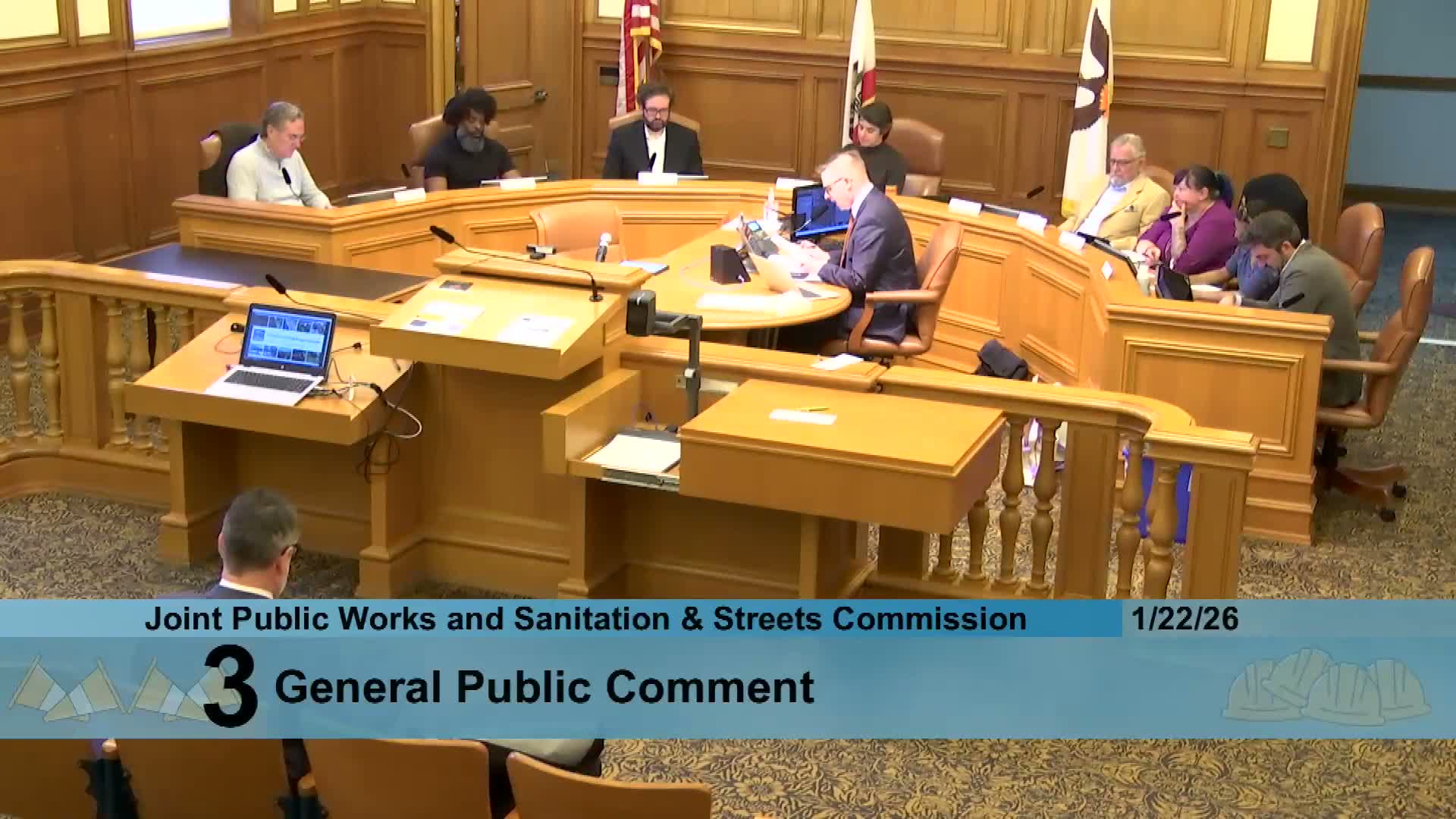
Carla Short, Public Works director, and Bruce Robertson, Deputy Director of Finance & Administration, presented the Department of Public Works’ operating priorities and preliminary figures for fiscal years 2026–27 and 2027–28 at a joint hearing of the Public Works Commission and the Sanitation & Streets Commission on Jan. 22.
Robertson told commissioners the department’s operating budget is $428,500,000 while noting that the department manages many programs funded outside that line — “we spend well north of $1,000,000,000 annually,” he said — and outlined a multiyear outlook in which revenues grow more slowly than expenditures. He said projected revenue growth over the next four years is about $617 million, while expenditure growth is roughly $1.8 billion, producing modeled deficits of about $296 million in FY27 and $640 million in FY28. Robertson said salary and benefit growth is the primary driver of the gap and described the mayor’s office direction to identify core services and options for an overall $400 million general‑fund reduction citywide.
Why it matters: Robertson and Short framed Public Works as providing core services that align with the mayor’s priorities — safe, clean streets and economic revitalization — but noted most of the department’s work is funded through a mix of non‑general‑fund sources. Commissioners pressed that because only a minority of Public Works’ budget is general‑fund, there is limited flexibility to make cuts that preserve visible front‑line services.
Key details and proposals: Robertson said the department’s financial models do account for possible federal policy changes. He described HR1 (federal legislation) as a material uncertainty that could reduce Medicaid and other reimbursements and that the city’s financial plan includes a modeled impact that begins near $84.5 million and could rise to about $205.8 million in later years, subject to substantial assumptions.
On department priorities, Robertson highlighted several near‑term asks if additional funds become available: restoring the Pit Stop public‑toilet program to pre‑reduction service levels (the department’s performance team forecasted and observed about a 21% increase in related 311 calls after reductions); a small pilot to address dog‑waste receptacles (estimated in the low hundreds of thousands); and expanding a consolidated project‑management system and a full life‑cycle asset‑management system to capture long‑term maintenance savings. Robertson described the asset‑management implementation as an approximately $1.5 million request intended to reduce reactive costs through preventive maintenance.
Commissioners’ questions and exchanges: Commissioners asked for more detail on the apprenticeship program and the timing of follow‑up briefings; Robertson said the apprenticeship program remains a core pathway to recruit field staff and that the department will schedule briefings prior to the Feb. 12 Public Works Commission vote. Commissioners also discussed whether one‑time investments could reduce long‑term costs and whether duplicative functions across city departments could be centralized; Robertson said those are policy choices for the mayor’s office but that Public Works has included information about overlapping functions in the program inventory it submitted.
Enforcement and revenue options: A commissioner representing commercial districts raised local concerns about illegal dumping and asked whether citation collection could generate revenue to help address service demands. Robertson said the department is increasing site ticketing and is working with the Treasurer‑Tax Collector’s bureau and the Bureau of Delinquent Revenue to improve collection of fines and enforcement outcomes.
Budget timeline and next steps: Robertson said Public Works submitted its program inventory to the mayor’s office on Jan. 20 and expects feedback by Feb. 1. The department expects to return for a formal commission vote on Feb. 12; the charter deadline for commission budget actions is Feb. 23. Robertson also outlined the mayor’s timeline for the citywide process, including the mayor’s submission to the Board of Supervisors on June 6 and anticipated final approvals and sign‑off in July–August.
Adjournment: Commissioners closed public comment for the budget item with no public speakers and adjourned the combined hearing at 12:29 p.m. The department will return with additional briefings and the commission will consider the budget plan at its Feb. 12 meeting.
Robertson told commissioners the department’s operating budget is $428,500,000 while noting that the department manages many programs funded outside that line — “we spend well north of $1,000,000,000 annually,” he said — and outlined a multiyear outlook in which revenues grow more slowly than expenditures. He said projected revenue growth over the next four years is about $617 million, while expenditure growth is roughly $1.8 billion, producing modeled deficits of about $296 million in FY27 and $640 million in FY28. Robertson said salary and benefit growth is the primary driver of the gap and described the mayor’s office direction to identify core services and options for an overall $400 million general‑fund reduction citywide.
Why it matters: Robertson and Short framed Public Works as providing core services that align with the mayor’s priorities — safe, clean streets and economic revitalization — but noted most of the department’s work is funded through a mix of non‑general‑fund sources. Commissioners pressed that because only a minority of Public Works’ budget is general‑fund, there is limited flexibility to make cuts that preserve visible front‑line services.
Key details and proposals: Robertson said the department’s financial models do account for possible federal policy changes. He described HR1 (federal legislation) as a material uncertainty that could reduce Medicaid and other reimbursements and that the city’s financial plan includes a modeled impact that begins near $84.5 million and could rise to about $205.8 million in later years, subject to substantial assumptions.
On department priorities, Robertson highlighted several near‑term asks if additional funds become available: restoring the Pit Stop public‑toilet program to pre‑reduction service levels (the department’s performance team forecasted and observed about a 21% increase in related 311 calls after reductions); a small pilot to address dog‑waste receptacles (estimated in the low hundreds of thousands); and expanding a consolidated project‑management system and a full life‑cycle asset‑management system to capture long‑term maintenance savings. Robertson described the asset‑management implementation as an approximately $1.5 million request intended to reduce reactive costs through preventive maintenance.
Commissioners’ questions and exchanges: Commissioners asked for more detail on the apprenticeship program and the timing of follow‑up briefings; Robertson said the apprenticeship program remains a core pathway to recruit field staff and that the department will schedule briefings prior to the Feb. 12 Public Works Commission vote. Commissioners also discussed whether one‑time investments could reduce long‑term costs and whether duplicative functions across city departments could be centralized; Robertson said those are policy choices for the mayor’s office but that Public Works has included information about overlapping functions in the program inventory it submitted.
Enforcement and revenue options: A commissioner representing commercial districts raised local concerns about illegal dumping and asked whether citation collection could generate revenue to help address service demands. Robertson said the department is increasing site ticketing and is working with the Treasurer‑Tax Collector’s bureau and the Bureau of Delinquent Revenue to improve collection of fines and enforcement outcomes.
Budget timeline and next steps: Robertson said Public Works submitted its program inventory to the mayor’s office on Jan. 20 and expects feedback by Feb. 1. The department expects to return for a formal commission vote on Feb. 12; the charter deadline for commission budget actions is Feb. 23. Robertson also outlined the mayor’s timeline for the citywide process, including the mayor’s submission to the Board of Supervisors on June 6 and anticipated final approvals and sign‑off in July–August.
Adjournment: Commissioners closed public comment for the budget item with no public speakers and adjourned the combined hearing at 12:29 p.m. The department will return with additional briefings and the commission will consider the budget plan at its Feb. 12 meeting.
View the Full Meeting & All Its Details
This article offers just a summary. Unlock complete video, transcripts, and insights as a Founder Member.
✓
Watch full, unedited meeting videos
✓
Search every word spoken in unlimited transcripts
✓
AI summaries & real-time alerts (all government levels)
✓
Permanent access to expanding government content
30-day money-back guarantee
