DPH and HSH outline midyear spending, new behavioral-health facilities and housing investments
January 22, 2026 | San Francisco City, San Francisco County, California
This article was created by AI summarizing key points discussed. AI makes mistakes, so for full details and context, please refer to the video of the full meeting. Please report any errors so we can fix them. Report an error »
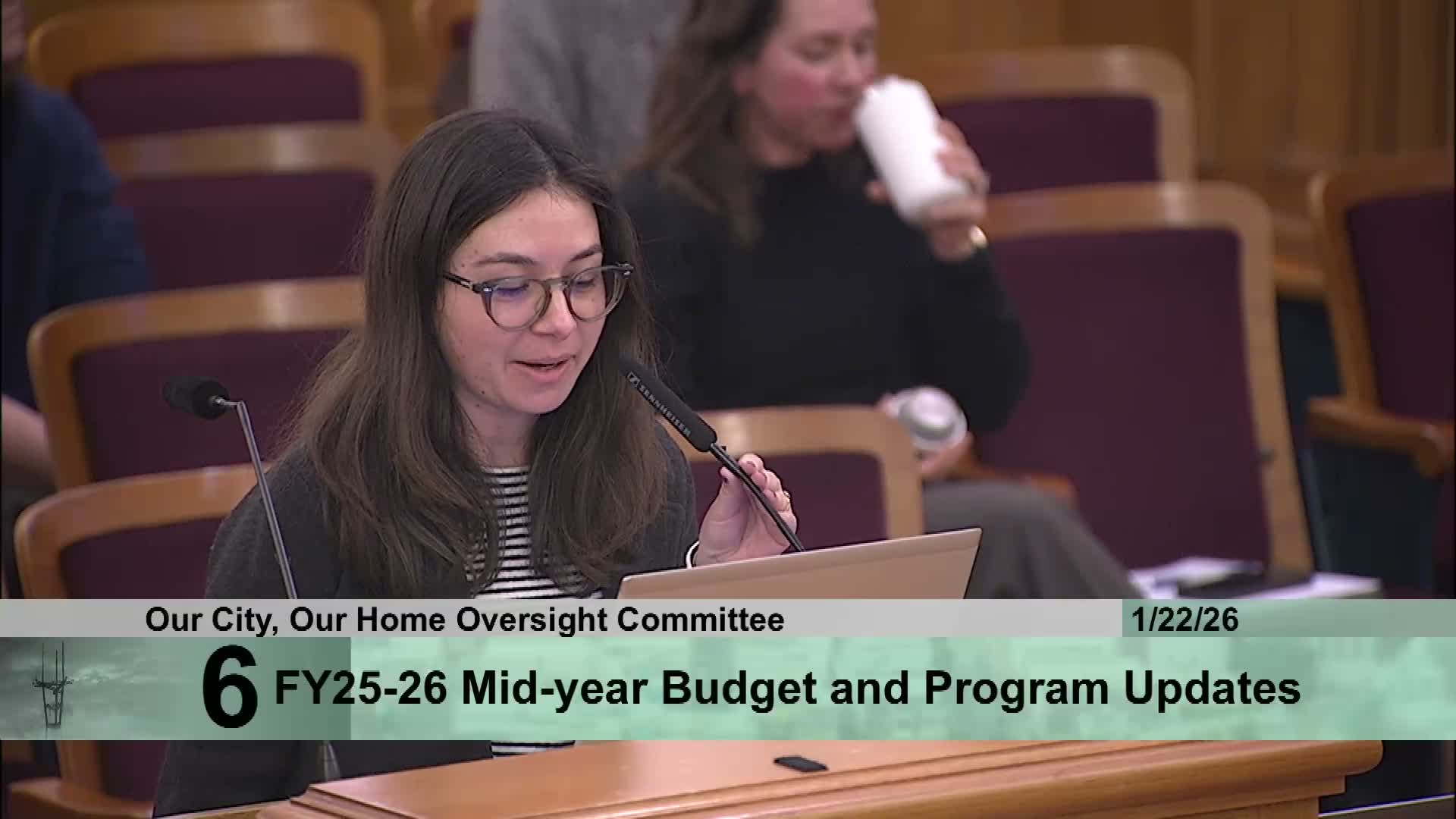
Department of Public Health and the Department of Homelessness and Supportive Housing presented six-month program and financial updates to the committee, describing capital acquisitions, new residential capacity and midyear spending projections.
Kelly Kirkpatrick, who identified herself as a Behavioral Health Services staffer at DPH, said DPH anticipates spending about $100,000,000 on mental-health and related programs this fiscal year — a roughly 26% increase from FY24–25 — and an annual operating budget for behavioral health of about $130,000,000. Kirkpatrick said almost half of the behavioral health allocation is for treatment-bed operations (about 300 additional behavioral health beds), and reported an anticipated year-end balance of roughly $54.2 million that combines current-year savings and prior-year carryforward. She warned of an ongoing structural shortfall (about $40,000,000 in later years) and of potential future revenue losses tied to federal and state policy changes.
Kirkpatrick reviewed recent capital acquisitions and program starts funded in part by Proposition C: purchase and renovation of 601 Laguna (about $20 million) to become a residential care facility; purchase of 1660 Mission (about $18 million expended with an anticipated $10 million state reimbursement) to expand behavioral health access services; and two new residential programs — the Eleonora Fagan Center (72 short-term health-respite beds at the Keene Hotel) and Wells Place (62 post-treatment recovery beds operated by the Salvation Army) — which opened late in the prior year and are ramping up.
Raina McKinnon (HSH budget manager) and Salvador Menhivar (HSH Director of Housing) presented HSH program investments: the OCO budget invested roughly $46.9 million in housing components that will add about 130 family rapid rehousing slots ($17.3M), 65 family property housing slots ($8.2M), 30 family shallow-subsidy slots ($2.8M), and 100 adult rapid rehousing slots for people living in large vehicles (contracts in place; 35 households enrolled as of Jan. 2026 with 2 housed). HSH also described the Large Vehicle Outreach and Case Management Program (Catholic Charities contract): city data presented to the committee showed 323 households with active large-vehicle permits, 186 households enrolled in case management, 71 households in the buyback process and 4 households who completed buybacks and were housed.
Committee members pressed departments for clearer outcome metrics, retention and success data for rapid rehousing and prevention programs. Member Walton and others requested year-over-year comparisons of spending on short-term versus permanent housing and asked staff to provide annual-report-based breakdowns. Staff said the annual report contains program-level data and offered to work with the committee’s data officer to produce accessible comparisons.
Kelly Kirkpatrick, who identified herself as a Behavioral Health Services staffer at DPH, said DPH anticipates spending about $100,000,000 on mental-health and related programs this fiscal year — a roughly 26% increase from FY24–25 — and an annual operating budget for behavioral health of about $130,000,000. Kirkpatrick said almost half of the behavioral health allocation is for treatment-bed operations (about 300 additional behavioral health beds), and reported an anticipated year-end balance of roughly $54.2 million that combines current-year savings and prior-year carryforward. She warned of an ongoing structural shortfall (about $40,000,000 in later years) and of potential future revenue losses tied to federal and state policy changes.
Kirkpatrick reviewed recent capital acquisitions and program starts funded in part by Proposition C: purchase and renovation of 601 Laguna (about $20 million) to become a residential care facility; purchase of 1660 Mission (about $18 million expended with an anticipated $10 million state reimbursement) to expand behavioral health access services; and two new residential programs — the Eleonora Fagan Center (72 short-term health-respite beds at the Keene Hotel) and Wells Place (62 post-treatment recovery beds operated by the Salvation Army) — which opened late in the prior year and are ramping up.
Raina McKinnon (HSH budget manager) and Salvador Menhivar (HSH Director of Housing) presented HSH program investments: the OCO budget invested roughly $46.9 million in housing components that will add about 130 family rapid rehousing slots ($17.3M), 65 family property housing slots ($8.2M), 30 family shallow-subsidy slots ($2.8M), and 100 adult rapid rehousing slots for people living in large vehicles (contracts in place; 35 households enrolled as of Jan. 2026 with 2 housed). HSH also described the Large Vehicle Outreach and Case Management Program (Catholic Charities contract): city data presented to the committee showed 323 households with active large-vehicle permits, 186 households enrolled in case management, 71 households in the buyback process and 4 households who completed buybacks and were housed.
Committee members pressed departments for clearer outcome metrics, retention and success data for rapid rehousing and prevention programs. Member Walton and others requested year-over-year comparisons of spending on short-term versus permanent housing and asked staff to provide annual-report-based breakdowns. Staff said the annual report contains program-level data and offered to work with the committee’s data officer to produce accessible comparisons.
View the Full Meeting & All Its Details
This article offers just a summary. Unlock complete video, transcripts, and insights as a Founder Member.
✓
Watch full, unedited meeting videos
✓
Search every word spoken in unlimited transcripts
✓
AI summaries & real-time alerts (all government levels)
✓
Permanent access to expanding government content
30-day money-back guarantee
